
Animal Cell Culture
Among the core technologies that enable modern life sciences is animal cell culture. This technology has made it possible to investigate cell physiology, therapeutic responses, and pathophysiological processes under controlled in vitro conditions. In other words, by maintaining cells of animal origin in a well-controlled laboratory setting, scientists can replicate biological processes of tissues, overcoming biological variability, a challenge in biological investigations of whole organisms. Accordingly, modern advancements in biology, toxicity, regenerative biology, and biotechnology production rely on animal cell culture.
What is Primary Animal Cell Culture?
Animal primary cell culture basically involves the growth, maintenance, and isolation of cells harvested directly from an animal cell through cell culture, followed by their subculture. Unlike microbial cultures, animal cells must be carefully maintained within a sophisticated environment, which includes temperature (usually 37°C for mammalian cells), pH, osmolarity, oxygen, carbon dioxide, and additives of growth factors, hormones, and sera or their substitutes. This is because animal cells are highly specialized, adding to their relevance in models of animal cell cultures.
Primary Animal Cell Culture: Almost Identical to In Vivo Biology
The primary Animal Cell Culture involves the isolation and in vitro maintenance of cells directly derived from animal tissues or organs. The cells possess characteristics close to those of their parent tissues; therefore, research conducted using this type of culture is highly biologically relevant.
Important Aspects of Primary Animal Cell Culture
Direct physiological relevance:
Primary cells behave like physiological cells in terms of receptor expression, signaling pathways, metabolism, etc.
Finite lifespan:
Primary cells possess a limited lifespan owing to replicative senescence.
Higher variability:
The variability in the samples provided by the donors and the variability within the tissues could affect outcomes of experiments.
Technical complexity:
The process of isolating the cells might need enzymatic digestion (like trypsin or collagenase), or mechanical disruption.
Primary Cultures of Animal Cells have found numerous applications in toxicology, pharmacokinetics, infection biology, and functional genomics, where normal cellular responses cannot be replicated using immortalized cells.
Animal Cell Culture Types
Animal cell culture systems are classified into various categories according to the source of cells, growth characteristics, and cell arrangement. Hence, knowledge of these Primary Animal Cell Culture systems is essential for selecting model systems for experiments.
Primary vs. Secondary and Continuous Cultures
Primary cultures: Primary cultures are obtained directly from tissues.
Secondary cultures: Primary Cell Cultures with a restricted number of passages.
Continuous (immortalized) cell lines: Cells that are transformed and capable of prolonged growth and proliferation.
Adherent versus Suspension Cultures
Adherent cultures: The cells adhere to the treated plastic or extracellular matrix-covered surfaces. Such cells include fibroblasts and epithelial cells.
Suspension cultures: Cells are freely suspended in the medium (for instance, hematopoietic and hybridoma cells).
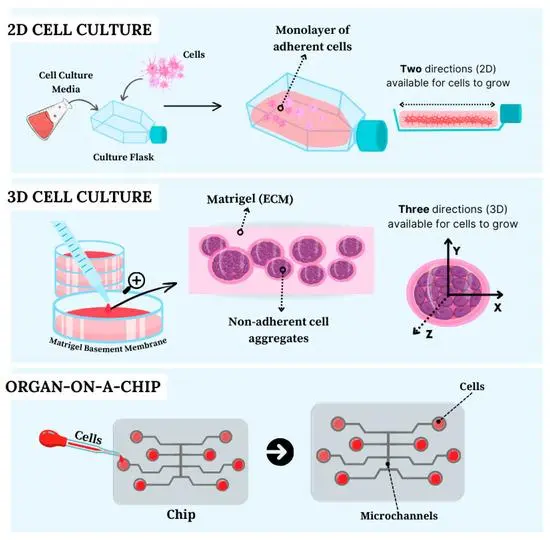
Two-dimensional (2D) vs. Three-D Cultures
2D cultures are conventional monolayer cultures employed for routine analysis, whereas
3D cultures are spheroidal cultures, organoids, and scaffolded systems. These provide a better imitation of tissue architecture and cell interactions.
Co-culture and Advanced Systems
The incorporation of diverse cell types to mimic tissue complexity can be found in co-culture models, and additional biological complexity has been introduced by using microfluidic “organ-on-chip” systems, which include mechanical forces and perfusion.
Animal Cell Culture From A Variety of Cells
The range of Animal cell Culture Applications is diverse and includes fundamental and applied aspects of biotechnology.
Drug Discovery and Toxicology:
Animal cell cultures can be used for drug screening, mechanism-based toxicological studies, and dose-response analysis on a high throughput screening platform. Thus, cell cultures of hepatocytes are critical for drug metabolism and hepatotoxicity evaluations.
Disease Modeling:
Cultured cells from animals are used to research cancer biology, neurodegenerative diseases, metabolic diseases, and infectious diseases. Furthermore, gene editing by CRISPR/Cas9 technology adds to their utility for functional genomics and target validation.
Manufacturing of Vaccines and Biopharm:
Continuous cell lines like CHO, HEK 293, and Vero cells are commonly used for the production of recombinants, monoclonal antibodies, viral vectors, and vaccines due to their scalability and the possibility of post-translational modification.
Regenerative Medicine and Tissue Engineering :
Animal cell culture is also useful for the development of engineered tissues, testing of biomaterials, and preclinical validation of cellular therapies. 3D culture models have enhanced the predictive validity of preclinical models.
Systems Biology and Omics Integration:
The integration of transcriptomics, proteomics, metabolomics, and single-cell sequencing techniques enables comprehensive characterization of states and reactions of cells and, therefore, positions animal cell culture at the center of systems research.
Quality Control and Animal Cell Culture Challenges:
Non-human cell culture has its own set of difficulties despite its benefits. These include contamination (mycoplasma, bacteria, fungi), genetic drift, instability of phenotypes, or variability in cell culture reagents from batch to batch.
Primarily, quality control, such as validation, screening for contamination, optimized cell culture methods, and defined media, has also not lost its importance for data production. Ethical concerns also shape the use of animal cells; as a result, there is a growing interest in reduction, refinement, and replacement approaches and in high-end in vitro substitutes.
Product-Related Queries, Or Partnership Inquiries
Future Directions
To summarize, the future of animal cell culture will continue to be driven by more complex and biologically realistic models. The continued evolution of bioprinting in three dimensions, organ-on-chip technology, serum-free media, and AI imaging analysis is changing the face of experimental accuracy and scale.
Above all, as these technologies advance, so will animal cell culture and its role in translating fundamental research into clinical applications.
FAQ’s
Q- How does primary animal cell culture differ functionally from immortalized cell lines?
A major advantage associated with primary cultures is their close approximation to live cells in terms of preserving their natural characteristics, which include gene expression, signaling pathways, and metabolism. In contrast, scaled-up production can be achieved for cell lines, though their characteristics might also vary owing to differences in gene expression levels.
Q- Why are 3D animal cell culture models currently preferred in pharmaceutical research?
3D cell cultures are a better model of tissue structure and cell interactions and a more reliable model for effectiveness and toxicology testing, since animal cell studies have traditionally utilized the 2D cell model.