

The field of experimental biology is rapidly developing, and researchers require models precisely resembling human tissues, disease mechanisms, and responses to therapeutic methods. This has further necessitated quality biomedical research cells, such as primary cells, engineered lines, iPSC derivatives, and 3D constructs in academic, clinical, and industrial laboratories.
Biomedical Research Cells: The Foundation of Translational Assessments
These cells are useful because they can be used as regulated in vitro systems to decipher cellular physiology, gene regulatory networks, and functional outputs:
1. Better Fidelity to Human Physiology
Compared with conventional animal models, human primary cells and stem cell-based models enable researchers to circumvent interspecies variation and obtain more predictive modeling.
2. Compatibility with Advanced Technologies
The next-generation tools that Biomedical Research Cells can be integrated with include:
- Single-cell transcriptomics
- High-content imaging
- Genome and epigenome editing (CRISPR/Cas9), base editors
- Platforms of organoid and microfluidic organ-on-chips
These technologies broaden the analytical horizon and experimental potential of cell-based studies.
3. Reproducibility and Standardized Experimental Design
As the importance of reproducible science grows, authenticated and contamination-free sources of cells are necessary to produce reliable, peer-reviewed, and regulatory-compliant data.
Stem cells are redefining biomedical research with their unique characteristics such as:
- Self-renewal: sustained proliferation with no potency loss
- Pluripotency or multipotency
- Epigenetic plasticity: to model molecular transitions in development and disease, and
- Amenable to genetic engineering: efficient knock-in, knock-out, and generation of reporter lines.
Accordingly, integrating stem cells into biomedical research workflows has enabled researchers to simulate human development, recapitulate complex diseases, and develop patient-specific therapeutic strategies.
Applications of Stem Cells in Biomedical Research
1. Directed Differentiation of Precision Disease Modelling
Using stage-specific morphogens, defined media, and extracellular matrix cues, iPSCs and ESCs can be differentiated into a variety of functional cell types, such as neurons, cardiomyocytes, hepatocytes and pancreatic islet-like cells.
These differentiated cells allow researchers to:
- Investigate disease-forming mutations
- Study aberrant signaling pathways (e.g., mitochondrial dysfunction)
- Conduct comparative studies of healthy and diseased genotypes.
- Make tissue-specific phenotypes that recapitulate clinical phenotypes in patients
Moreover, stem-cell-based models are especially useful for studying rare hereditary diseases and single-gene, neurodegenerative, or metabolic diseases.
2. High-Fidelity Organoids and 3D Tissue Systems
Stem cell organoids recapitulate human tissue spatial structure, heterogeneity of cell populations, and functioning. Organoids of brain tissue, intestinal epithelium, hepatic progenitors, or lung alveoli offer very sophisticated platforms for:
- Analysis of tissue morphogenesis,
- Modeling infections caused by viruses (e.g., SARS-CoV-2 tropism),
- Assessing drug permeability and toxicity,
- Exploring dynamics of tumor microenvironment (TME);
- Especially, their increasing use in oncology research for identifying therapeutic vulnerabilities and screening combinatorial regimens.
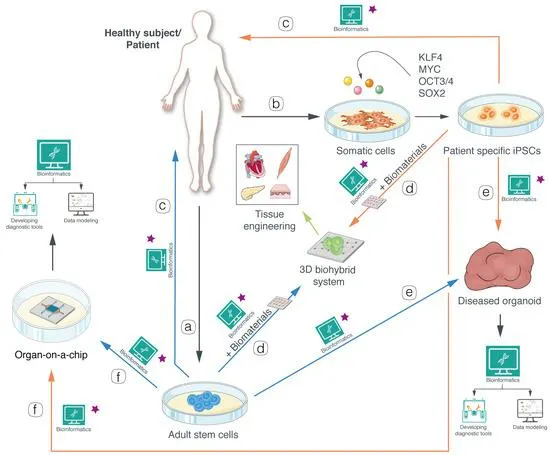
Schematic of ex vivo stem-cell based modeling systems. J. Pers. Med. 2020, 10(1), 8. (http://creativecommons.org/licenses/by/4.0/).
3. Regenerative and Reparative Medicine
Hematopoietic stem cells (HSCs), mesenchymal stem cells (MSCs) and adipose-derived stem cells (ADSCs) exhibit differentiation ability and paracrine signaling. Their cytokine-saturated growth factor-rich extracellular vesicle-containing secretome has:
- Anti-inflammatory effects,
- Pro-angiogenic responses,
- Immunomodulatory activity, and
- Tissue remodeling and repair properties.
These characteristics render Stem Cells good candidates for managing musculoskeletal injuries, autoimmune manifestations, ischemic diseases and chronic inflammation.
4. Enhanced Predictive Capacity in High-Throughput Drug Screening
Stem-cell based models facilitate more sophisticated pharmacological assessments as they better mimic human physiology than traditional animal or 2D models. They allow:
- Measure heart cell activity (e.g., action potential duration in iPSC cardiomyocytes)
- Study liver metabolism (Cytochrome P450 metabolic profiling in hepatocyte-like cells)
- Detailed imaging for toxicity and phenotypic screening, and
- 3D culture platforms that mimic interactions of an extracellular matrix.
Thus, these platforms significantly enhance the accuracy of safety pharmacology and reduce late-stage failures in drug development.

Cells 2022, 11(11), 1853. (http://creativecommons.org/licenses/by/4.0/).
5. Modeling Tumor Heterogeneity and Cancer Stem Cell Biology
- Chemoresistance mechanisms
- Epithelial-mesenchymal transition
- The risk for tumor recurrence
- Metabolic reprogramming (e.g., glycolytic shift)
Engineered iPSC-derived immune cells, such as NK- and T-cells, are also being utilized for immuno-oncology applications, including CAR-based therapies.
Ensuring Quality and Standardization in Biomedical Research Cells
For Robust Experimental Results:
- First, these cells must be ethically sourced and from well-characterized donors,
- Second, their identity should be verified by checking lineage-specific markers by flow cytometry or immunocytochemistry,
- Third, their chromosomes should be stable and confirmed through karyotype analysis, and
- Fourth, they should be Mycoplasma-free certified.
- Above all, they should be used within a specific number of passages and grown in well-defined culture media, and finally,
- The accessibility of isogenic lines and matched controls for accurate comparisons.
Reliable cell sources significantly minimize batch variation and ensure consistency across replicates.
Future Directions
The next frontier in the Biomedical Research of stem Cells involves combining cellular biology and engineering inventions, such as:
- CRISPR-edited isogenic pairs to study how specific genetic changes affect cell behavior,
- Microfluidic organ-on-chip systems that recreate real-life physical forces like fluid flow and mechanical stress,
- 3D bioprinting to create tissues based on stem cells with blood vessel-like structures,
- Furthermore, machine learning tools that analyze high-content images and predict cell behaviors, and
- Extracellular vesicle-based therapeutics derived from MSCs and iPSCs
These advances promise to further elevate the predictive accuracy and translational relevance of in vitro models.
Conclusion
In conclusion, biomedical research cells are invaluable tools that promote basic as well as translational studies. To this end, stem cell-based models have revolutionized experimental science. Having said this, quality and ethical sourcing of biomedical research cells is paramount to this advancement, as the science becomes more sophisticated and relies on human-relevant models.
Product-Related Queries, Or Partnership Inquiries
FAQ’s
Q- What are the benefits of using biomedical research cells to study human development and disease mechanisms?
Biomedical research cells, such as stem cell-isolated embryo and organoid models, enable accurate study of early developmental mechanisms, functional genomics, and disease pathways. They also provide human-relevant systems and reveal mechanisms that are complex to study using animal systems.
Q- What are the advantages and limitations of using the biomedical research cells in drug testing and translational research?
With biomedical research cells, predictive drug screening, toxicology testing, and target discovery are possible, although the development of high-fidelity models is ongoing.