
Primary Cell Culture in Modern Medicine
In research, primary cell culture acts as a platform for understanding disease mechanisms, cellular pathways, and therapeutic response at the cellular and molecular levels.
Primary Cell Culture closely mimics the physiological state of the cells or tissue from where they are isolated. The cells are directly isolated from specific organ tissue and growth is maintained in-vitro. Mammalian tissue is derived from embryonic germ layers that differentiate into different cell types- ectoderm, mesoderm, and endoderm. These cells form different tertiary structures in body-skin, blood vessels, blood cells, bone, cartilage, neural cells, and other internal organs.
Primary cells- epithelial cells, endothelial cells, keratinocytes, melanocytes, fibroblasts, mesenchymal stem cells, hematopoietic cells, etc. are used for translational and molecular research.
What Is Primary Cell Culture? A Scientific Overview
Primary cell culture refers to cell isolation directly from the organ of a multicellular organism. The first step involves obtaining tissue from humans or animals for cell isolation. Culturing primary cells involves a multi-step process. This includes:
- Tissue Acquisition: Tissue obtained from the desired source (humans/animals) in sterile condition
- Tissue Disaggregation: Mechanical (chopped and crushed) and enzymatic (trypsin and collagenase) disintegration
- Cell Isolation: Larger tissue debris is removed via filtration (0.2μm filter), obtaining a single cell suspension. Cell centrifuged to obtain a cell pellet and remove the enzyme.
- Cell Seeding: Cell pellets resuspended in desirable growth medium. Cell seeding done in a culture plate (petri dish, T-25, or T-75 flask)
- Incubation: Cell incubated in CO2 incubator (37°C, 5% CO2)
- Maintenance & Subculture: Cells reaching confluency (80-85%) are subcultured. Suitable for experimental use
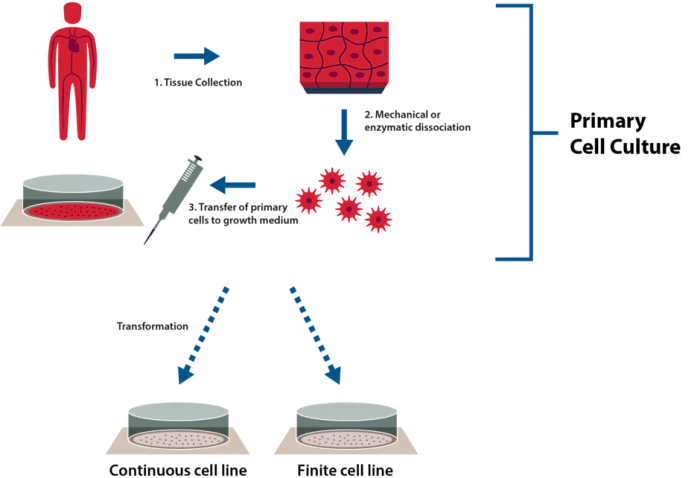
Steps Involved in Primary Cell Culture Development
Sub-Classification of Primary Cell Culture
Based on Cell Type/Morphological Structure
Primary cells in humans based on tissue type includes:
- Epithelial Cells: Polygonal-shaped, appear flattened, attached to substrate.
- Endothelial Cells: Round, outlined cells remain resuspended on medium
- Melanocytes: Specialized skin cells, produces melanin, dendritic/star-like shaped
- Neuronal Cells: Round pyramidal structure, spindle-shaped cells, and branching present in dendrites
- Fibroblasts: Angular-shaped cells, elongated structure, forms open network, attach to the substrate
- Lymphoblast: Spherical-shaped cells, size range from large cells to fine nuclear chromatin, smaller cells
Cell Adhesion
Cells are subcategorized into two subtypes, including:
- Adherent Culture: anchorage-dependent culture, cells attached on substrate
- Suspension Culture: anchorage-independent culture, cells remain resuspended in medium
Cell Differentiation
Depending on cell differentiation capability, primary cells are subcategorized as:
- Differentiated Cell Culture: Cells grow in a monolayer. Cells loses capacity to form another cell type
- Stem Cell Culture: Undifferentiated cells possess the ability to develop into distinct cell types
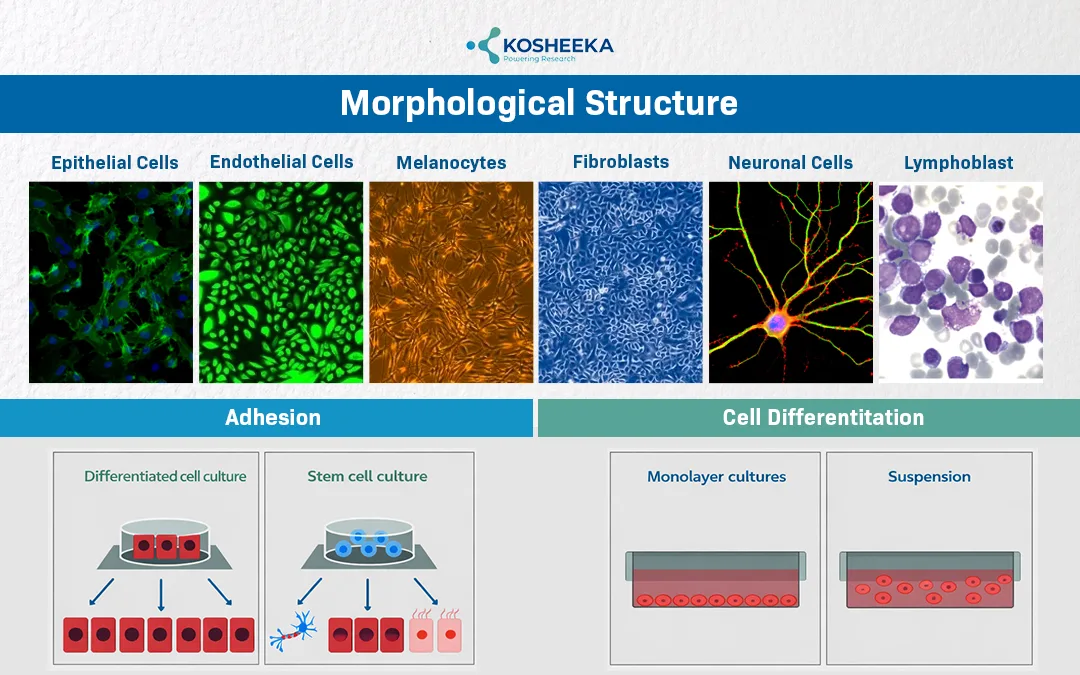
Sub-Classification of Human Primary Cells a) Morphological Structure b) Adhesion c) Cell Differentiation
Importance of Primary Cell Isolation and Culture in Biomedical Research
Relevance to Human Disease Modelling
- Accurate modelling of human disease in-vitro
- Primary cells retain physiological, genetic, and functional characteristics of the original tissue.
- Examples, such as primary hepatocytes, cardiac cells, or neurons, reflect responses in disease progression, gene expression, or cellular signalling abnormalities
Applications in Drug Discovery and Toxicology
- Applicable in drug toxicology and screening experiments
- Accuracy in predicting drug efficacy, metabolism, and toxicity profile
- Enable predicting adequate drug dosage, tolerance, half-life and excretion pathway.
- Determination of adverse effects reduces late-stage drug failures
Contribution to Personalized Medicine
- Enables culturing the patient’s specific cells
- Researchers evaluate how individuals respond to certain drugs, their dosage, or prescribed treatment modalities.
- Enables customized therapeutic planning in critical diseases. E.g. Cancer, metabolic disease, chronic diseases like CKD, or genetic disorders
Regenerative Medicine
- A culture of stem cell-derived primary cells enables regenerative studies.
- Isolation from specific tissue or organ, e.g. Umbilical cord tissue/blood, adipose tissue, bone marrow
- Strategizing regenerative treatment for degenerative disease
- Physiological model system for repair, regeneration and replacement of non-functional organs or tissues
Benefits of Primary Cell Culture Research
The benefits are multifold, including:
- Reliable in-vitro model for preclinical and investigative research
- Determining intracellular and intercellular communication
- Cellular mechanism ongoing in different diseases (Cancer, diabetes, Parkinson’s, Alzheimer’s, etc.)
- Using human primary cells reduces the need for animal experiments and eliminates the need for complex ethical regulation.
- Reduction of experimental cost, less reliance on animal experiments
- Acts as a mode in transforming research from bench-to-bedside development
Limitations of Primary Cell Culture Research
- Takes more time and is a critical condition for growth in comparison with an immortalized cell line
- Cells derived from distinct donors potentially show different responses to stimuli (depending on the body’s intrinsic mechanism)
- With the subsequent passage of primary cells or a change in optimal growth conditions, the characteristics of the primary cell change
- Definite lifespan, must maintain optimal growth conditions to avoid mutation.
- High risk of contamination in comparison to immortalized cells
- Reproducibility issue due to donor variability
Applications of Primary Cell Culture Research
- Cancer biology
- Neurodegenerative disorders
- Cardiovascular and metabolic diseases
- Chronic Kidney Disease
- Regenerative medicine
- Vaccine and virology research
Consideration During Experimental Planning
Primary Cell Isolation and Culture Services intend to provide high-quality, functional cells that are derived from animal or human tissue. We understand that primary cell culture isolation can be a hectic job due to:
- Complexity in finding or selecting an appropriate donor
- Posses high risk of contamination and maintaining the culture conditions
- Low yield and complexity in maintaining cell viability
- Requirement of high technical skills and time consuming procedure
- Limited life span and variation due to variable donors.
A potential solution is procuring primary cells from reliable commercial laboratories
Primary Cell Isolation and Culture Services: What to Look For
- Custom cell isolation services
- GMP-compliant laboratories
- Turnaround time and scalability
- Regulatory compliance
- Intact detection of adequate biomarkers
- Contamination-free cells
*NOTE: Kosheeka, India, is among the renowned laboratories that isolate, cultures and maintain primary cells. It is the topmost priority to maintain optimal culture conditions and provide superior quality primary cells. Utmost care is taken to maintain physiologically relevant cells
Conclusion
Primary Cell Culture Research is a reliable option for conducting advanced translational research. Using primary cell in-vitro reduces reliance on animal experimentation. This significantly reduces ethical concerns or regulations associated with animal use in experimentation. Generates more accurate preclinical results when derived from human organs or tissues.
FAQ’s
Q- How Long Do Primary Cells Survive?
Primary cells have a limited lifespan. They survive from a few days to months; after that, cells reach senescence. For example, 50-100 population doubling occurs in the case of fibroblast cells.
Q- Are Primary Cells Suitable for High-Throughput Screening?
Yes, primary cells are a suitable model for high-throughput screening. They reflect high physiological relevance in comparison with cell lines.
Q- Are Primary Cells Genetically Modified?
Yes, primary cells are genetically modified. This helps in research related to gene function, genetic disease, and developmental therapeutics. The common method used for genetic modification includes using viral vectors or electroporation.
Q- What are Common Beginner Mistakes?
The common mistake includes the inability to maintain adequate growth conditions. E.g. Inadequate handling, improper media, problems with maintaining or subculturing, contamination, etc.