
Primary Cells in Biomedical Research
Primary Cells serve as the gold standard in biomedical research due to high physiological relevance . They form bridges between in-vitro and in-vivo experimentation, offering solid platforms for translational discovery.
Primary cells are cells isolated directly from animals that retain the original characteristics of their origin. In animal cell culture, Primary Cells are obtained through mechanical, enzymatic or chemical disintegration. They have similar chromosome numbers and physiological properties of the original tissue.
What Are Primary Cells?
Primary cell cultures are the first line of cells that are directly isolated from the target organism. They share similar characteristics of parent tissue. The characteristics of primary cell culture include:
- Limited lifespan as they grow in finite numbers before entering senescence
- Restrictive proliferative capacity closely mirrors cellular behaviour, highly relevant for physiological and pathological studies.
- Retains tissue-specific functionality, native cellular and molecular signalling pathways, metabolic activities, and response to external stimuli.
- Preserving native phenotype enables the most accurate modeling of the disease state.
- Maintains a diploid karyotype and exhibits minimal genetic drift during early passage
- Genomic integrity reduces experimental artifacts, enhancing reproducibility in terms of various biomedical research (e.g., drug screening, translational research, toxicology)
What are the Types of Primary Cell Culture?
Types of primary cells are subcategorized into two groups depending on cell types. This includes:
Anchorage-Dependent Cell Culture
- Cells grow over an inert surface, adhere and grow on the surface.
- The surface must be non-toxic and solid, and the culture must be suitable for growing without a solid surface.
- Cells are generally obtained from tissue where cells are immobilized and remain within connective tissues.
- Some examples include Kidney or Liver cells, Fibroblast cells, Epithelial cells, Endothelial (blood vessels) cells.
Anchorage-Independent Cell Culture
- Cells grow efficiently in suspension state, and do not require a solid surface for growth.
- Grow within a liquid medium and obtain a fresh subculture.
- Cells suitable for suspension culture are sourced from body parts where cells remain in suspension.
- Some examples include blood cells like lymphocytes, leukocytes, hybridoma cells; organ-derived cells include CHO (Chinese hamster ovary)
How to Establish Primary Cell Culture?
Establishing Primary Cell Culture involves a stepwise process:
Selection:
- Determining the organ processed for primary cells isolation
- Either an in-vivo model or a human organ/tissue
Isolation:
- The isolation techniques include:
- Mechanical disintegration- chopping or slicing of cells using a sterile scalpel/razor, sieving, syringing or pipetting
- chemical disintegration/proteolytic enzyme- Collagenase, Tripsin, Bacterial protease
*The isolation method involves using one technique or combination, depending on the cell type
Cell Collection:
- With mechanical disintegration, cells are collected in two ways:
- Forcing tissue fragments through a syringe or needles
- Pressing tissue pieces through a series of sieve leads to a gradual reduction in mesh size.
- With enzymatic disaggregation, the most common method is trypsinization. Two methods can be used:
- Warm Trypsinization- Widely used, chopped tissue washed in basal solution and transferred to a flask containing warm trypsin (37°C)
- Cold Trypsinization- Higher yield of viable cells, better cell survival after 24 h incubation
- Collagenase disaggregation- suitable for abundant structural proteins (cells in extracellular matrix, muscle or connective tissue)
Plating:
- Cells obtained are washed with Phosphate basal salt and mixed with the media.
- Poured on suitable flask/plate for cellular growth
- In adherent culture, cells adhere to the inert flask surface; in suspension culture, cells float in the medium.
Passage:
- After cells achieve 80-85% confluency, cells are passaged/subcultured.
- Cells used for experimental purposes
What do you need to grow Primary Cells in a Laboratory?
Culture conditions in the laboratory replicate the maximum physiological environment. This includes:
- Growth medium (contains macro nutrients and micro nutrients)- supplies essential nutrients like carbohydrates, amino acids, vitamins, and minerals
- Growth Factors and Hormones
- CO2 Incubator- facilitates gaseous exchange (O2, CO2)
- Regulated physiological environment, maintains temperature (37°C), pressure, pH, and humidity.
Human Primary Cells by Tissue Types
Primary cells are classified based on their origin and biological function. The different categories based on tissue type include: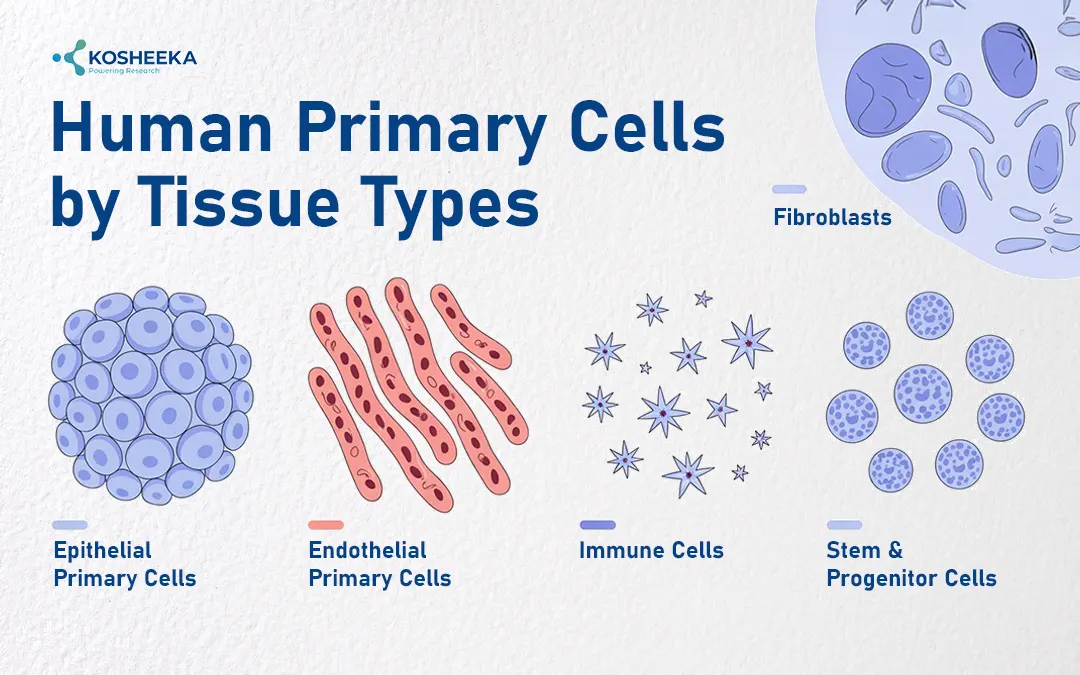
Epithelial Primary Cells
- Cells covering the whole body surface, blood vessels, organs and major tissue glands
- Primary epithelial cells, valuable tool for mediating barriers between the inside and outside of the body
- Involved in a variety of research- cancer research to toxicology
Endothelial Primary Cells
- Lines the interior surface of blood vessels and lymphatic vessels
- Crucial model for wound healing, high-content screening, high-throughput research, and toxicology screening
Fibroblasts
- Cells in connective tissues produce collagen, elastin, and other components of the extracellular matrix.
- Used in tissue engineering, wound healing, and regeneration applications
Immune Cells
- Popularly known as haematopoietic cells (T cells, B cells, macrophages)
- Derived from the lymphoid tissue or the circulatory system
- Suitable for cell-based assay and treatments
Stem and Progenitor Cells
- Undifferentiated cells possess potential to give rise to specialized cells.
- Stem cells differentiate into several cell types- mesenchymal stem cells (MSCs), neural stem cells (NSCs), adult stem cells (ASCs)
- Progenitor Cells belong to a specific lineage, with limited division capability.
Advantages of Using Primary Cells
- High physiological relevance with the original tissue/organ
- Better prediction of in-vivo responses
- Improved disease modeling and drug screening accuracy
- Decreased dependency on animal models
- More reliable as it replicates human physiological conditions and produces more relevant results
Limitations and Challenges of Primary Cells
- Takes a longer time to grow, has limited growth potential, is more sensitive to optimal growth conditions, and dies off with slight variation.
- Limited lifespan and senescence
- Donor variability, cells derived from distinct donors might behave differently in response to the same stimuli.
- Isolation costs are pretty high; procuring organs/tissues is complex, with technical complexity.
- Ethical and sourcing considerations
- With subsequent passage, the original characteristics might subside (if optimal growth condition not maintained)
*NOTE: For experimental purposes, the primary cells must be of superior quality. Kosheeka, Noida, India, is an experimental laboratory that maintains superior quality primary cells for research purposes.
Applications of Primary Cells in Research and Medicine9
Primary cells have a wide range of application including:
- Drug discovery and toxicity testing
- Disease modeling
- Cellular Interaction Study
- Immunological and Infection Studies
- Regenerative medicine and cell therapy research
Future Outlook: The Role of Primary Cells in Advanced Biomedical Research
- Integration with 3D culture and organoid systems
- Use in precision medicine
- Drug Discovery and Disease Modelling
- Advancements in primary cell culture technologies
Conclusion
Primary cells are of the gold standard in biomedical research. They are directly obtained from live tissue. They share the highest physiological relevance, genetic stability, accuracy in disease modelling, and lower risk of misidentification in comparison with immortalized cell lines. Primary cells are critical bridges in human translational research.
By preserving native cellular identity, primary cells remain most biologically relevant.
FAQ’s
Q- What is the Primary Cell Definition?
Primary cell are isolated from human tissue/organs directly. They share physiological and genetic relevance to their origin.
Q- What is the typical lifespan of primary cell in culture?
Primary cell have a finite lifespan that undergoes a doubling population before reaching senescence. The exact life span depends on various factors such as cell type and culture conditions.
Q- What are the main challenges of working with primary cells?
The challenges include limited availability, donor variability, high sensitivity to culture conditions, and finite lifespan.
Q- Can primary cells be used in high-throughput screening?
Yes, advancement in culture conditions and automation is making it possible to use primary culture widely for high-throughput screening.