

Introduction
In the quest for a respiratory disease model in research, swine lung alveolar cells play a crucial role.
Chronic respiratory disease affects the lung structure and airways. The most common respiratory diseases in humans include asthma, acute lung damage, COPD, and pulmonary fibrosis, etc. Globally, chronic respiratory disease affects more than 80 million individuals [1]. Currently, the treatment regimen focuses on relieving the respiratory symptoms and preventing exacerbation. Yet, the high mortality rate and emerging drug-resistant microorganism calls for intensive research.
Swine Lung Alveolar Cells are crucial primary cell culture models that are widely used by researchers in various respiratory diseases.
Anatomical and Physiological Similarities: Swine and Human Lungs
The compatibility of research models is a major factor in obtaining successful and reliable research outcomes. The use of Swine lung cell culture is ideal for respiratory research due to the shared physiological similarity between swine and human lungs. The features include:
- Lung Size and Structure: Similar lung volume relative to body size, segmental bronchial branching pattern
- Alveolar and Gas Exchange: Thin alveolar-capillary membrane, Type I and Type II, pneumocytes, gas diffusion efficiency
- Airway Architecture: Cells share functional similarities, such as goblet cells, mucus-producing glands, airway smooth muscle distribution, and mucociliary clearance mechanism
- Pulmonary Hemodynamics: Similarity in pulmonary arterial pressure range, ventilation–perfusion (V/Q) relationships, Parallel oxygen and carbon dioxide exchange dynamics
- Immune and Inflammatory Response: Porcine alveolar macrophages share a similar response as in humans, cytokine and chemokine responses, response to respiratory infections or lung injury
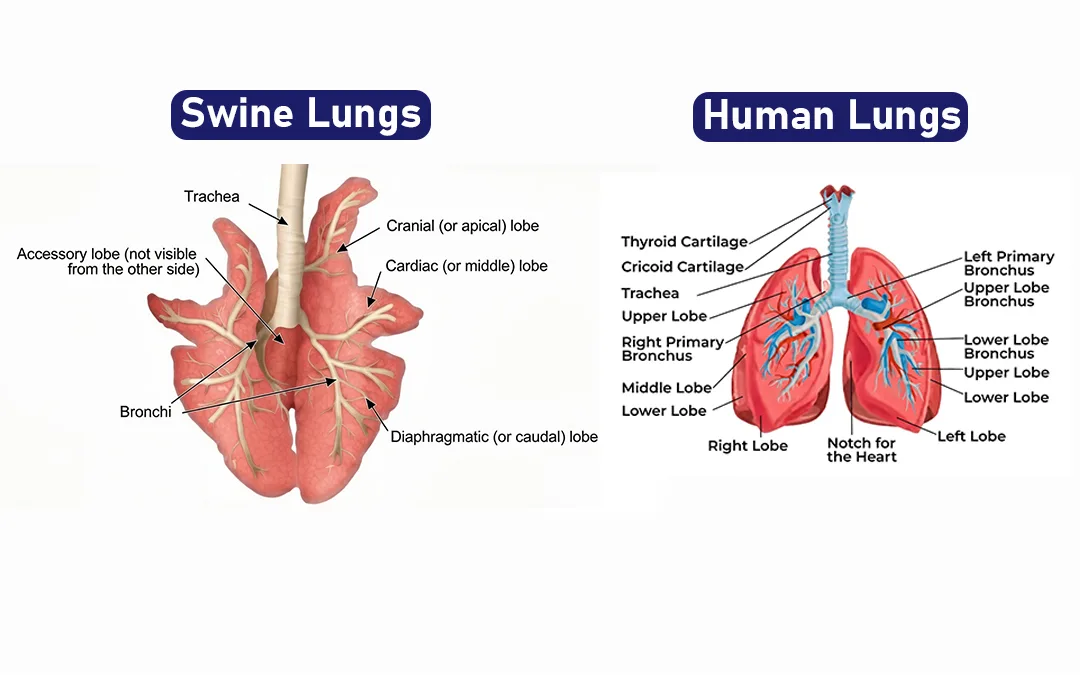
Visual representation of anatomical feature of swine and human lung
The physiological and anatomical relevance of Swine lung alveolar cells to humans makes them suitable models for respiratory research. Respiratory diseases like ARDS, COPD, fibrosis, lung infection, etc., are widely studied. Suitable for preclinical drug and regenerative research.
Swine Lung Alveolar Cells: Types and Biological Roles
Swine lung alveolar cells are of distinct subtypes based on their functional characteristics. This includes:
- Type I Pneumocytes: Cells are thin, squamous cells covering approximately 95% of the alveolar surface. They are involved in efficient gaseous exchange.
- Type II Pneumocytes: Cells are cuboidal, produce pulmonary surfactant, reduce surface tension and prevent alveolar collapse. They act as progenitor cells, involved in epithelium repair and differentiate into Type 1 cells.
- Pulmonary Endothelial Cells: Cell lines, capillaries in lung parenchyma
- Porcine Alveolar Macrophages (PAMs): Specialized immune cells that scavenge pathogens and cellular debris, plays crucial role in immune signalling
- Interstitial Fibroblast: Cells supports alveolar structure, secretes important proteins of the extracellular matrix (ECM)
Isolation of Swine Lung Alveolar Cells
Swine Lung Cell Culture involves primary cell culture techniques. The steps of cell isolation: 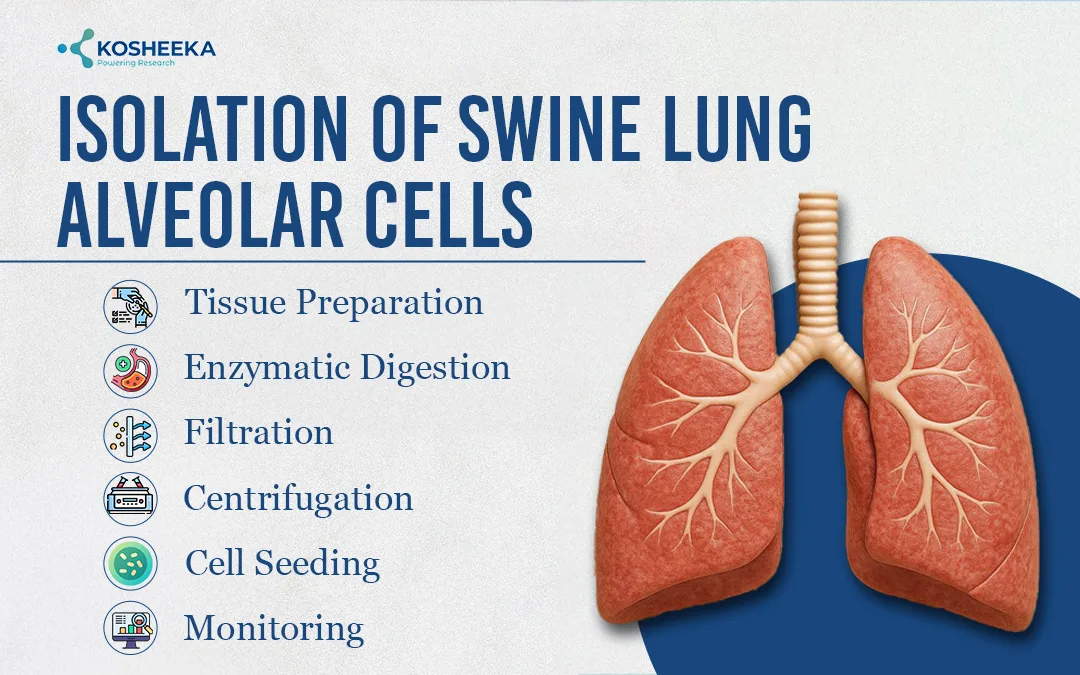
- Tissue Preparation: Tissue is procured from healthy swine. Tissues are washed with 1X PBS and mechanically crushed.
- Enzymatic Digestion: Crushed tissues are incubated with digestive enzymes (Trypsine/ Collagenase) for 1-1.5 h at 37 °C. This step aids in the breakdown of the tissue structure.
- Filtration: Cell suspension are filtered via a 50-100 µm filter.
- Centrifugation: Cells are centrifuged (500 g). Pellets washed with excess 1X PBS.
- Cell Seeding: The cell palette is resuspended and seeded with suitable culture medium. Incubated in a CO2 incubator with 5% CO2 supply, temperature 37 °C, and 95% humidity.
- Monitoring: Cells are monitored at distinct time intervals. At 80-85% confluency, cells are passaged and used for experimental purposes [2]
Molecular Characterization of Swine Alveolar Cells
The molecular characterization of isolated swine lung cells is crucial for understanding distinct disease mechanisms, precise diagnosis, development of precision or regenerative medicine. The characterization includes:
- Receptor Expression: the primary swine respiratory cells show abundance in Sia2–6Gal receptors
- Biomarker Identification: Elevated expression of cytokeratin in epithelial cells, and CD163 in Porcine alveolar macrophages
- Inflammatory Response: Both swine alveolar epithelial cells and PAMs secrete inflammatory cytokines (IL-6, TNF-α) when encounters pathogens [2]
Applications in Respiratory Disease Research
Swine lung alveolar cells have multiple research application including:
- Research model for acute lung injury
- Research involving Chronic obstructive pulmonary disease (COPD)
- Pulmonary fibrosis
- Influenza and viral respiratory infections
- ARDS and inflammatory signaling pathways
Role in Drug Testing and Regenerative Medicine
Swine lung alveolar cells have distinct functions in drug testing, toxicology studies, and regenerative medicine. This includes:
- Drug Toxicology Profiling: Assess pulmonary toxicity of new respiratory drugs, therapeutic aerosols, pollutants, etc., mimics human response
- Vaccine Development: vaccine testing for various viral infections (influenza, PRRSV, coronavirus, etc.)
- Inflammatory Response: Effect of anti-inflammatory drugs like NSIDs, study cytokine response
- Stem Cells Model: Type II pneumocytes are studied as stem cells for lung repair mechanisms, crucial for epithelial regeneration.
- Lung Tissue Engineering: Development of an engineered “lung-on-a-chip” device that replicates the mechanical lung microenvironment
- Translational Research: Sets up preclinical data for stem cells, tissue engineering, or translational research—preliminary data for setting up human clinical trials.
Advantages of Swine Lung Models Over Rodent Models
The swine lung model presents better in terms of human disease in comparison with rodents. The major advantages include:
- Structural and size similarities (Physiological and anatomical)
- Comparable immune response resemblance (swine immune response have upto 80% resemblance vs. rodent 10%)
- Genetic manipulation (CRISPR/Cas9) enables efficient creation of transgenic pigs, relevant for modeling human disease.
Challenges in Using Swine Lung Models in Research
- The swine model is heavy, incurs logistic and cost limitations
- Reproducibility in the case of primary cell culture is a challenge
- Differences in age, genetic makeup, and microbiota challenges result reproducibility
- Genetic manipulation using CRISPR/Cas9 or regenerative research is still at an early stage
- Isolation and establishing a Swine lung cell culture is a time-consuming, incurs high cost and complex process
*Kosheeka, India, is among the renowned laboratories in isolated and maintained high-quality swine lung alveolar cells and Porcine Alveolar Macrophages.
Conclusion
Swine Lung Alveolar cells play a crucial role in respiratory research. They represent high physiological and translational relevance. Their close anatomical, cellular and immunological similarity with human lungs makes them an ideal model in primary cell culture research. Swine model enables preclinical investigations- gaseous exchange, inflammatory pathways, infectious disease, and regenerative medicine.
References
- World Health Organization. Chronic respiratory diseases. Available from: https://www.who.int/europe/news/item/12-06-2025-chronic-respiratory-diseases–more-than-80-million-affected-and-many-more-undiagnosed–warns-new-who-and-european-respiratory-society-report
- Sreenivasan CC, Thomas M, Antony L, Wormstadt T, Hildreth MB, Wang D, Hause B, Francis DH, Li F, Kaushik RS. Development and characterization of swine primary respiratory epithelial cells and their susceptibility to infection by four influenza virus types. Virology. 2019 Feb 1;528:152-63.
FAQ’s
Q- What are Swine Lung Alveolar Cells?
Swine Lung Alveolar Cells are primary cells isolated from pig. These cells include Type 1 and Type II pneumocytes that are responsible for gaseous exchange.
Q- Why are Swine Lungs a Suitable Model for Respiratory Research?
Swine lungs have shared similarities in anatomical, physiological, and immunological function with humans. This makes them highly relevant for translational studies.
Q- What Disease can be Studied by the Use of Swine Lung Alveolar Cells?
Respiratory diseases (ARDS, COPD, pulmonary fibrosis, influenza, pneumonia, or acute lung injury) are studied using swine lung alveolar cells.





Thanks for sharing this overview of lung-derived research tools—especially the focus on lung fractions S9/microsomes. It’s fascinating how these primary cell models are helping advance our understanding of respiratory diseases and drug metabolism. The emphasis on quality and consistency in cellular research really highlights the importance of using reliable, well-characterized sources.
We’re happy that you love our content. Thank you for reaching out to us. Please contact us via WhatsApp or call us at +91-9654321400, or mail us on info@advancells.com for more information. We’re here to support you every step of the way.
The emphasis on specialized models like the lung fractions really highlights how critical these resources are for moving beyond generic cell lines. It is fascinating to see how choosing such tissue-specific models can help bridge the gap in predictive translational research.
Thankyou for reaching out.
Absolutely agree with your comment—tissue-specific models like lung fractions add a whole new layer of relevance to research. By closely mimicking the native microenvironment, they significantly improve the predictive accuracy of preclinical studies compared to generic cell lines. This kind of approach is key to narrowing the gap between lab findings and real-world clinical outcomes.