
Introduction
Mast Cell Markers, powerful particles that play pivotal roles in shaping immune response.
Human mast cells are microscopic granulated multifunctional leukocytes that reside throughout the body. With allergic reactions or interaction with foreign molecules, these cells are the first responders. Mast cell markers are specialized proteins that play a crucial role in immunological studies. The expression of mast cells across the tissue varies based on cellular state, such as proliferation, differentiation, inflammation, etc. Identification of Mast Cell Markers aids in targeted approaches such as immunophenotyping or disease profiling. They possess greater value in immunological research.
Understanding Human Mast Cells
Hematopoietic Stem Cells (HSCs) give rise to human mast cells. Immature mast cells or mast cell progenitors leave the bone marrow and circulate in the bloodstream. On reaching different tissues, mast cell proliferation occurs. They differentiate, mature and undertake specific tissue functions. The coordinated function involves:
- Interaction with basophils for immune response
- Recognition of environmental, immunological or inflammatory cues
- Consists of various biomarkers or receptors such as CD34, c-Kit, CD13, or IgE receptor.
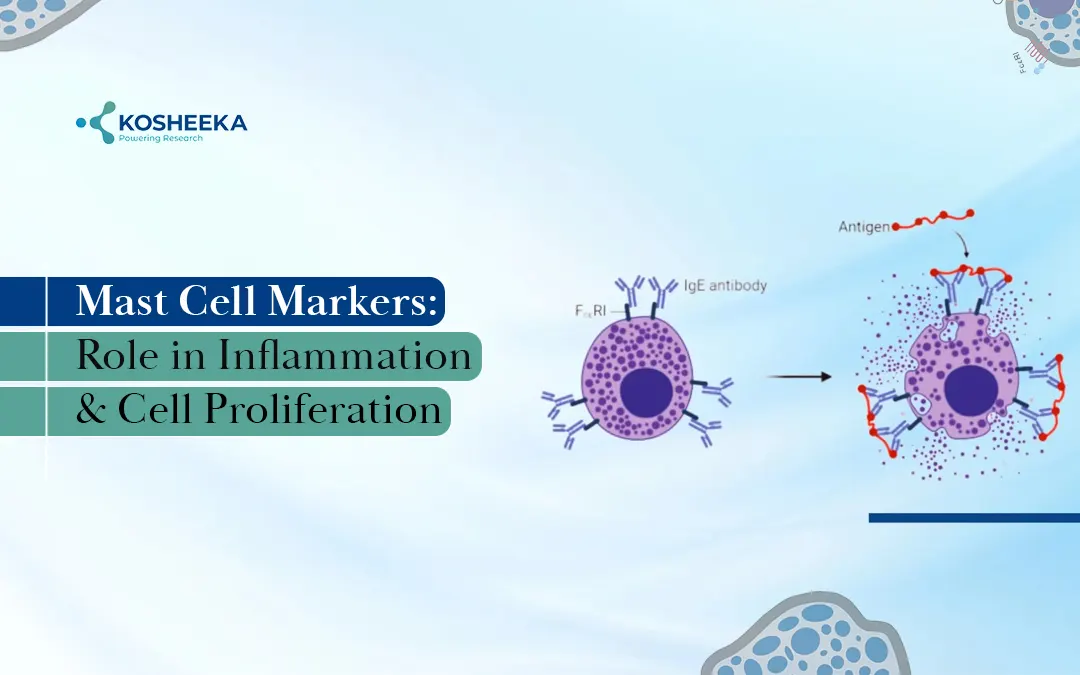
- On stimulation, mast cells release various cytoplasmic granules, such as histamines or proteoglycans.
- On identification of local inflammation or increased vessel permeability, mast cells actively produce response molecules.
- Examples include prostaglandins (PGE₂ and PGD₂, etc.), cytokines (IL-4, IL-6, IL-9, IL-1β, IL-33, 3tc.), and leukotrienes (LTB4, LTC4, etc.) [1]
What Are Mast Cell Markers?
Mast cell markers are widespread in tissues that actively interact with external environments. This includes the skin, gastrointestinal tract, or lungs. Cross-linking of IgE-Fc epsilon RI receptors mediates the activation. This leads to releases of various molecules like histamine, prostaglandin D2, heparin, chymase, cysteinyl leukotrienes, tryptase, or cytokines. The core function involves a response to the host defense mechanism. The other primary function of mast cell markers involves:
- Smooth muscle contraction
- Mucus production
- Increased vascular permeability
- Recruitment of immune cells
- Promoting wound healing
- Allergic response
- Several autoimmune diseases
- Anaphylaxis
- TLR2-5, 7 and 9 expressed in pathogenic interactions
Below is the list of commonly studied biomarkers expressed at the surface and intracellular levels
Table 1: List of mast cells/markers
| Mast Cell Markers | |
| Surface Markers/ Membrane Associated | Intracellular Markers/ Granule-Associated |
| CD117- Receptor for Stem Cells | Tryptase – Human Mast Cells |
| FcεRI- Binds with IGE Antibodies | Chymase – Connective Tissues (MCTC) |
| CD203c- Surface Markers on Elevation of Mast Cells or Basophils | Histamine |
| CD63- Degranulation Process | Carboxypeptidase A3- Connective Tissues |
| CD25- Systemic Mastocytosis | Heparin |
| CD30- Mastocytosis | Elevated in Neoplastic Mast Cells |
For a specific function or stage, these markers plays crucial role:
- Progenitors: CD34+, FcεRI, Lin-
- Mature Mast cells: FcεRI, CD117+, Clymase+, Tryptase+
- Neoplastic/ Mastocytosis: CD2+, CD25+, CD117+ [1]
What is the Role of Mast Cell Markers in Inflammation?
Mast Cell Function in Inflammation acts as the ‘first responders’. They are an active part of the acute part of the innate immune system that resides in tissue for pathogen detection or site-specific injury, thus triggering inflammation. The key functions include:
- Degranulation: On stimulation, mast cells releases pro-formed granules consisting of histamine, TNF-alpha or proteases
- Inflammatory Response: Following activation, mast cells synthesize various prostaglandins, leukotrienes, and cytokines
- Vascular or Tissue Effect: Increase vasodilation, edema, bronchoconstriction, mucus secretion
- Chronic Inflammation: Involves various inflammatory diseases, e.g, Inflammatory bowel disease (IBD), asthma, rheumatoid arthritis, MS, etc.
- Significant Inflammatory Markers: CD23 (allergic reaction, chronic inflammation), CD64 (mast cell activation or disease states- autoimmune disease, allergy, immunopathology) [2]
What is the Significance of Mast Cell Proliferation?
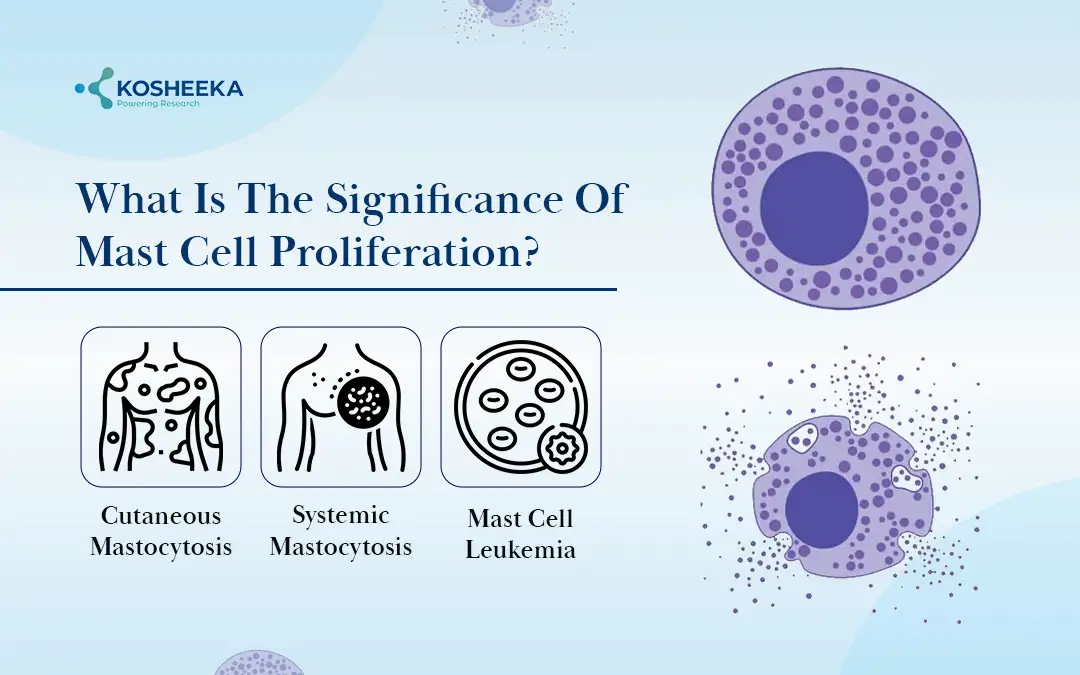
Mastocytosis or unregulated mast cell proliferation accounts for abnormal accumulation of mast cells in specific tissues. Dysregulated mast cell proliferation is mediated via autophosphorylation of receptors. Mastocytosis is categorized as:
- Cutaneous Mastocytosis: Occurs among children, presenting with urticaria pigmentosa. Characterized by salmon or brown maculopapular rash. Appearance of nodular lesion or plaque
- Systemic Mastocytosis: occurs among adults, characterized by multifocal bone marrow lesions. Most affected organs include the skin, lymph nodes, spleen, lymph, and gastrointestinal tract.
- Mast Cell Leukemia: Presence of > 20% mast cells in bone marrow results in multi-organ failure.
Mast Cell Differentiation: From Precursors to Function
Mast cell differentiation involves the following stages:
- Origin: HSCs in the bone marrow.
- Release: Immature mast cell precursors are released into the bloodstream
- Migration: Peripheral tissues via the bloodstreams
- Maturation: Occurs within a specific tissue site (skin, lungs, or gastrointestinal tract)
During maturation, cells develop granules containing histamine, proteases, and other bioactive molecules.
Research and Clinical Applications of Mast Cells
Mast cells and mast cell markers have widespread application in immunological research. Some human mast cell lines include HMC-1, LUVA and LAD2. Various research application includes:
- Anaphylaxis, allergy mechanism and prevention
- Targeting chronic inflammatory disease or fibrotic disease
- Modulation of cancer microenvironment
- Targeting infection control via infection control
- Wound healing, repair mechanism or cell regeneration
- Research associated with the neuroimmune response to pathogens, the mechanism of blood-brain barrier dysfunction
- Understanding biomaterial interaction, development of scaffolds for regenerative studies
- Regenerative research, understanding the immune rejection mechanism or modulation in the application of stem cells for various diseases
*NOTE: Mast cells have a wide range of immunological research applications. Kosheeka, India, is a renowned laboratory that supplies various superior-quality primary and secondary cells for research purposes.
What are the Existing Challenges in Mast Cell Marker Research?
Some of the major challenges in mast cell marker includes:
- Lack of exclusive specificity in mast cell markers
- Heterogeneity across tissue in humans
- Marker expression level depends on various factors like environment, disease state and activation status. It varies across distinct stages.
- Mast cell lines do not completely replicate human physiological conditions.
Future Perspectives: New Frontiers in Immunology
- Novel mast cell markers discovery
- Development of precision medicine depending on individuals immune profiling.
- Improved diagnostic tool development for early detection of inflammatory and immune-associated diseases
- Integration of multi-omics and regenerative research
Conclusion
Mast cell markers play a crucial role in understanding the role of mast cells in the immune system. Human Mast Cells process identification, including proliferation, activation and role in inflammation, provide valuable insights about immune response. The advanced studies involving mast cells will play a critical role in shaping immunology research.
References
- Worrall WP, Reber LL. Current and future therapeutics targeting mast cells in disease. Pharmacology & Therapeutics. 2025 Sep 1;273:108892.
- Burchett JR, Dailey JM, Kee SA, Pryor DT, Kotha A, Kankaria RA, Straus DB, Ryan JJ. Targeting mast cells in allergic disease: current therapies and drug repurposing. Cells. 2022 Sep 27;11(19):3031.
FAQ’s
Q- What is the Importance of Mast Cell Markers?
Specific proteins characterize mast cell markers. They are specific to specific tissue types and their stage. These markers play a crucial role in various conditions like inflammation, immune response, dysregulated proliferation or disease progression.
Q- What is the Mast Cell Function in Inflammation?
Mast cell markers enable researchers to unveil mast cell behaviour in inflammatory response. Various health conditions, including allergic reactions, rashes, asthma, inflammatory bowel disease or other GI issues.
Q- What is the Role of Markers in Dysregulated Mast Cell Proliferation?
Dysregulated mast cell proliferation is often associated with Mastocytosis. The condition is characterized by abnormal accumulation of mast cells in skin, other organs or bone marrow. Overexpression of>20% in bone marrow is an indication of mast cell leukemia.
Q- What are the Research Applications of Mast Cell Markers?
In research, mast cell markers are widely used for diagnosis and therapeutic applications. It enables a detailed understanding of disease development, progression, the effect of the drug, etc. Moreover, it is useful in multi-omics and regenerative research.