

Introduction
Understanding human biology is an extraordinarily complex task. Replicating cellular and molecular behaviour in laboratory environments is challenging in biomedical science. Over the decades, researchers have strived to shift simplified immortalized cell models towards more physiologically relevant systems.
Human Primary Cells are considered the cornerstone of modern biomedical and regenerative research. The use of primary cells has enabled scientists to develop disease models, understand altered cellular or molecular pathways, evaluate drug safety, etc. The cells preserve donor-specific biological characteristics, bridging the gap between bench and bedside application.
Historical Evolution of Human Primary Cells
Human primary cell culture evolution dates back to the 80s when Robert Koch laid the foundation for establishing cell culture methodologies. The following are timelines and major developments in establishing primary cell culture:
- Late 1800s: Robert Koch and Richard Petri laid the foundation for cell culture techniques (solid cell culture media, sterilization, Petri dishes, etc.). Wilhelm Roux demonstrated embryonic cell ability to thrive in in vitro conditions.
- Early 1900s: Ross G. Harrison first isolated and grew nerve cells (primary cells from a frog), introduced the aseptic technique and the hanging drop cell culture technique
- Early- Mid 1900s: Alexis Carrel developed a 3-D cell culture system. Introduced long-term cell cultivation
- Mid 1900s: George Gay & Henrietta established HeLa cells (first immortal human cell lines). One of the wide used secondary cell line examples used in biomedical research till date
- 1960s: E. McCulloch & James Till established the first self-renewing stem cells via a bone marrow transplantation study
- 1960s-1990s: A. Friedenstein & A Caplan identified mesenchymal stem cells
- 1980s: Martin Evans, M Kaufman, and G. R. Martin established and introduced the term ‘embryonic stem cells’
- Late 1990s: James Thomson: Isolated and cultured human embryonic cells from blastocytes
- Mid 2000s: S. Yamanala & K. Takahashi developed and reprogrammed induced pluripotent stem cells (iPSCs) [1]
What Are Human Primary Cells?
Human primary cells closely mimic the physiological condition, chromosomal numbers, and genetic makeup of the parent tissues. They have a wide range of applications in in-vitro culture for preclinical and investigative biomedical and regenerative research. Historically, researchers relied on secondary cell lines for laboratory investigation. However, these cells can be poor indicators due to gross mutation and chromosomal abnormalities.
Human primary cells are isolated directly from the specific tissue and maintained in Primary Cell Culture media with supplements and an adequately controlled environment. It serves as an advanced cell culture model for recapitulating cell tissue type in comparison with cell lines.
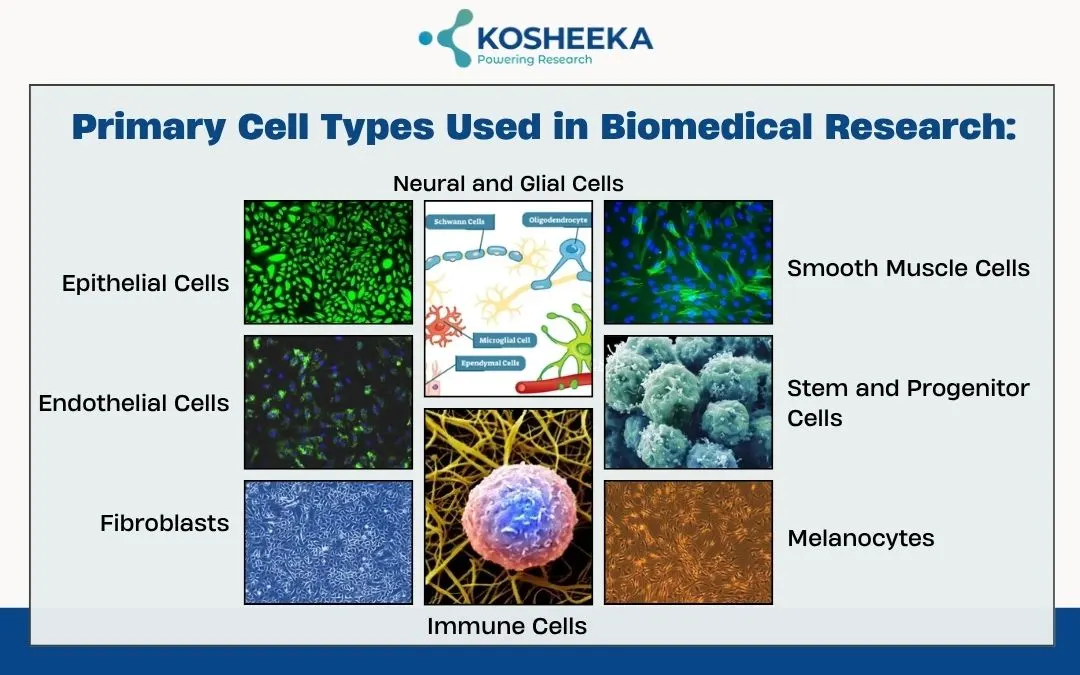
Primary Cell Types Used in Biomedical Research
Types of Primary Cells Depend on Their Source or Origin. This Includes:
Epithelial Cells
- Primary epithelial cells are used for modeling barriers between the inside of the body and the outside environment.
- Crucial role in understanding absorption functions
- Research applications include skin, lung, cancer, gastrointestinal research, etc.
Endothelial Cells
- Specialized flat cells form single inner linings of the blood vessels, heart or lymph organ
- Gatekeeper for molecular or gaseous exchange (oxygen, nitric oxide exchange, waste products), maintains cellular homeostasis
- The application includes vascular biology, angiogenesis, cardiovascular disease, and inflammatory disease.
Fibroblasts
- Most abundant in connective tissue
- Synthesis of collagen and elastin maintains the tissue framework.
- Crucial role in wound healing, inflammation, and tissue repair mechanisms
Immune Cells
- Immune cells act as the first responders to any infectious disease
- Peripheral blood mononuclear cells (PBMCs) isolates (heterogeneous cell composition)
- PBMCs consist of T cells, B cells, macrophages, dendritic cells, and NK cells.
- Immunotherapy, infectious disease, therapeutic development, vaccine development, autoimmune disease, transplantation
Smooth Muscle Cells
- Forms inside the hollow organs, involved in contractility
- Models hypertension, fibrosis, cancer research, etc.
Stem and Progenitor Cells
- Stem cells are multilineage, posses de-differentiation capacity
- Isolates from umbilical cord blood/tissue, bone marrow, embryonic cells, adipose tissue
- Applications include tissue engineering, regenerative research, and extracellular vesicle isolation.
Neural and Glial Cells
- Neurons (responsible for sending electrical signal from brain to other body parts)
- Glial cells (forms mature central nervous system: astrocytes, microglial cells, and oligodendrocytes)
- Research applications include neurodegenerative disease, neurotoxicity studies, and regenerative medicine
Melanocytes
- Specialized cells regulate melanin production.
- Models wound healing, dermal response to UV radiation, skin research, and cosmetic research.
Primary Cells vs Cell Lines: Key Differences
Understanding primary cells vs cell lines is crucial in choosing appropriate models in research applications. The key aspects include:
Biological Accuracy
- Human primary cells mimics native tissue biology with the source
- Cell lines undergoes phenotypic or genetic alterations
- Primary cells provide more reliable data
Growth Characteristics and Lifespan
- Primary cells have a finite lifespan and possess limited proliferative capability
- Cell lines are immortalized cells that have the capability of multiple passages
- Primary cells are suitable for specialized experiments, while cell lines are suitable for result reproducibility, long-term experimentation
Experimental Reliability
- Primary cells produce more reliable results (drug screening, drug toxicology, and personalized medicine, regenerative medicine)
- Cell lines suitable for routine experimentation or long term experimental design
Reproducibility and Scalability
- Experimentation with secondary cell lines has high reproducibility due to their uniform genetic background and unlimited proliferative capability
- Cell lines suitable for large-scale studies (vaccine production)
- Primary cells are subjected to donor variability
Ethical Considerations
- Primary Cell Isolation from human tissue requires ethical clearance
- Primary cells are highly sensitive in culture conditions, more susceptible to contamination or phenotypic changes
- Cell line maintenance in culture is comparatively easier; however, prolonged culture can lead to genetic drift, altered morphology and cellular behaviour
What are the Key Benefits of Primary Cells in Modern Research?
The Key Benefits of Primary Cells Include:
- Closely mimic native human biology
- Enable gaining reliable predictive value in preclinical studies
- Possesses better disease modeling capabilities
- Reduces the translation gap in laboratory and clinical study outcomes
- Reliant on precision medicine, targeted therapy, and regenerative research
Challenges in Using Primary Cell Culture
- Limited lifespan, reaches senescence at a faster pace
- Features vary with donor variability
- The isolation and maintenance process is complex
- It has a higher cost and involves more technical expertise
- Highly sensitive to the culture condition, more prone to contamination
Applications of Human Primary Cells
Primary cells have a wide range of research applications. Primary cell examples involve blood cells, organ-specific cells, vascular cells, etc.
The Key Research Application Includes:
- Drug screening, toxicology, or targeted drug discovery
- Oncology Research, altered molecular and cellular pathways
- Regenerative medicine, including stem cell research, exosome therapy, etc.
- Immunological research, vaccine development
- Gene Therapy, gene editing, cell-based therapeutics
What are the Emerging Trends?
Human Primary Cells are Continuously Evolving in Modern Medicine. The Advanced Trends Include:
- Development of organoids and organ-on-chip technologies
- CRISPR-Cas9 gene editing technique
- AI-assisted cellular analysis
- Exosomes isolation from MSCs, application in various chronic diseases (neurodegenerative disease, bone health, metabolic condition, etc.)
- Development of single-cell sequencing technologies
Conclusion
Human primary cells play a pivotal role in modern biomedical and regenerative research. These cells enable researchers to lay the foundation for transforming research applications from laboratory to animal studies. Primary cells are the gold standard for in vivo human biology modelling.
References
- Moro LG, Guarnier LP, Azevedo MF, Fracasso JA, Lucio MA, Castro MV, Dias ML, Lívero FA, Ribeiro-Paes JT. A brief history of cell culture: from Harrison to organs-on-a-chip. Cells. 2024 Dec 15;13(24):2068.
FAQ’s
Q- What are Human Primary Cells?
Human primary cells are directly isolated from the human tissue/blood. They closely mimic the physiological conditions, genetic makeup and chromosomal number of the source/ origin.
Q- Distinguish Between Primary Cells vs. Secondary Cell Lines?
Primary cells are derived directly from human tissue. Cell lines are transformed from primary cells in a controlled laboratory environment. Primary cells mimic native features of the source or origin. Secondary cell lines might develop genetic drift or altered cellular behaviour with time.
Q- What are Common Primary Cell Examples?
Some of the common primary cell examples include epithelial cells, endothelial cells, keratinocytes, stem cells, melanocytes, hepatocytes, neural cells, etc. Various research applications include drug screening, toxicology profiling, targeted drug discovery, regenerative medicine, and precision medicine.



The distinction between various primary cell types and their specific subcellular fractions is crucial for building accurate models in both immuno-oncology and regenerative medicine. Focusing on these foundational sources rather than traditional cell lines truly helps researchers bridge the gap between in vitro data and real-world physiological responses.
The emphasis on how primary cells serve as a more accurate foundation for disease modeling compared to cell lines is a crucial point for advancing research in fields like immuno-oncology and regenerative medicine. Having access to diverse source tissues, particularly those from reproductive and vascular systems, seems essential for developing truly relevant lifestyle disease models and 3D culture applications.
Thanks for your comment. Primary cells provide narrative of native tissue biology. For more latest update, visit us:https://www.kosheeka.com/
The expansion of research areas into 3D Cell Culture and lifestyle disease models really highlights how primary cells are becoming indispensable for creating more biologically relevant data. It is particularly impressive to see the diverse sources, from dental pulp to extra embryonic fetal tissue, bridging the gap between basic science and clinical applications. This deep dive into subcellular fractions and exosomes indeed adds significant value to the field of regenerative medicine.
Indeed. 3D cell culture model significantly decrease dependence on animal use as well. Don’t miss out the weekly updates:https://www.kosheeka.com/
The discussion on primary cells really highlights how crucial accurate biological models are for translational research. In our experience, visually showcasing the morphology and behavior of these cells in 3D culture has become much more impactful when paired with dynamic video content rather than still images. Tools like Photo to Video AI help researchers transform microscopy and lab snapshots into engaging presentations that better convey subtle cellular dynamics to wider audiences.
Absolutely right. Primary cell culture and 3D model enables development of crucial preclinical data
The point about 3D culture bridging the gap between monolayers and animal models is well made. Donor variability and limited expansion windows do remain the biggest practical obstacles for primary cell work, but standardized isolation and QC protocols continue to improve. Increasingly, teams are pairing live-cell imaging with short video documentation to share protocols and reduce reproducibility gaps across labs.
Completely agreed. The development of advanced research protocol continues to evolve. It is bridging the gap for reproducibility and accuracy in biomedical research
Fantastic breakdown of how primary cells are reshaping translational research. The section on 3D culture and donor variability really resonates with what we have seen in our own work. On a practical note, sharing live-cell imaging across collaborators is often limited by shaky or out-of-focus recordings, and Unblur Video has been a useful lightweight tool for restoring those clips without distorting the actual cellular behavior.
We completely agree—3D culture and donor variability are critical considerations in translational research. High-quality live-cell imaging also plays an important role in improving collaboration, and enhancing video clarity while preserving cellular behaviour. contact us via WhatsApp or call us at +91-9654321400, or mail us on info@advancells.com for more information. We’re here to support you every step of the way.
The donor variability and limited expansion windows you describe are exactly what motivates consistent live-cell imaging in our workflow. Pairing 3D culture timelines with short, time-lapse documentation makes protocol handoffs between labs far less ambiguous, and we have found that keeping a small archive of those clips greatly speeds up cross-site QC reviews.
Absolutely. Consistent live-cell imaging and time-lapse documentation can significantly improve protocol standardization, reduce ambiguity during technology transfer, and streamline cross-site quality control. For animal cells sourced from mice, Sprague Dawley (SD) rats, Wistar rats, Beagle dogs, or humans, contact us via WhatsApp or call us at +91-9654321400, or mail us on info@advancells.com for more information. We’re here to support you every step of the way.
Great overview of how primary cells anchor modern translational research. The sections on donor variability and 3D culture really resonate with our own experience, and the practical QC discussion is genuinely useful. One recurring headache in our imaging workflow is preparing clean publication-ready microscopy figures, since the raw captures often come with stamped labels and date overlays that are tedious to remove without touching the cells themselves. For that step, image text remover has been quite handy at cleaning up those annotations while keeping the underlying cellular morphology intact. Thanks for putting together such a clear and well-structured piece.
Glad for finding time for appreciation. For any animal cell culture related need, contact us via WhatsApp or call us at +91-9654321400, or mail us on info@advancells.com for more information. We’re here to support you every step of the way.
The way this article connects the historical development of cell culture with its importance in modern research is really helpful. It gives useful context for understanding why primary cells have become such an important part of studying human biology and disease.
Absolutely. Understanding how cell culture has evolved makes it easier to appreciate the role primary cells now play in human biology and disease research.
This was an interesting overview of how primary cell research has developed over time. I especially liked the historical context, as it makes it easier to understand how earlier discoveries helped shape the methods used in biomedical research today.
Absolutely , the historical perspective helps connect early primary cell discoveries with the techniques researchers rely on today. It’s a useful reminder of how these developments have gradually shaped modern biomedical research.
This is a useful overview of both the strengths and limitations of primary cell culture. The points about donor variability, limited lifespan, and sensitivity to culture conditions make it clear why careful experimental design is so important in this kind of research.
Exactly. These factors can strongly influence experimental outcomes, which is why consistent handling and appropriate controls are essential when working with primary cells. For any animal cell culture needs, For more information contact us via WhatsApp or call us at +91-9654321400, or mail us on info@advancells.com for more information. We’re here to support you every step of the way.