
Introduction
In-vitro cell culture models have a pivotal role in experiment designing in biomedical research. Their physiological and pathological relevance to humans makes them suitable choices for drug screening and mechanistic studies. In fact the applications are unlimited. Yet, the discussion between cell type choices, that is, immortalized cell lines vs primary cells, sustains.
Researchers often mark primary cell use superior due to their closer physiological relevance to the in-vivo function. Immortalized cell lines have their own advantages and preferred conditions.
Hereby, let’s break down the key differences between both cell types and understand how to make smart choices.
What Are Primary Cells?
Primary cells are directly isolated from the origin (animal or human tissue). It shares closure physiological relevance with in-vivo conditions. In biomedical research, primary cells have key advantages in understanding intracellular and intercellular communication, molecular signalling, disease modelling, gene expression, drug response, etc. All the cells develop from embryonic germ layers and differentiate into distinct cell types [1].
Primary Cell Type Includes:
- Epithelial Cells: Compact cells that possess a protective, secretory barrier and absorptive properties. The cells are polarized, actively regulating fluid or gaseous transportation. Forms largest organ, like skin or forms the gut linings
- Endothelial Cells: Thin single-layer cells, responsible for forming the linings of blood vessels or the lymphatic system. The cells form semi-permeable barriers and actively regulate vascular tone, tissue homeostasis, or permeability.
- Fibroblasts: Form the structural framework of the connective tissue. Known as mesenchymal cells involved in extracellular matrix (ECM) formation, collagen or elastin production. Involved in the wound healing mechanism
- Keratinocytes: Constitutes the outermost layer of skin, produces keratin. The cells are responsible for re-epithelialization (crucial role in wound-healing)
- Immune Cells: Cells originated from bone marrow, active role in protection against pathogens, toxins, or disease
- Smooth Muscle Cells: Spindle-shaped cells derived from mesoderm or neural crest cells. Present in multiple organs like the heart, airway myocytes, gastrointestinal tracts, etc.
- Melanocytes: Cells involved in melanin production (pigment responsible for skin colour)
- Stem Cells: Undifferentiated cells that have the potential to differentiate into any cell type (blood, nerve, bone, muscle). The cells possess regenerative potential, induce repair mechanisms, and maintain the body’s tissue [2].
What Are Immortalized Cell Lines?
Cells isolated from multicellular organisms and transformed to escape normal cell senescence. In biomedical research, immortalized cell lines play a crucial role in long-term experiments. Various research applications include cell biology, oncology, hematology, immunology and molecular biology. The cells are artificially transformed either by gene editing- human telomerase reverse transcriptase (hERT) (telomerase or oncogens) or viral transformation [3].
Immortalized Cell Lines Examples and Its Source
- HeLa Cells: Cervical Cancer
- HEK 293: Human embryonic kidney
- MCF-7: Breast cancer (ER+, PR+)
- MDA-MB231: Breast Cancer (Triple negative; ER-, PR-, HER2-)
- CHO: Chinese hamster ovary cells
- Jurkat: T-cell leukemia
- SK-MEL-1: Human origin metastatic melanoma cells
- PANC-1: Pancreatic Cancer
What are the Key Difference Between Cell Lines vs Primary Cells
| Features | Immortalized Cell Lines | Primary Cells |
| Origin | Transformed from primary cells | Isolated from origin tissue |
| Lifespan | Unlimited | Limited |
| Function | Might loose certain characteristic or function of original tissue Genetic stability uncertain | Closely resembles physiological properties of cell origin Hold genetic stability |
| Maintenance | Comparatively easy | Tedious |
| Passage |
| Low passage number Goes upto 2-3 passages Strict growth conditions (environmental, nutritional, etc) must be maintained |
| Donor Characteristics | Not available | Available |
| Biomedical research Application | Oncology, Drug Screening, Toxicology Profiling | Immunology, Vaccination, Disease Modelling, Drug toxicology |
| Advantages |
|
|
| Limitations |
|
|
Why is there a Need for Immortalized Cell Lines?
Cell lines are the basic model for performing any biomedical research. Due to its lower complexity and longer life span it is suitable for laying the foundation of any new research. The reproducibility and consistency are relatively high. Primary cells reach senescence quickly (a few passages). Re-establishing fresh primary culture is a tedious task in itself.
Immortalized cell lines closely share genetic and phenotypic resemblance with their parental tissues. hTERT immortalized cell possesses both the in vivo primary cells nature and traditional cell lines ability.
How are Immortalized Cell Lines Transformed?
The strategies for transforming primary cells into cell lines involve passing the hayflick limit and induce immortality. The key strategies include:
Induce Viral Gene
SV40-T antigen simplest and most reliable antigen for cell immortalization. Example transformation of HEK293T or 293T cell line (Figure 1)
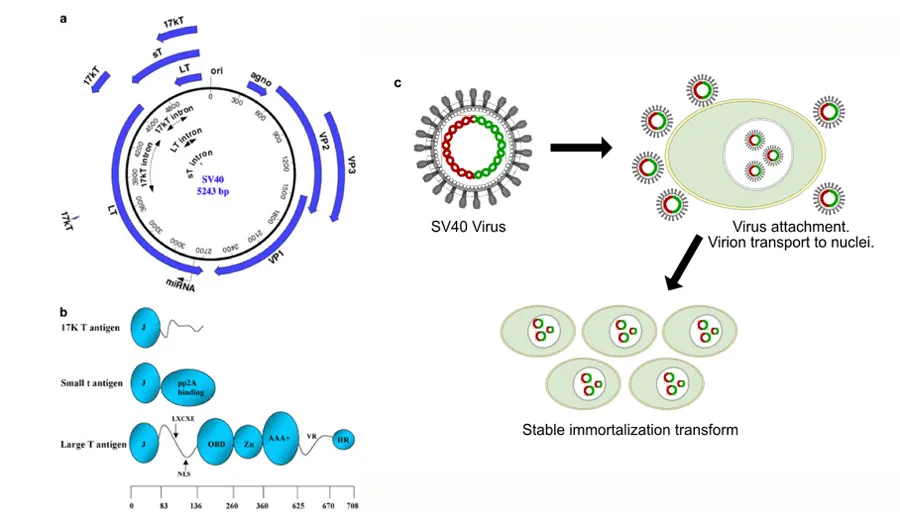
Brief Overview of SV40 Induces Cell Immortalization
Human Telomerase Reverse Transcriptase (hTERT) Protein Expression
Telomerase is a ribonucleoprotein that extends telomerase length in the DNA sequence. The cells can undergo infinite division, abating the senescence process (Figure 2). hTERT is a modern technology that ensures cell lines maintain their physiological properties. The key characteristic of hTERT-transformed cells includes:
- Nonmalignant transformation
- Existence of normal cell cycle controls- p53 and pRB checkpoints
- Anchorage-dependent, contact inhibition
- Normal growth response against mitogens and serum
- Growth factor for proliferation
- Normal karyotype
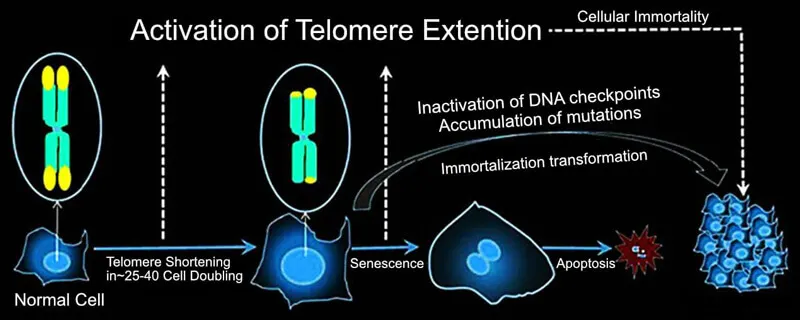
hTERT Induced Cellular Transformation
Choosing the Right Cell Model for Research
The choice of the right cells for research depends on specific requirements. Primary cells are suitable when:
- Conducting a personalized study
- Donor-specific study
- Moving toward in-vivo testing
- Choosing immortalized cell lines is suitable when:
- Planning long-term experiments
- High reproducibility and consistency across the experiments
- High-throughput drug screening
- Development of preclinical data for moving towards advanced study
*NOTE: For long-term, reliable study outcome the combination of both primary and immortalized cell lines study is recommended. Kosheeka, India, is one of the leading research laboratories that supplies primary and immortalized cell lines for research purposes. The cells maintained are in a suitable environment and undergo a stringent quality check before dispatch.
Future Perspectives
- Development of 3D cell culture
- Transformation towards a hybrid model
- Advanced gene editing, use of tools like CRISPR
- Development of personalized medicine
- Development of regenerative research and regenerative medicine
Conclusion
The use of both primary cells vs immortalized cell lines have unique roles in biomedical research application. Immortalized cell lines maintain consistency and reliability in research, while primary cells maintain high biological relevance. The choice needs to be made with careful understanding and choices based on research requirements.
References
- Harper JM. Primary cell culture as a model system for evolutionary molecular physiology. International Journal of Molecular Sciences. 2024 Jul 19;25(14):7905.
- American Type Culture Collection (ATCC). Primary cells. Manassas (VA): ATCC. Available from: https://www.atcc.org/cell-products/primary-cells
- American Type Culture Collection (ATCC). hTERT-immortalized cells. Manassas (VA): ATCC. Available from: ATCC hTERT-immortalized cells
FAQ’s
Q- What are the Immortalized Cell Lines Examples?
The commonly used immortalized cell lines include HEK-293, HeLa, MCF-7, MDA-MB231, CHO, etc.
Q- What are the Key Differences Between Immortalized Cell Lines vs Primary Cells?
Immortalized cell lines are transformed cells that have skipped cellular senescence. Primary cells are isolated directly from the origin, that is tissue of multicellular organism
Q- What are the Main Challenges in Primary Cell Culture?
The establishment of primary cell culture is a sensitive and complex process. They have limited lifespan and result reproducibility is a challenge.