

Introduction
In modern times, regenerative medicine has evolved far beyond traditional therapeutic approaches or organ transplantation. It presents an interdisciplinary approach that involves regeneration of the diseased cells, induction of repair mechanisms, and modulation of cellular signalling.
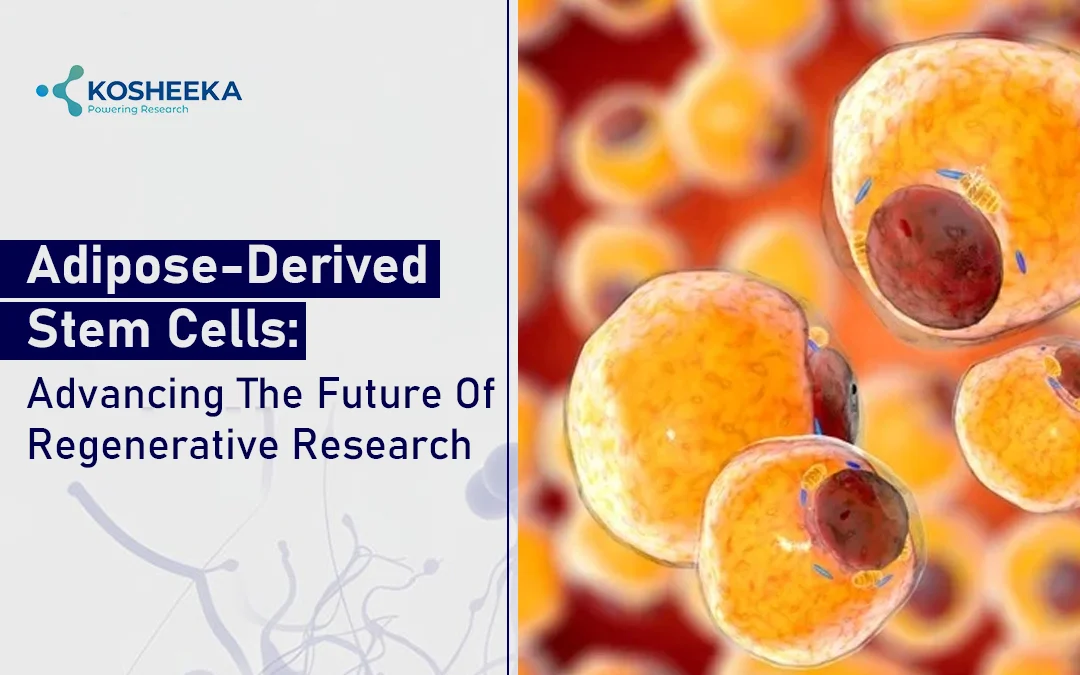
Adipose-Derived Stem Cells (ADSCs) are adult stem cells that are harvested/isolated from the adipose (fat) tissue. The isolation/extraction procedure is a minimally invasive procedure. They offer higher cellular yield and possess strong regenerative and immunomodulatory potential. Human Adipose Derived Mesenchymal Stem Cells (hAD-MSCs) have gained immense clinical research implications due to their ability to reduce inflammation, regenerative signalling, and repair mechanisms. Clinical implications of ADSCs are widespread, including areas like orthopedics, vascular biology, metabolic disorders, neurology, and skin biology.
ADSCs: Regenerative Medicine Research Relevance
What Makes ADSCs Biologically Unique?
- Human adipose-derived stem cells possess multipotent characteristics
- Possess superior proliferative capacity
- Induces active paracrine effect (anti-inflammation, immunomodulation)
- Holds self-renewal ability and maintains cellular plasticity
- Consists of key surface markers and maintains a stemness profile
Why Researchers Prefer Adipose Tissue Sources
- Adipose-derived stem cells are abundant and easier to isolate
- They have high cellular yield (proliferative capability) and longevity
- Reduced donor-site limitations or ethical controversies
- Easy to harvest, minimally invasive and far less painful in comparison with bone-marrow derived cells
Isolation and Laboratory Expansion Strategies
- Stromal vascular fraction (SVF) isolation undergoes a stringent isolation protocol and grows on a pre-coated surface
- Expresses positive markers including CD73+, CD90+, CD105+
- Negative markers includes CD11b, CD34, CD45, and HLA-DR
- Human-derived adipose stem cells have trilineage differentiation, i.e. adipogenic, chondrogenic, and osteogenic
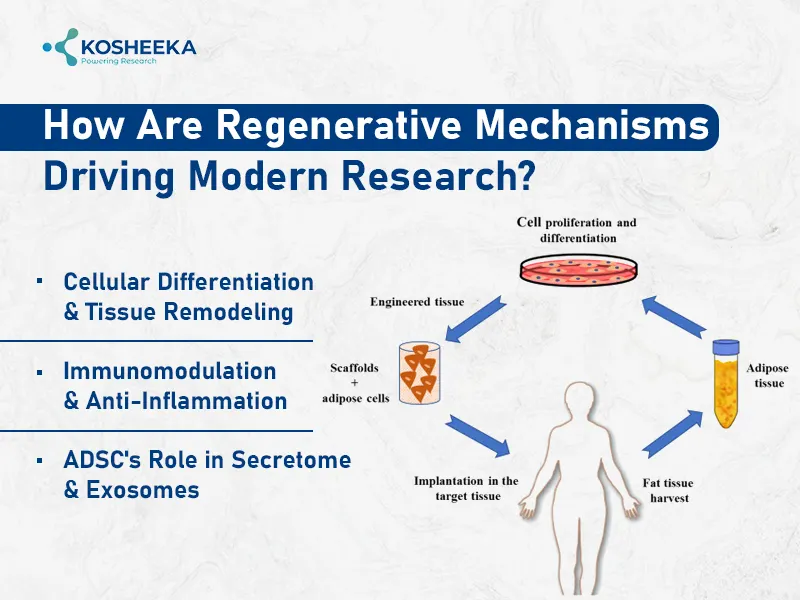
How are Regenerative Mechanisms Driving Modern Research?
Regenerative medicine is extensively exploring human adipose-derived mesenchymal stem cells. The key drivers include:
Cellular Differentiation and Tissue Remodeling
ADSCs demonstrate multipotent capacity that can differentiate into various cell types. Researchers grow various cells using ADSCs, including bone, cartilage, vascular cells, neural cells, beta-islet cells, etc. ADSCs actively contribute to tissue remodeling. It regulates extracellular matrix organization, collagen remodeling, cellular turnover and restoration of the tissue microenvironment.
Immunomodulation and Anti-Inflammation
Human adipose-derived mesenchymal stem cells actively regulate the immune response inside the body. The cells release anti-inflammatory molecules such as IL-10, TGF-β, PGE₂, HGF, etc. These molecules neutralize pro-inflammatory cytokine effects that are abundant at the affected site. It significantly reduces inflammation and creates a supportive microenvironment.
ADSC’s Role in Secretome and Exosomes
Increased regenerative research is exploring the ADSCs’ secretome. ADSCs release extracellular vesicles that are rich sources of bioactive molecules, including proteins, microRNAs, cytokines, and growth factors. The cell-free approach enables researchers to avoid any theoretical risk, such as stem cell tumourigenicity. These components facilitate active cellular communication and activate regenerative signalling. The future looks promising for the development of next-generation cell-free therapeutic platforms.
What are the Key Research Areas Powered by ADSCs?
Human adipose-derived stem cells are widely explored in various disease areas. It includes:
Musculoskeletal and Orthopedic Regeneration
- Regeneration of cartilage and bone, increased synovial fluid
- Development of 3-D scaffold-like advanced silk or hydrogels, which enable cells to remain viable at the injury site and support their structural development
- Use in joint disease research, development of programmed hAD-MSCs seeded into porous metal prosthetics. It aids in implant fixation and combats severe bone loss
Neuroregenerative and Spinal Research
- ADSCs, widely explored for axonal repair and myelination, promote the survival of neurons and oligodendrocytes.
- Releases anti-inflammatory signals, modulates the effect of pro-inflammatory markers, promotes cellular survival and prevents neural scarring
- To bridge spinal cord injury gaps, researchers are exploring the integration of ADSCs with biodegradable scaffolds. It can physically guide nerves and maintain regenerative signalling.
Vascular and Ischemic Tissue Repair
- ADSCs release growth factors like VEGF, FGF, etc., which support new blood vessel formation (Angiogenesis)
- Enables an adequate supply of blood, oxygen and nutrients at the injury site
- In metabolic diseases like diabetes, ADSCs enable regeneration of pancreatic beta islet cells, enabling adequate insulin production (maintaining blood sugar level)
- Enable endothelial repair (heart muscles), promotes impaired circulation
Skin Biology and Wound Healing Research
- ADSCs modulate fibroblast activation and proliferation. It facilitates collagen and elastin remodelling.
- In areas with chronic wounds or scars, ADSCs aid in faster recovery and effective closure of wounds [1]
What are the Emerging Areas in Enhancing ADSC Research?
Researchers are widely exploring ADSCs in advanced regenerative and translational research. The focused areas include:
Developing 3D Bioprinting and Tissue Engineering
Human adipose-derived stem cells are widely explored for biomaterial-integrated regenerative constructs. It can resemble the native structure. Scaffold-based systems enable better functional integration of the cells. It enables better adhesion, proliferation, differentiation, and formation of matrix systems. The use of biodegradable scaffolds and integration of ADSCs are widely optimized, which enables long-term regenerative outcomes.
Organoids and Disease Modeling
ADSC-based organoid and disease modeling systems enable researchers to develop in vitro platforms for disease progression, cellular interactions, or tissue regeneration. The model is 3-D, which closely mimics the human tissue environment. Researchers are widely exploring the development of personalized systems as per individuals’ needs.
AI and Precision Regenerative Medicine
Widely exploited for predictive analytics. The cells are automated and optimized based on the shortcomings and boost the regenerative potentials. The integration of machine learning models can efficiently analyze large-scale biological datasets. It predicts suitable conditions for cell growth. It differentiates proliferation time, therapeutic behaviour or outcome with changing experimental conditions.
Production Standardization & GMP Processing
Currently, there is an immense need for procedure and application standardization in regenerative research. This includes isolation procedure, growth condition/media, and number of cells for application. Following the GMP-optimized condition is essential for ensuring long-term efficacy, safety and tolerability of the cells in the human system.
*Kosheeka, India, is a leading animal cell culture research laboratory that supplies superior quality stem cells for research purposes. For regenerative research, the cells are sourced from adequate sources and grown in a highly controlled environment.
What are the Translational Challenges & Future Directions?
The core challenges include:
- Standardization of the procedure, quality control, result reproducibility concerns, and standardization of GMP conditions
- Maintain genetic stability, therapeutic consistency, and translate laboratory research into clinical application
- Development of regenerative therapies, development of cell-free regenerative molecules for therapeutic use
- Developing next-generation translational research pathways
- Clinicians and researchers are striving to develop large-scale clinical trials with ADSCs for chronic diseases
Conclusion
ADSCs have been established as the cornerstone of next-generation regenerative medicine against chronic diseases. Human Adipose-Derived Stem Cells are explored widely for their abundance, ease of isolation, multipotent nature, and regenerative potential.
References
- Qin Y, Ge G, Yang P, Wang L, Qiao Y, Pan G, Yang H, Bai J, Cui W, Geng D. An update on adipose‐derived stem cells for regenerative medicine: where challenge meets opportunity. Advanced Science. 2023 Jul;10(20):2207334.
FAQ’s
Q- Why are ADSCs Widely Used in Regenerative Research?
Adipose-derived stem cells have a wide range of applications in regenerative medicine research. The cells are available in abundance, they are easily accessible, release regenerative signalling properties, and can differentiate into different cell lineages.
Q- What are hAD-MSCs?
Human Adipose-Derived Mesenchymal Stem Cells are multipotent cells that are isolated from the adipose (fat) tissues. These cells can differentiate into different cell lineages (adipogenic, chondrogenic, and osteogenic). They have a wide range of applications in various chronic diseases. They induce cellular regeneration and induce paracrine signalling.
Q- What are the Upcoming Technologies Shaping the Future of ADSCs Research?
Researchers are widely exploring ADSCs for innovative technologies. It includes 3-D bioprinting, AI-assisted analytics, organoid models, or the development of cell-free platforms (exosomes or secretome).



The focus on adipose-derived stem cells highlights an important area of regenerative research, especially because adipose tissue offers a relatively accessible source for studying repair and tissue regeneration. One aspect that would be interesting to explore further is how researchers are addressing challenges like donor variability and maintaining consistent cell behavior across studies.
Really informative article! I’ve been using Whisper AI for transcribing medical consultations and health podcasts — having accurate text transcripts makes it much easier to review key points.
Glad that you liked the information. For weekly updates visit us: https://www.kosheeka.com/
The point about researchers preferring adipose tissue sources over bone marrow for yield and accessibility is well made — the isolation process is so much less invasive for donors too. Would be interested in how ADSC differentiation consistency compares across collection sites like abdominal versus thigh fat.
That’s an excellent observation. While adipose tissue offers higher cell yield and easier collection, differentiation consistency can vary by harvest site, making standardized isolation and characterization protocols essential. For any animal cells related to research need, contact us via WhatsApp or call us at +91-9654321400, or mail us on info@advancells.com for more information. We’re here to support you every step of the way.
Adipose-derived stem cells are such a promising area — the accessibility compared to bone marrow harvesting makes the research a lot more scalable.
Absolutely. Isolating stem cells from adipose tissue is lot more easier in comparison with bone marrow. While umbilical cord derived stem cells are youthful, highly proliferative and have more powerful immunomodulatory properties. For more information contact us via WhatsApp or call us at +91-9654321400, or mail us on info@advancells.com for more information. We’re here to support you every step of the way.
Solid overview of where adipose-derived stem cell research currently stands. The section on isolation yield compared to bone marrow-derived cells was particularly helpful for understanding why ADSCs are gaining traction in regenerative studies.
That’s correct, isolating adipose derived stem cells are more feasible due to their abundance, ease in isolation procedure, and lesser complications. For any animal cell culture related requirement, For more information contact us via WhatsApp or call us at +91-9654321400, or mail us on info@advancells.com for more information. We’re here to support you every step of the way.
Excellent overview of adipose-derived stem cells — the immunomodulatory properties section is especially well-explained. The fact that fat tissue, once considered metabolically passive, has become such a valuable research resource is a fascinating scientific reversal. The applications in wound healing and orthopedic repair look particularly promising based on current clinical trial data.
Absolutely. Kosheeka thrive to bring latest research development to our reader. For any cell culture associated needs, Visit: https://www.kosheeka.com/
This is a genuinely useful technical breakdown — the standalone versus networked capability distinction is something that procurement teams often miss until they’re already mid-deployment. Clear and practical.
Thankyou. For any animal cell culture related needs, For more information contact us via WhatsApp or call us at +91-9654321400, or mail us on info@advancells.com for more information. We’re here to support you every step of the way.
Very informative article — the evidence-based approach you’ve taken is refreshing. Clear visual explanations can make complex medical topics much more accessible for patients and the general public.
Thankyou for your appreciation. For more information contact us via WhatsApp or call us at +91-9654321400, or mail us on info@advancells.com for more information. We’re here to support you every step of the way.
Very well-researched article. The scientific context helps make the information more trustworthy than what you typically find on health blogs.
Thank you for your valuable time. Our goal at Kosheeka is to provide authentic animal cells and present complex scientific concepts in a simple, reader-friendly way. For more information: contact us via WhatsApp or call us at +91-9654321400, or mail us on info@advancells.com for more information. We’re here to support you every step of the way.
Informative article on adipose-derived stem cells and their regenerative applications. The potential for autologous cell therapies is exciting from both a scientific and clinical perspective. Well-researched overview.
Thankyou for appreciation, For more information, Contact: us via WhatsApp or call us at +91-9654321400, or mail us on info@advancells.com for more information. We’re here to support you every step of the way.
Well-researched piece — the science behind microbiome-safe formulations is more nuanced than most product marketing suggests. The ingredient list analysis is genuinely useful. Sharing this with a few people who’ve been asking about cleaner skincare options.
Glad that you found our article helpful. For detailed information, Contact: us via WhatsApp or call us at +91-9654321400, or mail us on info@advancells.com for more information. We’re here to support you every step of the way.
Excellent overview of adipose-derived stem cells and their role in regenerative research. The relatively non-invasive collection procedure compared to bone marrow makes ADSCs particularly attractive for clinical applications. Their multi-lineage differentiation potential makes them genuinely versatile research tools.
Thankyou for appreciation, For detailed information, Contact: us via WhatsApp or call us at +91-9654321400, or mail us on info@advancells.com for more information. We’re here to support you every step of the way.
Informative overview of adipose-derived stem cell therapies — the explanation of why fat tissue is a particularly accessible and abundant source of mesenchymal stem cells helps demystify why this approach has gained traction in regenerative medicine research. The distinction between autologous and allogeneic applications clarifies the key regulatory and compatibility considerations.
Glad that you liked it. Get in touch with us for a comprehensive portfolio of primary cells, cell lines, microsomes, S9 fractions, and more, For more information contact us via WhatsApp or call us at +91-9654321400, or mail us on info@advancells.com for more information. We’re here to support you every step of the way.
Excellent overview of the adipose-derived MSC landscape — the scalability advantage over bone-marrow-derived cells is often underappreciated by non-specialists. The section on paracrine signalling really clarifies why these cells punch above their weight in regenerative protocols.
Thankyou for your appreciation. Get in touch with us for any animal cell culture related requirement. For more information contact us via WhatsApp or call us at +91-9654321400, or mail us on info@advancells.com for more information. We’re here to support you every step of the way.
The accessibility of adipose-derived stem cells compared to bone marrow sources is really a key factor in scaling regenerative medicine research — the relatively non-invasive collection procedure opens up donor populations that simply weren’t viable before. The paracrine signaling mechanisms you’ve described for tissue repair are where much of the therapeutic potential seems to be concentrated. Scientific visualization tools have become valuable for communicating these cellular processes to non-specialist audiences.
Absolutely. Get in touch with us for cell culture requirements, For more information contact us via WhatsApp or call us at +91-9654321400, or mail us on info@advancells.com for more information. We’re here to support you every step of the way.