

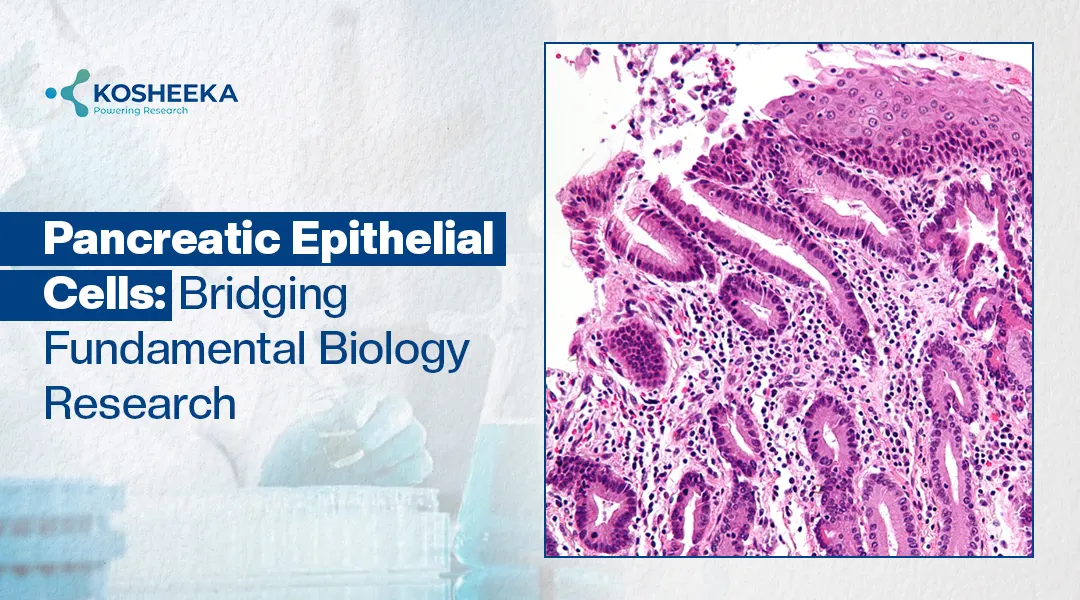
Pancreatic epithelial cells (PECs) are a vital component of glandular epithelium and have an exclusive role in digestive function. The cells are organised into two subtypes: exocrine and endocrine tissues. Exocrine tissue forms the majority of the pancreas. They are responsible for the secretion of pancreatic digestive enzymes. At the same time, the endocrine glands are structured as small islands that secrete crucial hormones. These cells are valuable tools in biomedical research investigations such as cystic fibrosis, cancer plasticity, EMT transition, early disease detection biomarkers, etc.
The current article explores the distinct functions, subtypes, and structure of the Pancreatic Epithelial Cells and unveils their role in biomedical and regenerative research.
Types of PECs
Human pancreatic epithelial cells form specialized cellular networks that support exocrine function. The cells line the ducts and secretory units of the pancreas and facilitate the production, transportation and regulation of the digestive enzymes. Based on the morphological characteristics and function, the cell types include:
Pancreatic Ductal Epithelial Cells
- Lines the pancreatic ductal system, including small intercalated ducts, larger intralobular, interlobular and major pancreatic ducts
- Pancreatic ductal epithelial cells are cuboidal in shape and form a columnar structure when the size increases.
- Cells are connected in tight junctions and form selective barriers, preserving tissue integrity.
- Facilitate the movement of water, ions, and other molecules
- Cells form an interface between enzyme-producing acinar cells and the small intestine
- The cells modify and transport pancreatic fluid before they reach duodenum
- Secretes bicarbonate-rich fluid, which neutralizes the acidic gastric environment and maintains the pH
- Forms specialized ion channels and transport proteins, including cystic fibrosis transmembrane conductance regulator (CFTR), bicarbonate transporters, and chloride channels
Acinar-Associated Epithelial Components
- Consists of enzyme-secreting units of the exocrine pancreas
- Morphologically, the cells are organised into grape-like clusters (acini)
- Highly specialized cells produce enzymes, including amylase, proteases, lipase, and nucleases
- Acinar cells are enriched in rough endoplasmic reticulum, Golgi complexes, and secretory granules, and possess a high capacity for protein synthesis
- Coordinate secretary activities, including maintaining efficient digestion and nutrient absorption
Pancreatic duct epithelial cells and acinar cells have distinct characteristics and yet coordinated functions. Acinar cells synthesize and secrete enzymes, while Pancreatic Ductal Epithelial Cells modify the secretion via the addition of bicarbonate and water. They maintain enzyme stability and direct it to reach the enzymes. Paracrine signaling pathways, growth factors, and inflammatory mediators mediate the coordination. In biomedical research, in-vitro use of these pancreatic epithelial cells enables researchers to unveil the healthy function, altered condition, disease modeling, develop diagnostic biomarkers and identify therapeutic molecules.
What Are The Functions of PECs?
Normal Pancreatic Epithelial Cells Have Functions Including:
- Synthesis, secretion and regulation of the pancreatic enzymes
- Bicarbonate production and maintaining pH
- Guided transportation of the digestive enzymes
- Maintains tissue integrity, coordinates the cellular network and immune response
What Is The Importance of PECs In Biomedical Research?
- Pancreatic epithelial cells act as gatekeepers of pancreatic health
- Maintains tissue homeostasis
- Influences and regulates digestive and metabolic functions
- Coordinate the tissue repair mechanism following any injury
- Disease modelling such as pancreatic cancer (PDAC), 3D organoid system, drug screening, targeted therapy, regenerative medicine, etc.
Molecular Markers and Laboratory Identification
Human Pancreatic epithelial Cells Authenticity is Marked By Biomarker Availability. The Markers Include:
- EpCAM (CD326), a classic marker, regulates with circulating PECs
- Cytokeratins (CK7 and CK19), sensitive markers, expressed in normal pancreatic epithelial cells, overexpressed in PDAC
- Sox9, Ngn3, Pdx1, Hnf6, progenitor or ductal marker
- Pan-keratin, epithelial carcinoma
- CA 19-9, pancreatic cancer marker
- AUC1 and MUC4, low in normal pancreatic epithelial cells, are overexpressed in PDAC
- KRAS mutation, >90% in pancreatic adenocarcinoma
What Are The Applications Of PECs In Biomedical Research?
Human pancreatic epithelial cells have a wide range of research applications, including biomedical and regenerative research. The application includes:
Disease Pathogenesis
- Normal pancreatic epithelial cells maintain the structural and functional integrity of the pancreatic ductal system
- Diseased states like acute or chronic pancreatitis show activation of multiple inflammatory pathways (NF-κB, JAK-STAT, and TGF-β)
- Activates pro-inflammatory cytokines and chemokines
- Involved in fibrosis, acts as a hallmark of pancreatic dysfunction
- Genetic alterations (KRAS, TP53, CDKN2A, and SMAD4 mutations) transforms normal ductal epithelium into lesion
Experimental Models
- Drug screening, drug discovery, targeted therapy and preclinical testing
- Safety and efficacy of novel drug-like molecules
- Monitor changes like cell viability, inflammatory response, epithelial integrity and gene expression on exposure to the drug
- Used for the development of diagnostic and prognostic markers for the identification of diseased states
- Advanced research application including transcriptomics, metabolomics and proteomics
- Primary cells isolated from a patient’s tissue sample aid in the development of precision medicine
- Patient-specific epithelial cells for unveiling the genetic and molecular characteristics of the disease
Stem Cell Research
- Opened up new avenues of research in developmental biology and regenerative medicine
- Human stem cells differentiate into pancreatic epithelial lineages
- The transformation is mediated by a signalling pathway that mimics pancreatic organogenesis
- Stem cell-derived epithelial cells enable epithelial cell differentiation, regeneration, repair and anti-inflammation
- Researchers considers transcription factors and signaling networks (SOX9, Notch, PDX1, Wnt, Hedgehog), regulates epithelial specification and maturation
- Cellular plasticity determination, understanding dedifferentiation, proliferation and redifferentiation mechanisms enables researchers to understand the repair mechanisms and regeneration of pancreatic damage
Organoid Technology and Tissue Engineering
- 3D pancreatic organoid model development
- Closely mimics the architecture, arrangements, and physiological behaviour of the native pancreatic tissue
- Organoid culture preserves epithelial polarity, cellular diversity, and upholds complex cell-to-cell communication
- In tissue engineering, pancreatic organoid culture combines biomaterials, extracellular matrix scaffolds and biofabrication technology
- Valuable platform for studying tissue regeneration, cellular interaction, proliferation, vascularization, etc.
Regenerative Medicine
- Pancreatic epithelial cells are widely used in regenerative medicine research
- Stem cells differentiate into PECs that coordinate responses related to proliferation, migration, communication and immune response
- Multiple signaling pathways, such as Notch, Wnt/β-catenin, TGF-β, Hippo-YAP, and EGFR signaling, indicate the regulation of regenerative processes
- Preclinical studies demonstrated the ability of PECs to exhibit adaptability to epithelial plasticity, which promotes regeneration of damaged pancreatic tissues
- However, in regenerative research, certain challenges exist. Examples: stable epithelial differentiation, long-term functional integration, preventing abnormal cellular transformation, maintaining tissue-specific organization, etc.
- With growing research, pancreatic regeneration possibilities are greatly evolving.
Future Therapeutic Applications
- Stem cell-derived pancreatic epithelial cells have regenerative potential. The researchers focus on activating the repair mechanism and restoring normal cellular function
- Advanced 3-D bioprinting and tissue engineering for regenerative potential
- Development of precision medicine and targeted therapy based on the specific needs of the patient
- Pancreatic cell models enable biomarker discovery, targeted drug development and preclinical evaluation of novel therapy
- Technologies like CRISPR-Cas9 are investigated (gene-editing therapeutic potential)
- Preclinical data development for transforming regenerative research into clinical studies for pancreatic disorders
Challenges And Future Directions
- Pancreatic epithelial cells have limited regenerative capability
- Generating and expanding functional Human Pancreatic Epithelial Cells and maintaining their phenotype is complex
- Successful regeneration requires a complex microenvironment
- Ensuring long-term safety and efficacy is challenging
- Quality of the cells used in in-vitro research influences the outcome. Researchers must procure superior-quality primary cells, stem cells, or cell lines for optimal outcomes
*Kosheeka, India, is a leading research laboratory that supplies primary and secondary cells for research purposes
Conclusion
PECs are a crucial element in biomedical and pancreatic regenerative research. The cells have an established role in enzyme production, secretion, bicarbonate release and epithelial barrier maintenance. They are key players in understanding pathogenesis. Increases in biomedical research advancement are evolving their role in precision medicine, diagnostics, regenerative medicine and personalized treatment.
FAQ’s
Q- What Are Pancreatic Duct Epithelial Cells?
Pancreatic duct epithelial cells direct the enzymes or digestive juices to the duodenum. These cells are a crucial part of the exocrine system. They secrete bicarbonate ions, neutralize stomach acid and maintain pH in the duodenum.
Q- How Are Pancreatic Epithelial Cells Used In Research?
Researchers use human pancreatic epithelial cell in various biomedical research. Both primary cells (isolated from human tissue) and secondary cells (cell lines) are used for disease state research (fibrosis, cancer, pancreatitis, inflammation).