
Drug metabolism is the key determinant of drug candidate safety. The first step to drug discovery is understanding the drug candidate’s transformation mechanism. Inside the body, the drug undergoes a cascade of reactions. They produce metabolites, show half-life, and reach excretion routes. Researchers develop these insights during preclinical drug development, tested on reliable in vitro models. This enables identification of metabolic liabilities and guidance of compound optimization.
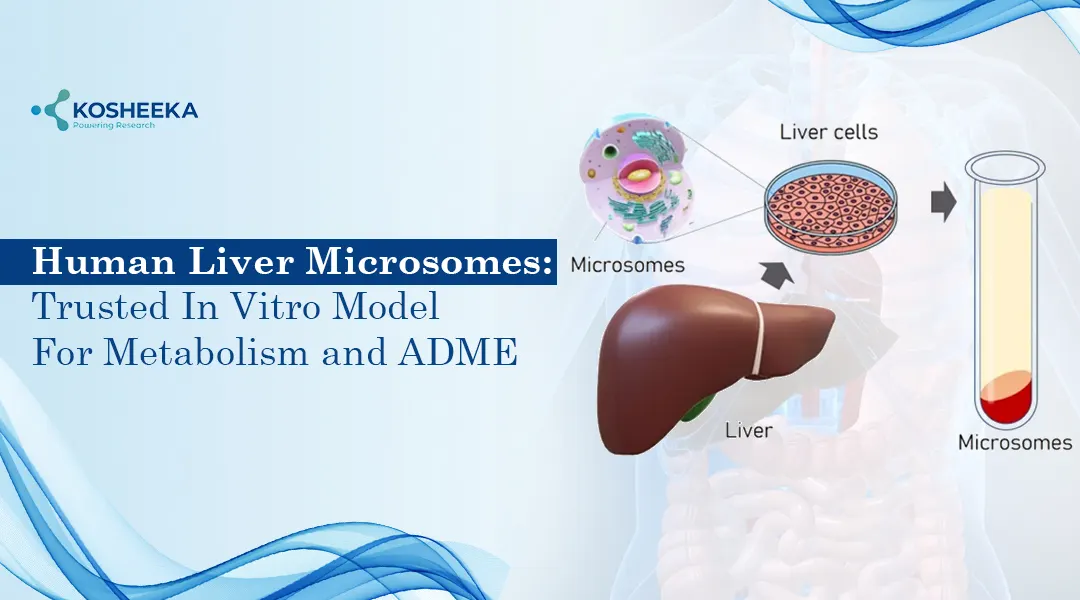
Human liver microsomes (HLM) have become an extensively reliable tool for investigating drug metabolism. The molecules are subcellular fractions from the human liver endoplasmic reticulum (ER). HLM have intact drug-metabolising enzymes involved in Phase I and Phase II reaction. The current article exclusively explores the key function of Human Liver Microsomes as a comprehensive in vitro research model in drug metabolism studies.
Understanding Human Liver Microsomes (HLM)
What are Liver Microsomes?
Liver microsomes are tiny bilipid vesicles. The molecules are procured from hepatocyte endoplasmic reticulum. Liver tissue homogenised in a suitable buffer is subjected to differential centrifugation. This enable microsomes isolation. These molecules are enriched with all Phase I and Phase II enzymes that play a crucial part in drug metabolism. This includes:
- Phase I: Cytochrome P450 isomers (CYP3A4, CYP2D6)
- Phase II: Glutathione S-transferase (GST), UDP-glucuronosyltransferases (UGTs), Sulfotransferases (SULTs)
What Makes Liver Microsomes a Popular Research Choice?
Drug metabolism is a key component of drug discovery as it displays drug safety, dosing, metabolism, clearance route, and possible toxicity. Traditionally, in vivo models served as the gold standard model to gain whole-body pharmacokinetics information. However, this is resource-intensive, time-consuming, and influenced by physiological complexity. Predictive in vitro metabolism model resolves such complexities.. Human liver microsomes at the current time serve as the cornerstone of Absorption, Distribution, Metabolism, and Excretion (ADME) and toxicity research [1].
What are the Characteristics of Human Liver Microsomes (HLM)?
- Origin: Human liver microsomes are derived from smooth and rough ER. These are artificial laboratory artifacts that are produced with differential centrifugation
- Structure: Composed of f phospholipid bilayer (49% phosphatidylcholine, 31% phosphatidylethanolamine, fractions of sphingomyelin, phosphatidylinositol, phosphatidylserine)
- Fluidity: Composed of a low cholesterol-to-phospholipid ratio, facilitating high fluidity; embedded enzymes change and adjust their function
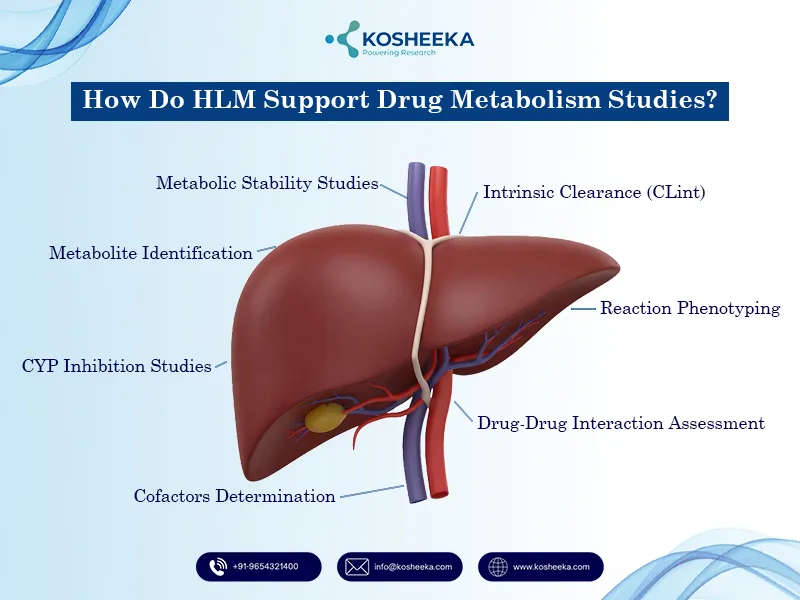
How Do Human Liver Microsomes (HLM) Support Drug Metabolism Studies?
Human liver microsomes retain the metabolic machinery of the liver’s ER. It allows investigation of how drug candidates transform inside the body and are excreted. The core assessment involves:
Metabolic Stability Studies
- Estimation of how long drug candidates persist in the body
- Identification of compounds that can undergo rapid metabolic degradation
- Comparison of structural analogues of parent compounds
- Drug candidates are selected based on their pharmacokinetic properties
Intrinsic Clearance (CLint)
- Key pharmacokinetic parameter for determining parent drug depletion
- Prediction of hepatic clearance route
- Comparison of drug candidate metabolic efficiency
- Estimation of appropriate drug dosing strategies
Metabolite Identification
- LC-MS/MS used as analytical platform for Human Liver Microsomes Assay
- Detection of both major and minor metabolites
- Elucidation of the metabolic pathways
- Site for biotransformation identification
Reaction Phenotyping
- Enzyme identification for compound metabolism
- Identification of CYP isoforms are involved in drug candidate metabolism
- Relative involvement of the distinct enzymes
- Determination of metabolic pathways and likelihood of genetic polymorphism
CYP Inhibition Studies
- CYP450 enzymes metabolise the maximum marketed drugs
- Identification of reversible or time-dependent CYP inhibition
- IC₅₀ or Ki determination
- Assessing the risk of enzyme-mediated interactions
- Compound prioritization based on lower interaction potential
Drug-Drug Interaction Assessment
- Inhibition of the other drug metabolism
- Antagonist effect on same metabolic enzyme
- Altered metabolite formation
Cofactors Determination
- Human liver microsomes assay involves specific cofactors
- NADPH is important in Phase I oxidative metabolism
- UDPGA is involved in Phase II metabolism
- UGTs catalyse glucuronidation reaction
- PAPS support the sulfation reaction
- GSH and Acetyl-CoA are involved in the glutathione conjugation pathway or acetylation
How Does Human Liver Microsomes (HLM) Transform Experimental Design to Data Interpretation?
Human Liver Microsomes Undergo a Series of Steps Including:
- Assay Selection: Liver microsome assay selection depends on the experimental design. Various assays include metabolite stability assay, CLint, MetID, CYP inhibition assay, TDI, Phase II metabolism, etc. Performing distinct assays enables researchers to gain distinct insight into the drug metabolism process
- Experimental Design: Development of experimental design and its optimisation plays a vital role in research outcome authenticity. Researchers develop a comprehensive experimental design based on the research objective. This involves determining microsomal protein concentration, drug substrate, incubation time, temperature, pH, etc. Experimental design optimization is crucial in obtaining reliable and reproducible results.
- Incubation: Key conditions include substrate concentration relative to enzyme affinity, preventing substrate depletion, incubation time, cofactor concentration, etc.
- Quality Control: Robust quality control of the experimental set is crucial to maintain authenticity and reliability. Monitoring batch-to-batch consistency, CYP activity certification, protein concentration, maintenance of storage and handling conditions
- Data Interpretation: Disappearance of the parent compound rate with time, metabolite production, its bioavailability, enzymatic activities, and excretion route
- Analytical Platforms: Sensitive platforms including LC-MS/MS, HRMS, HPLC, high-throughput LC-MS for large-scale ADMET profiling, etc. [2]
*NOTE: Human liver microsome use from experimental setup to data interpretation consistency depends on microsome quality. Kosheeka, India is a leading supplier of cell culture products including liver microsomes for research purposes. The available products are isolated from different sources including human, mouse, rat, and beagle dog.
What are the Factors Influencing Human Liver Microsomes (HLM) Studies?
The Key Factors that Influence HLM Use in an in Vitro Setting Include:
- Donor variability
- Source variability
- Pooled microsomes vs individual microsomes
- Protein concentration
- Incubation time
- Availability of the cofactors
- Storage condition
- Enzyme activity characterization
Conclusion
Human liver microsomes are currently an indispensable part of in vitro drug metabolism research. It is crucial to choose an adequate model based on the experimental objectives. This model enables determination of enzymatic activities and metabolic pathways involved in drug candidate metabolism.
References
- Gajula SN, Vora SA, Dikundwar AG, Sonti R. In vitro drug metabolism studies using human liver microsomes. InDosage Forms-Innovation and Future Perspectives 2022 Oct 20. IntechOpen.
- Attwa MW, Abdelhameed AS, Kadi AA. An ultra-fast validated green UPLC-MS/MS method for the quantification of osimertinib in human liver microsomes: Screening for ADME parameters and in vitro metabolic stability. Acta Chromatographica. 2025 Oct 15;37(4):515-30.
FAQ’s
Q- What are the use of HLM?
Human liver microsomes are an efficient in vitro experimental model. Researchers develop preclinical data by incubating HLM and potential drug candidates. The experiment enables metabolite identification, CYP450 activity determination, MDMET profiling, etc.
Q- How are HLM different from primary hepatocytes?
Primary hepatocytes are isolated directly from the liver tissue. These are whole cells. However, liver microsomes are the artificial tiny vesicles artifacts. These are obtained via differential centrifugation of the liver homogenates. These molecules consist of intact membrane-bound drug-metabolising enzymes.
Q- What enzymes are present in HLM?
Human liver microsomes consist of membrane-associated enzymes including CYP450 isoforms, FMOs, UGTs, and epoxide hydrolases. HLM have intact enzymatic activity, which enables them to participate actively in drug biotransformation and other xenobiotic processes.
Q- How do liver microsomes contribute to drug discovery?
Liver microsomes serve as reliable in vitro models that enable researchers to understand the fate of drugs in the liver. This allows researchers to understand drug metabolism pathways, liabilities, optimization of the lead compound, unveil drug-drug interactions, and identify possible toxicity.