
The quality of liver research not only depends on the question that is investigated, but also on how efficiently the research model reflects human biology. The reliability of the experiments investigating drug metabolism, hepatotoxicity, metabolic disorders, or liver repair mechanisms is crucial. For researchers, adapting an efficient hepatocyte model plays a pivotal role across drug discovery, toxicology research and regenerative studies.
Hepatocytes make up the majority of the liver tissue. Primary human hepatocyte cells retain liver-specific characteristics in vitro. Hepatocyte culture serves as a reliable platform for researchers to investigate drug candidate metabolism, enzyme and transport activities, drug responses, potential cellular injuries, etc. Simultaneously, hepatocytes are the center of liver regeneration, where insights related to responses to liver injury, proliferative signals and cellular environmental changes are gained. The current article unveils various aspects of Primary Human Hepatocytes, including their importance as research models involving metabolic investigation and regenerative biology.
Human Hepatocytes: Structure, Function & Research Significance
Structure
- Human hepatocytes make up 60-80% of the liver’s cellular mass
- Possess distinct cellular architecture: polygonal-shaped cells; on maturation, become bi- or trinucleated
- Consist of a higher level of cell organelle organisation, including mitochondria, endoplasmic reticulum (ER), Golgi apparatus, peroxisomes. This enables a distinct level of metabolic function
- Hepatocytes are closely arranged in liver lobules; they share close contact with sinusoidal blood vessels, bile canaliculi and other liver cells
Function
- Active involvement in metabolism and systemic metabolic homeostasis. They regulate carbohydrate, lipid, or protein metabolism
- Biotransformation of xenobiotic compounds via Phase I and Phase II metabolic pathways
- Protein synthesis, including plasma proteins, albumin, etc.
- Bile formation, bilirubin elimination, etc.
- Detoxification and elimination of metabolic end products or toxins
- Response to liver injury, cellular regeneration, tissue repair
Research Significance
- Investigating drug metabolism (metabolic stability, biotransformation, and enzymatic activities)
- Drug-induced liver injury and hepatotoxic responses
- Investigating metabolic disorders, liver diseases and cellular dysfunction mechanisms
- Primary human hepatocytes are a reliable in vitro model that displays physiological relevance to liver function
Understanding the Liver’s Metabolic Machinery
Human hepatocytes are the primary site of metabolic processes. Hepatocyte metabolism involves the metabolism of lipids, carbohydrates, xenobiotic compounds, proteins, hormones, etc. Primary Hepatocyte Culture enables detailed understanding of how compounds are absorbed, metabolised, transported and eliminated from the body. The key features of hepatocyte metabolism include:
Phase I and Phase II Metabolism
Inside the human body, any drug or xenobiotic candidate undergoes an interconnected metabolic process
Phase I Metabolism
- Oxidation, reduction and hydrolysis of the compounds; polarization of the metabolites
- Cytochrome P450 (CYP450) isoforms (CYP3A4, CYP2D6), flavin-containing monooxygenases (FMOs) modify the chemical structure of the metabolites [1]
Phase II Metabolism
- Facilitates conjugation reactions, attaching molecules to facilitate water solubility
- UDP-glucuronosyltransferases (UGTs), sulfotransferases (SULTs), and glutathione S-transferases (GSTs) are core enzymes
- Attaches glucuronic acid, glutathione or sulfate to metabolites, supports elimination [2]
Sequential Metabolism
- Xenobiotic compounds may undergo both Phase I and Phase II reactions or undertake alternative pathways
- The reaction depends on the chemical characteristics or enzymes expressed by the hepatocytes [1.,2]
*NOTE: The studies of these pathways enable researchers to unveil drug candidate biotransformation, metabolite formation, metabolic stability and its potential toxicity
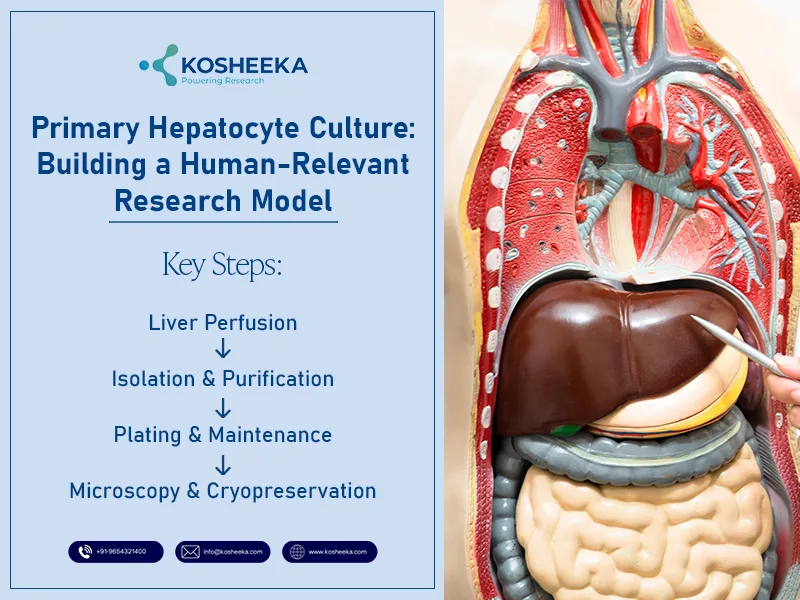
Primary Hepatocyte Culture: Building a Human-Relevant Research Model
Primary hepatocyte culture cells are harvested directly from human liver tissues. These primary hepatocyte cells are used fresh or cryopreserved for in vitro investigation. They serve as vital tools in enzyme induction, drug screening, toxicity, transporter efflux, drug-drug interaction, or disease modeling. The key steps of primary hepatocyte culture include:
Liver Perfusion
- Collect the liver tissue and perfuse in a calcium-free perfusion buffer. This step flushes out all blood clots or impurities
- Transfer liver tissue homogenates into a buffer containing enzymes (collagenase/trypsin). This digests away the extracellular matrix, softens liver capsules and expands it
Isolation and Purification
- Transfer homogenized tissue to a Petri dish with complete medium
- Gently tease the digested tissues
- Filter the cell suspension by passing through a 70 – 100 µm nylon mesh strainer. This removes cellular debris
- Low-speed centrifugation to pellet the viable cells (Percoll gradient for high purity)
Plating and Maintenance
- Resuspend cell pellet in complete medium. Count viable cells with the help of a haemocytometer
- Seed an adequate number of cells in a pre-coated culture plate or flask
- Incubate at controlled environment (CO2 incubator with 5% CO2, 37°C, and relative humidity)
Microscopy and Cryopreservation
- Observe culture plate/flask under microscope at regular time intervals
- On reaching 80-85% confluency, use cells for experimental purposes
- The cells are cryopreserved and stored in liquid nitrogen for future use
*NOTE: The isolation of primary human hepatocyte cells before experimental planning is hectic. Kosheeka, India is a leading supplier of well-characterized primary cells, including human hepatocytes for research purposes. The cells are sourced, isolated and stored in a GMP-standard laboratory. The cells are shipped with utmost care and maintain high viability.
How Liver Cells Support Regenerative Research?
Primary human hepatocytes serve as a definitive model in hepatocyte regeneration research. Research investigates key molecular processes involved in regeneration and repair mechanisms. Application involves:
- Investigation of Liver’s Regenerative Capacity: The liver is an exclusive organ with self-regenerative capacity. Researchers investigate these regenerative responses to regulate injury
- Hepatocyte Proliferation: Primary human hepatocytes are used to understand changes in cell proliferation, viability and functional recovery post-injury
- Regenerative Signalling: Uncover the signaling pathway involved in hepatocyte survival, proliferation, differentiation, or tissue remodeling. These mechanisms enable researchers to understand the molecular mechanisms involved in liver repair.
- Hepatic Microenvironment: Hepatocyte interaction with surrounding cells and signalling. This includes interaction with other liver cells, ECM, inflammatory signals, growth factors, etc.
- Translational Research: primary human hepatocytes retain physiological and functional characteristics of liver-specific function. They bridge experimental findings with clinical questions.
- Regenerative Research: Preclinical investigation related to regenerative medicine. For example, use of stem cells for liver-associated diseases.
Choosing the Right Hepatocyte Model for Research
The Use of Adequate Research Models Plays a Vital Role in Acquiring Reliable Data. The Key Model Involves:
Table 1: Comparison between Primary Human Hepatocytes vs. Hepatic Cell Line
| Features | Primary Human Hepatocytes | Hepatic Cell Line |
| Function | Retains complete physiological characteristics (drug metabolism, transporter activities, enzymatic induction) | Indefinite proliferation, high genetic homogeneity, cost-effective, reproducible |
| Application | ADME, high-value toxicity screening, drug-drug interaction | High-throughput techniques, large scale drug candidate screening, preliminary data generation |
| Limitations | Finite lifespan (limited passage no.), donor variability, complex in culture | Might reflect altered energy metabolism, reduced enzymatic expression (CYP450) |
Table 2: Comparison between Fresh vs. Cryopreserved Primary Hepatocytes
| Features | Fresh Hepatocytes | Cryopreserved Primary Hepatocytes |
| Function | Maximum viability, high physiological relevance | Allow experimentation planning flexibility |
| Application | Time sensitive metabolic changes, acute suspension assay | Enzymatic assay, possibility to use identical lots |
| Limitations | Immediate use, perishable | Minor reduction in cell viability post-thaw |
Conclusion
Primary human hepatocytes serve as a reliable model in studying liver disease, drug metabolism, and regenerative studies. Researchers must set clear research objectives to choose an adequate in vitro research model. This enables researchers to generate reliable and physiologically relevant findings. With the advancement of liver research, well-characterized hepatocyte cells support human-relevant studies.
References
- Guo J, Zhu X, Badawy S, Ihsan A, Liu Z, Xie C, Wang X. Metabolism and mechanism of human cytochrome P450 enzyme 1A2. Current Drug Metabolism. 2021 Jan 1;22(1):40-9.
- Lampou VK, Poller B, Huth F, Fischer A, Kullak-Ublick GA, Arand M, Schadt HS, Camenisch G. Novel insights into bile acid detoxification via CYP, UGT and SULT enzymes. Toxicology in Vitro. 2023 Mar 1;87:105533.
FAQ’s
Q- What are Primary Human Hepatocytes?
Primary human hepatocytes are directly isolated from human liver tissue. They serve as an effective in vitro research model for hepatocyte metabolism, liver disease, hepatotoxicity, drug discovery and regenerative medicine research.
Q- Is Primary Hepatocyte Culture Important for Liver Research?
Yes, primary hepatocyte culture have pivotal role in liver research. They share physiological relevance with the human liver. In a controlled laboratory environment, these cells enable researchers to investigate drug metabolism, toxicity, excretion routes, and cellular responses.
Q- What is the Difference Between Primary Human Hepatocytes vs. Hepatic Cell Lines?
Primary human hepatocytes are directly isolated from human liver tissue (fresh or cryopreserved). In contrast, hepatic cell lines are carefully engineered or modified from primary hepatocytes. They have longer life spans.