
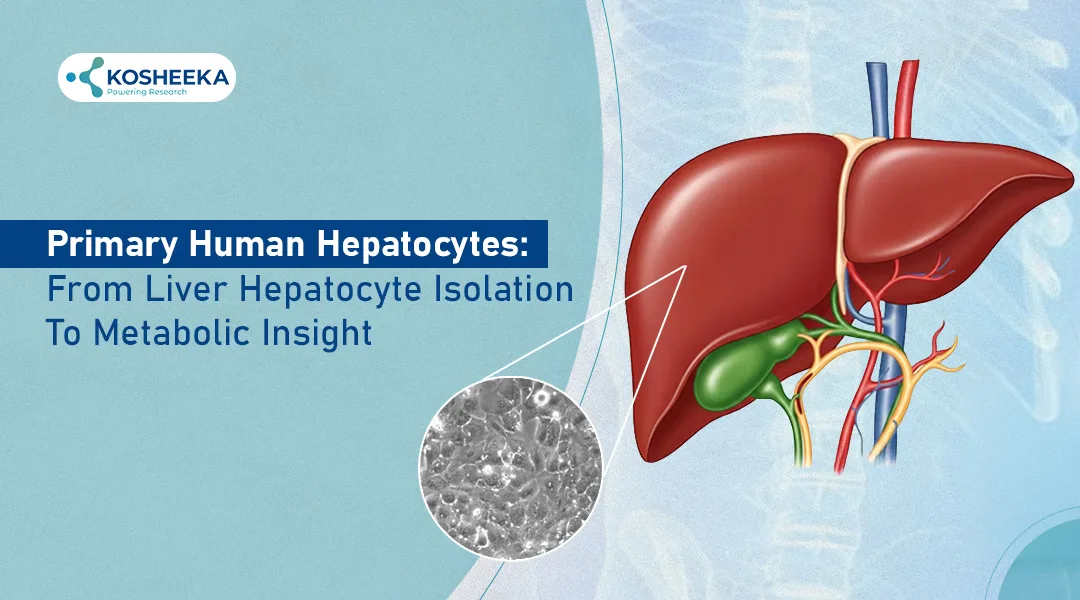
The liver coordinates multiple bodily functions. Among several cell types, hepatocytes are the cell type that makes up 60-70% of the liver cells. They are primarily responsible for performing vital functions, including drug or xenobiotic metabolism, detoxification, lipid or protein synthesis, glucose homeostasis, etc. Studying hepatocyte biology outside the body isn’t just about isolating and placing cells in a culture plate. Once isolated from the native tissue, the primary human hepatocytes require suitable medium and environmental conditions.
For biomedical research, liver hepatocyte isolation and maintenance of primary hepatocyte culture are crucial laboratory techniques that reflect hepatic function. They remain a valuable model for understanding hepatocyte metabolism, including drug-metabolising enzymes, drug development, ADME profiling, metabolite formation, toxicology and transport systems. The development of Primary Human Hepatocytes cells requires maintaining controlled laboratory conditions. The current article unveils the historical perspective of animal cell culture development. Further, the article elaborates on the key features, culture conditions, and applications of primary human hepatocyte culture.
How Did Hepatocytes Evolve from Liver Tissue to a Research Model?
The Emergence of Primary Human Hepatocyte Cells as an Efficient in Vitro Research Model Came with Greater Breakthroughs. The Key Evolution Involved:
- Transformation of Whole Liver to Individual Cells: Earlier researchers considered intact liver tissue that offered limited control over individual cellular processes
- Cell Isolation: Development of enzymatic approaches (collagenase-based perfusion) enabled isolation of primary human hepatocyte cells precisely from the liver tissue
- Primary Hepatocytes Served as a Bridge: The establishment of the primary hepatocyte culture serves as a bridge in the development of preliminary data. In between whole animal studies and cell lines, primary hepatocytes serve as a bridge to understand cellular mechanisms, as they retain various characteristics of the native liver tissue
- Translational Research Relevance: primary human hepatocyte culture enables investigation of human-specific metabolism, enzymatic activities and drug responses
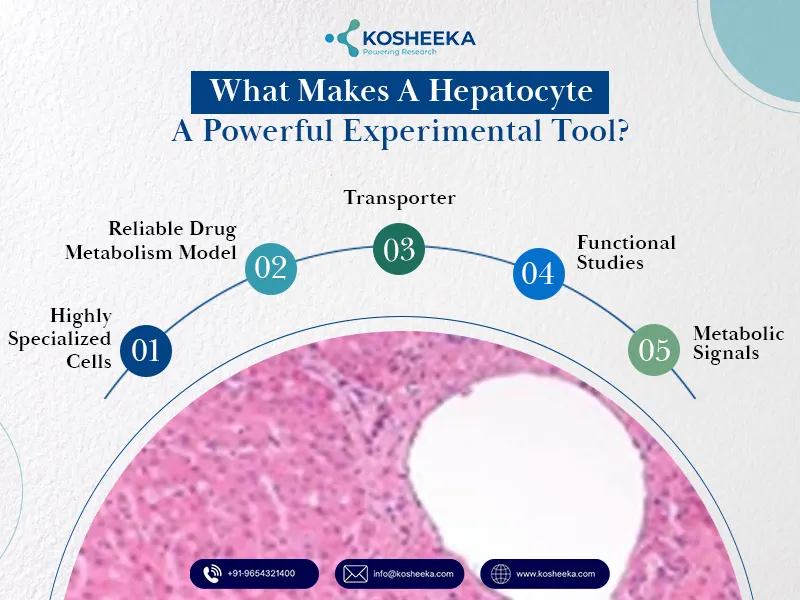
What Makes a Hepatocyte a Powerful Experimental Tool?
- Highly Specialized Cells: Hepatocytes are highly specialised metabolic cells that retain liver-specific functions. Researchers investigate various aspects, including drug or xenobiotic compound metabolism, detoxification, nutrient processing, and cellular responses
- Reliable Drug Metabolism Model: Hepatocyte cells express key enzymes involved in Phase I and Phase II metabolic reactions. This includes Cytochrome P450 enzyme isomers, FMOs, aldehyde dehydrogenase, esterases, etc. This enables researchers to understand the drug candidate’s fate
- Transporter: Hepatocytes uptake and efflux transporters that control how compounds enter, distribute, and are eliminated from the cells.
- Functional Studies: Hepatocytes support various body mechanisms including protein synthesis, lipid metabolism, glucose regulation, etc. This enables investigation of diverse liver biology aspects
- Metabolic Signals: Changes in nutrients, hormones, drugs, and other environmental conditions potentially can alter hepatocyte function. This enables studying normal liver physiology and diseased states
How are Liver Hepatocytes Isolated?
Liver Hepatocyte Isolation is the first step to gain superior quality hepatocyte cells. The key isolation step includes:
- Liver Tissue Preparation: Researchers process fresh liver tissue carefully in aseptic laboratory conditions
- Perfusion: Wash fresh liver tissue with a suitable buffer. This removes blood clots or impurities
- Enzymatic Digestion: Incubate aseptically minced liver tissue with collagenase enzyme. This breaks down the extracellular matrix and allows separation of single cells
- Cell Release: Gentle mechanical processing aids in the release of hepatocyte cells
- Filtration and Washing: Pass hepatocyte cells through filter mesh to remove cellular debris. Wash the cells to remove residual enzymes
- Centrifugation: Centrifuge cells to obtain cell pellets. Collect cells and mix with suitable complete medium
- Incubation: Hepatocytes are incubated in a suitable environment (5% CO2; 37°C, relative humidity)
- Microscopy: Monitor primary hepatocyte culture at suitable time intervals. Change media at suitable time intervals. The quality assessment involves determination of cell viability, morphology, yield, and functional characteristics
*NOTE: Hepatocyte isolation with utmost care and well-characterisation is crucial to gain reliable hepatocyte metabolism data. Kosheeka, India is a renowned supplier of superior quality primary human hepatocytes for research purposes. The product comes with a Certificate of Authentication (CoA).
What are the Research Applications of Hepatocytes?
Hepatocyte Metabolism Research Involves:
- Drug Metabolism and ADME: Primary human hepatocytes enable investigation of absorption, distribution, metabolism, and excretion routes of potential drug candidates
- Phase I and Phase II Metabolism: Investigation of oxidation, hydrolysis, and conjugation reactions of drug transformation
- CYP Enzymes: CYP-mediated metabolism involving unveiling enzyme activities, inhibition, and induction
- Drug-Drug Interaction: Researchers potentially investigate the interaction influences of distinct drug candidates
- Transportation: Hepatocytes enable understanding of hepatic uptake and efflux transporters. This enables detailed understanding of how drug candidates enter hepatocytes, move in cells, and return to circulation/bile
- Metabolite Formation: Measurement of the metabolites enables understanding of metabolic pathways, predicts how the drug candidate potentially behaves in an in vivo system, and estimates clearance route
- Hepatotoxicity: Primary hepatocyte culture enables investigation of the cellular responses to the drug candidates. It enables identification of potential liver toxicity of the new drug candidates
- Disease Modelling: Hepatocyte applications involve an efficient platform for investigation of the altered liver metabolism and function. Certain diseased states, including fatty liver, metabolic disorders, or other hepatic disorders
- Translational Research: Primary human hepatocytes potentially present human-relevant insights into the testing of drug candidates. Such outcome potentially complements animal studies and serve as hepatic cell models [1]
Choose the Correct Research Hepatocyte Model
Based on the Research Question and Goals, Researchers Ought to Choose an Effective Research Model.
| Features | Primary Human Hepatocytes | Hepatic Cell Lines | 3D Culture/ Organoid Model |
| Key characteristics | Closely retain human liver-specific function (metabolic enzymes, transport, excretion) | Reproducible outcome, retains basic features of hepatic environment | Recreates 3 D tissue architecture, cell-cell interactions |
| Lifespan | Short-term, limited no of passages | Long-term; multiple passages | Potentially support longer-term culture in comparison with primary cells |
| Application | Drug metabolism, ADME, CYP studies, transporter studies, hepatotoxicity and human-relevant research | Drug screening, mechanistic studies, assay development and high-throughput experiments | Disease modelling, drug screening, toxicity studies and more physiologically relevant liver research |
| Advantages | High physiological relevance; strong metabolic competence; directly represents human donor biology | Cost-effective, scalable and highly reproducible; easier handling | Disease modelling, drug screening, toxicity studies and more physiologically relevant liver research |
| Limitations | Limited lifespan; donor-to-donor variation; relatively demanding culture requirements | May show altered or reduced expression of key hepatic enzymes and transporter system | Complex, costly and technically demanding; greater variability between model system |
What are the Key Considerations?
Researchers Must Consider:
- Note species or donor characteristics
- Determine cell viability and morphological characteristics
- Presence of functional markers
- Potential CYP activities
- Experimental reproducibility
- Possible batch-to-batch variation
Conclusion
Primary Hepatocyte Culture involves careful isolation, preservation of the hepatocyte phenotype, conservation of metabolic function, and development of reliable research data. Primary human hepatocytes serve as reliable models for various biomedical and metabolic research. They aid in screening a huge number of drug candidates and in determining the metabolic fate, metabolic pathway and elimination route.
References
- Paradiso A, Volpi M, Rinoldi C, Celikkin N, Contessi Negrini N, Bilgen M, Dallera G, Pierini F, Costantini M, Święszkowski W, Farè S. In vitro functional models for human liver diseases and drug screening: beyond animal testing. Biomaterials Science. 2023 May 2;11(9):2988-3015.
FAQ’s
Q- What is the use of Primary Human Hepatocytes?
Researchers use primary human hepatocytes for various purposes, including liver metabolism, drug disposition, toxicity, enzyme activity and other liver-specific functions.
Q- Why is Hepatocyte Isolation Important?
A well-executed isolation process helps researchers obtain viable, functional cells and supports more reliable downstream experiments.
Q- How does Primary Hepatocyte Culture Affect Cell Function?
Culture conditions can influence hepatocyte morphology, metabolic activity, enzyme expression and overall functionality. Researchers therefore need to select conditions that match their study goals.
Q- Why do Researchers use Primary Human Hepatocytes Instead of Cell Lines?
Primary human hepatocytes retain many specialised liver functions, making them useful when researchers need a more physiologically relevant model for human hepatic metabolism.

Author: Dr. Siuli Shaw
PhD in Biotechnology | Scientific Writer | Advancells Group
Translating cutting-edge science into impactful scientific communication.
Research Interests: Cancer Therapeutics | Nanotechnology | Stem Cell Research | Regenerative Medicine