Drug metabolism is thought to be associated with the liver. In the case of oral medication, the intestine is the first site of interaction for drug metabolism. Before reaching systemic circulation, many drug molecules pass through the intestinal wall, where they encounter a range of metabolic enzymes. These enzymes can modify drug compounds, influence their bioavailability, and affect how much of the original drug eventually reaches the bloodstream. Understanding these processes is an important part of predicting drug behaviour during early-stage development.
The Human Intestinal S9 Fraction is a subcellular fraction of the intestinal tissue that acts as an efficient in vitro research model. The S9 fraction is composed of both microsomal and cytosolic enzymes. This enables researchers to investigate distinct metabolic pathways involved in drug metabolism. The core application involves investigation of phase I and phase II biotransformation, metabolic profiling, and drug–drug interaction studies. The study reliability and reproducibility depend on the biological material quality and biological molecule content. The current article focuses on understanding human intestinal S9 fraction isolation, quality assessment, and its major applications across biomedical research.
What is the composition of the Human Intestinal S9 Fraction?
The human intestinal S9 fraction is a mixture of microsomal and cytosolic cellular components. The quality of the S9 fraction depends on its enzymatic composition, tissue integrity, isolation, controlled processing, and maintenance of adequate storage conditions. The key composition of the Human intestine S9 fraction includes:
- Phase I oxidative enzymes: Cytochrome P450 (CYP450) isoform (CYP450, CYP2C9, CYP2C19, etc.). These enzymes are actively involved in oxidation, reduction, and hydroxylation of the drug candidate
- Hydrolytic enzymes: Carboxylesterases rapidly hydrolyse ester- and amide-containing drug candidates into carboxylic acids or alcohols
- Phase II enzymatic reaction: UDP-glucuronosyltransferases (UGTs) enzymes embedded in the microsomal fraction. It is involved in glucuronidation. Sulfotransferases (SULTs) located in the cytosolic section are involved in sulfation. Other enzymes include glutathione S-transferases (GSTs), N-acetyltransferases (NATs), etc. [1]
*NOTE: Superior quality human intestinal S9 fraction has a pivotal role in performing metabolic stability assays and identification of the specific metabolites. It enables determination of the potential drug candidate suitability or its toxicity.
How Is Human Intestinal S9 Fraction Prepared?
Human intestinal S9 fraction preparation involves following an internally standardized protocol. It involves following carefully controlled steps from tissue sourcing to the supply of human intestinal S9 fraction for research application. Intestinal S9 fraction isolation involves multiple steps, including:
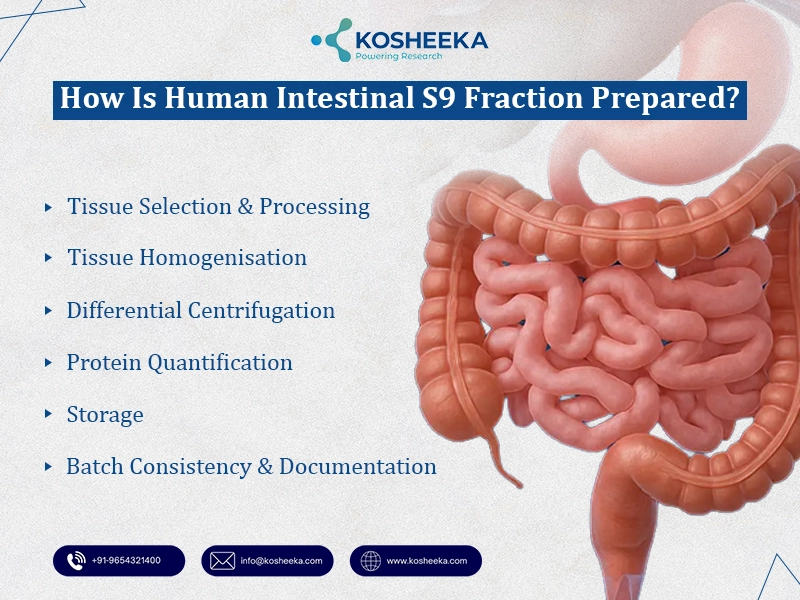
Tissue selection and processing
- Procure a reliable human intestinal tissue sample
- Ensure availability of the donor documentation, tissue traceability, and tissue integrity
- Wash the tissue sample, remove the blood, luminal contents, and any possible contamination
- Mechanically mince the tissue and prepare for homogenisation
Tissue Homogenisation
- Use suitable buffer for tissue homogenisation
- This releases cellular components and maintains enzyme integrity
- Maintain processing conditions (temperature, buffer, homogenisation)
Differential Centrifugation
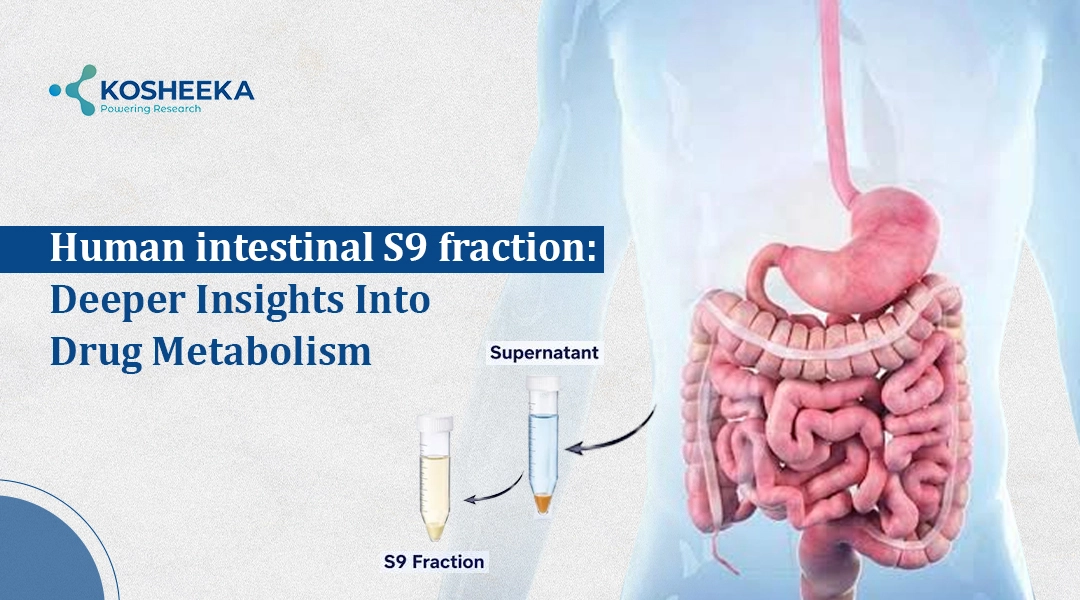
- Homogenised tissue undergoes differential centrifugation
- Separation of the cellular components; the unbroken cells or cell debris are removed
- First centrifugation separates larger tissue fragments, unbroken cells, and nuclei
- Centrifuge supernatant to remove mitochondrial components and other heavier components
- The supernatant consists of the human intestinal S9 fraction
Protein quantification
- Quantify the isolated human intestinal S9 fractions
- Assess total protein concentration in the sample (BCA/Bradford)
- Functional characterization with enzyme-specific assay (CYP 450, UGTs, other metabolic enzymes)
Storage
- Maintain intact enzymatic activities with adequate handling and storage
- Maintain temperature, minimal processing delays, and follow adequate storage procedures
- Final aliquot with suitable volumes, minimise freeze-thaw cycles
Batch consistency & Documentation
- The key attributes of human intestinal S9 fraction are well-documented
- Total protein content in each batch
- Metabolic enzyme function and availability
- Monitor sample handling and storage conditions
- Maintain batch consistency via comparison of the protein content and functional enzymes
- Availability of the donor tissue record, processing details, batch documentation, etc.
*NOTE: It is crucial to choose a human intestinal S9 fraction supplier to gain reliable and replicable research outcomes. Kosheeka, India, is the leading manufacturer and supplier of various animal cell culture-associated components, including human intestinal S9 fractions for research purposes. The product comes with complete Documentation and a Certificate of Authentication (CoA).
What is involved in quality assessment?
Human intestinal S9 fraction quality assessment includes:
- Details including total protein concentration and batch details
- Information related to enzymatic markers (Phase I and Phase II enzymes), and possible enzymatic activities
- Evaluation of the key metabolic activity with use of probe substrate
- Assess sample integrity, storage, product stability, and freeze-thaw tolerance [1]
What are the key applications of Human Intestinal S9 Fraction?
- Drug candidate screening, unveiling drug metabolism and biotransformation pathways
- Phase I and phase II metabolic reactions
- Determination of drug-drug interactions in vitro
- Determination of ADME profiling of the potential drug components and toxicology report
- Determination of metabolic components using advanced analysis including LC-MS/MS
- Understanding species-specific differences in the intestinal metabolism [2]
Conclusion
As drug development moves towards more human-relevant research models, understanding how the intestine contributes to drug metabolism becomes increasingly important. Human intestinal S9 fractions provide opportunities to the researchers to explore these processes alongside models such as human liver microsomes, liver S9 fractions, and intestinal microsomes. Each model offers a different perspective on how the body processes drug compounds. By combining these approaches, researchers can better understand metabolic pathways, compare enzyme activity across tissues and investigate why individuals respond differently to certain drugs. Continued improvements in isolation, enzyme characterisation, and quality assessment will further strengthen the role of human-derived models in preclinical drug metabolism and ADME research.
References
- Seo SW, Han DG, Choi E, Park T, Byun JH, Cho HJ, Jung IH, Yoon IS. Development and application of a physiologically based pharmacokinetic model for entrectinib in rats and scale-up to humans: Route-dependent gut wall metabolism. Biomedicine & Pharmacotherapy. 2022 Feb 1;146:112520.
- Ahire DS, Basit A, Karasu M, Prasad B. Ultrasensitive quantification of drug-metabolizing enzymes and transporters in small sample volume by microflow LC-MS/MS. Journal of pharmaceutical sciences. 2021 Jul 1;110(7):2833-40.
FAQs
Q. Why is the human intestinal S9 fraction important?
The human intestine is responsible for drug absorption and actively breaks them down. The human intestinal S9 fraction helps researchers understand the metabolic changes and enzymatic action involved in phase I and phase II reactions. It is particularly useful for studying intestinal drug metabolism and identifying potential metabolic pathways.
Q. How is the human intestinal S9 fraction prepared?
Intestinal S9 fraction preparation begins with carefully selected intestinal tissue, followed by washing, homogenisation, and differential centrifugation. The resulting post-mitochondrial supernatant contains both microsomal and cytosolic components, making it suitable for studying different drug-metabolising enzymes.
Q. What makes an intestinal S9 fraction fit for in vitro research?
Procuring a good-quality intestinal S9 fraction depends on its protein concentration, tissue integrity, isolation procedure, enzymatic activity, and storage conditions. Functional enzyme assessment and batch consistency help researchers gain reliable and reproducible research outcomes.
Q. How is the intestinal S9 fraction different from intestinal microsomes?
Intestinal S9 fraction vs intestinal microsomes have key differences in enzymatic composition. Intestinal S9 fraction retains both microsomal and cytosolic components, while intestinal microsomes are primarily enriched in membrane-associated enzymes.
Q. What should researchers look for while selecting a human intestinal S9 fraction supplier?
Consistency and product characterisation are crucial when choosing a human intestinal S9 fraction supplier. Researchers enquire about clear information on protein concentration, enzyme activity, batch traceability, and storage conditions. A reliable human intestinal S9 fraction supplier should also provide relevant product specifications to help researchers select material suited to their experimental requirements.