
Drug metabolism research accounts for the development of safe and effective medication. Before any potential drug candidate progresses to clinical trials, researchers investigates its transformation inside the body. This involves understanding drug metabolism pathways, possible toxicity, and determination of the elimination route. In modern research, the demand for complex drug molecules has increased. This has raised demand for reliable in-vitro models for accurate prediction of human metabolism.
In the past few decades, Human Liver S9 Fractions have evolved as a versatile tool for investigating drug metabolism. These tiny molecules are isolated from liver tissue via differential centrifugation and consist of both microsomal and cytosolic enzymes. They support both Phase I and Phase II biotransformation pathways. They have become an integral part of preclinical ADME (Absorption, Distribution, Metabolism, and Excretion) profiling that supports metabolic assays, reactive metabolite screening, drug-drug assessment, toxicological evaluation, etc. The current article explores the growing importance of liver S9 fraction drug metabolism studies.
What is Liver S9 Fraction?
Human Liver S9 Fraction is the 9000g supernatant of liver homogenate. The molecules are pooled as post-mitochondrial supernatant fractions. These are rich sources of drug-metabolising enzymes, including Cytochrome P-450 (CYP-450). The S9 fraction consists of both soluble cytosolic proteins and microsomal vesicles, which are a unique combination for xenobiotic metabolism. The core components of the Liver S9 fraction include:
- Cytosolic metabolic enzymes (GSTs, ALDHs, ADHs, etc.)
- Microsomal membrane bound enzymes (CYP450 isoforms, CYP3A4, CYP2C9, CYP2C19, etc.)
- Cofactors and intracellular proteins (NADPH, UDP-glucuronic acid, glutathione, acetyl-CoA, etc.)
- Soluble components that support enzymatic activities (endogenous proteins, transportation proteins, metabolic intermediates, small molecules, etc.)
In biomedical research, Human Liver S9 fractions are widely used to predict clinical drug metabolism. They reflect the expression of catalytic activities of human metabolic enzymes. This enables researchers to infer intrinsic clearance pathways, metabolite formation, species-specific drug metabolism, etc.
Why Is The Human Liver S9 Fraction A Preferred Model?
Presence of Enzyme System
- Consists of both microsomal and cytosolic enzymes
- Microsomal components consist of Phase I drug metabolizing enzymes such as CYP450 isoforms, FMOs, epoxide hydrolases, esterases, etc.
- Enzymatic reactions facilitate oxidation, reduction, and hydrolysis. It transforms drug candidates into polar metabolites
- Cytosolic fraction involves Phase II reaction enzymes (UGTs, GSTs, NATs, SULTs)
- Enable conjugation of metabolites, increase water solubility, and promote elimination process
Metabolic Pathways & Profiling
- Liver S9 fraction metabolism displays sequential metabolic reactions that occur in the liver
- Display Phase I reactions as oxidation, reduction, and hydrolysis
- Phase II reactions (glucuronidation, sulfation, glutathione conjugation, acetylation) occur before drug candidates are eliminated
- Enable comprehensive metabolic profiling and unveil a compound’s metabolic fate
- Enable identification of primary and secondary metabolites, estimate intrinsic clearance, evaluate metabolic stability, and detect toxic or reactive metabolites
Advantages
- Availability of human-specific enzymes enables accurate in-vivo metabolism prediction
- Metabolic stability, metabolite identification, drug–drug interaction, and ADME studies
- Translational drug discovery and preclinical research
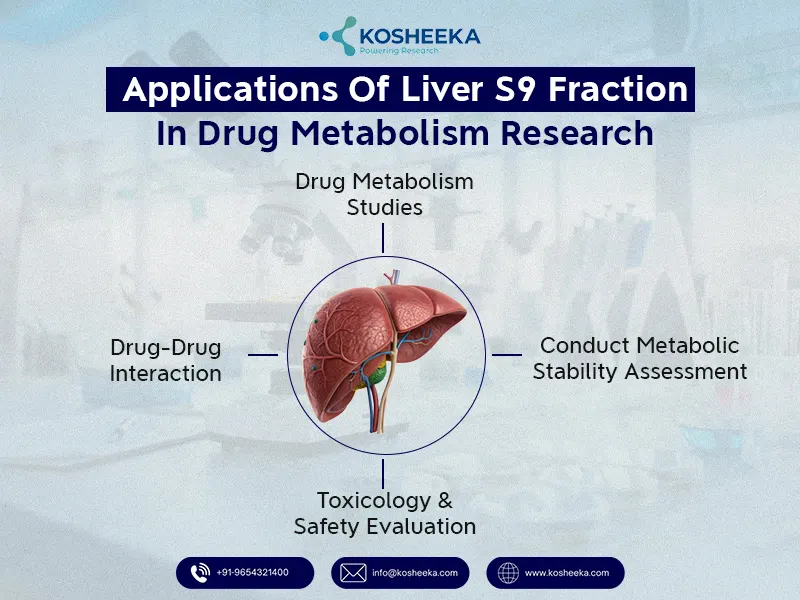
Applications Of Liver S9 Fraction In Drug Metabolism Research
There are Widespread Applications of the Liver S9 Fraction in Drug Metabolism, Including:
- Drug Metabolism Studies: Identification of metabolic pathways, metabolite characterization
- Conduct Metabolic Stability Assessment: Understanding intrinsic clearance, half-life prediction of the drug candidate, marking compounds for lead optimization
- Drug-Drug Interaction: Enzymatic inhibition studies, enzyme induction assessment
- Toxicology and Safety Evaluation: identification of metabolite formation, ADME profiling of the drug candidate, toxicity screening.
Human Liver S9 Fraction In Metabolic Stability Studies
The involvement of the Liver S9 Fraction in Metabolic Stability research is evident. Metabolic stability is a key determinant of a drug candidate’s pharmacokinetic profile, half-life, clearance, bioavailability, dosing determination, and clearance route. In the Liver S9 Fraction Metabolic Stability Assay, the test compounds are incubated with the Human Liver S9 fraction at a defined concentration and time interval. The quantification is subjected to LC-MS/MS or HPLC technique. The key measured parameters include:
- Intrinsic Clearance (CLint): Estimation of the liver’s inherent capacity to metabolise any drug-like candidates
- Remaining Components: Measures the rate of drug disappearance over time, indicating metabolic stability
- Metabolite Formation Rate: Identifies and quantifies metabolites, helping elucidate metabolic pathways and detect potentially active or reactive metabolites [1]
Comparative Analysis: Liver S9 Fraction vs Other In-Vitro Metabolism Models
| Model | Strength | Limitations | Research Application |
| Human Liver S9 Fraction | Combined Phase I and II metabolism | Intact cellular architecture absent | Drug metabolism, metabolic stability |
| Liver Microsomes | CYP activity | Limited to Phase II metabolism | CYP metabolism |
| Primary Human Hepatocytes | Closer physiological model | Cost, donor variability | ADME studies |
| Recombinant Enzymes | Single enzyme specificity | Limited physiological relevance | Enzyme phenotyping |
Factors That Influence Liver S9 Fraction Assay Performance
Liver S9 Fraction Assay Outcome Depends on Exogenous Cofactors, their Concentration, and Dilutions. This Includes:
- Exogenous Cofactor Supplementation: For Phase I reaction, addition of NADPH is done. For the Phase II reaction, UDPGA, PAPS, and GSH is added
- Concentration: Excessive or insufficient concentration of the proteins and cofactors can potentially halt metabolic pathways
- Dilution: Liver S9 fractions are available at lower concentration. For experimental purposes, pooling larger concentrations is desirable [1]
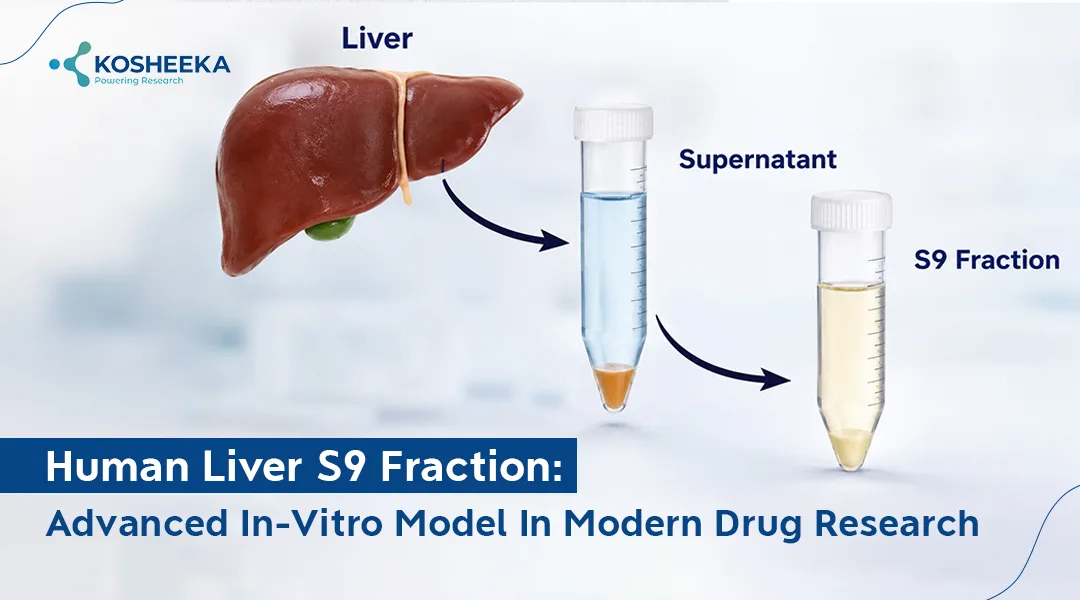
Human Liver S9 Fraction Isolation
The Isolation of the Liver S9 Fraction Involves a Multi-Staged Process. This Includes:
- Liver Tissue Homogenization: Liver tissue collection, mincing, and disruption in ice-cold isotonic solution
- Spin: Low-speed spin (600 * g- 1000* g) for crude homogenate. Collection of unbroken cells, nuclei, heavier cellular debris
- Differentiation Centrifugation: Supernatant collection and spun at 9000* g for approximately 20 min
- Collection: Collection of post-mitochondrial supernatants. This is the S9 fraction with intact cytosolic and microsomal components
- Characterization: Enzymatic activity (CYP450isoforms, GST, UGT, etc.), determination of purity and sterility
*NOTE: Using a superior quality S9 fraction is crucial for reliable and authentic experimental outcomes. Kosheeka, India is a leading supplier of high-quality animal cell culture components including Human Liver S9 fractions for research use. The products are well-characterized and are delivered with a Certificate of Authentication (CoA).
What Is The Trending Research Area?
Liver S9 Fractions have Recently Gained a Wide Range of Popularity in Biomedical Research. This Includes:
- High-throughput metabolic screening
- Metabolomics along with integration with LC-MS/MS
- Physiologically based pharmacokinetic (PBPK) model integration
- ADME and toxicology profiling for drug candidate screening
- Precision medicine and regenerative research
Conclusion
The human Liver S9 Fraction is an impactful structure that holds metabolic information. With research advancements, liver S9 fractions have become reliable in-vitro models for metabolic research. The presence of both cytosolic and microsomal enzymes makes them more predictable tools for drug metabolism, determination of metabolic pathways, possible toxicity, and drug clearance route.
References
- Jyrkäs J, Lassila T, Tolonen A. Extrahepatic in vitro metabolism of peptides; comparison of human kidney and intestinal S9 fraction, human plasma and proximal tubule cells, using cyclosporine A, leuprorelin, and cetrorelix as model compounds. Journal of Pharmaceutical and Biomedical Analysis. 2023 Feb 20;225:115219.
FAQ’s
Q- What is a Human Liver S9 Fraction?
Human liver S9 fractions are 9000g supernatants of liver tissue homogenate. They consist of both cytosolic and microsomal enzymes.
Q- How is the Liver S9 Fraction Different from Liver Microsomes?
Liver S9 fraction consists of both cytosolic and microsomal enzymatic content (Phase I and Phase II metabolic enzymes). In contrast, liver microsome content is limited to Phase II enzymes.
Q- Which Enzymes are Present in the Human Liver S9 Fraction?
The human liver S9 fraction consists of all Phase I and Phase II metabolic enzymes, such as CYP450 enzyme isoforms, FMOs, MAOs, UGTs, SULTs, GSTs, NATs, etc.