
The liver is the active organ involved in drug candidate, foreign compounds, or chemicals processing in the body. This makes hepatic drug metabolism a key area in naive drug discovery. Researchers often turn to liver microsomes, a subcellular fraction of the liver tissue homogenate that retains the intact enzymatic concentration of the hepatocytes.
Microsomes in cells are not present naturally. They are formed as endoplasmic reticulum (ER) fragments. Homogenised liver cells through differential centrifugation forms microsomes. Human Liver Microsomes (HLM) are relevant model for translational research in understanding hepatic metabolism. In fact, researchers widely use liver microsomes in metabolism stabilization studies, enzyme phenotyping, understanding drug-drug interactions, and metabolism profiling. The current article explores the application of liver microsomes as practical in vitro tools and their impact on drug development decisions.
What Are Liver Microsomes? Understanding Their Cellular Origin
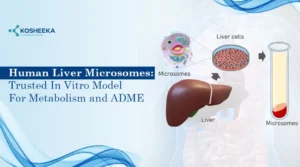
Liver microsomes are subcellular fractions of the ER that are obtained with differential centrifugation. The liver serves as the predominant site for drug metabolism that affects drug toxicity and efficacy. Within the cells, the ER is the primary site of protein synthesis, lipid metabolism, and xenobiotic transformation. During mechanical disruption of the cells, ER fragments reorganize into vesicles, producing microsomal function. Microsomes consist of intact enzymatic concentrations from both rough ER (involved in protein synthesis) and smooth ER (involved in xenobiotic metabolism and lipid metabolism). Unlike intact liver hepatocytes, microsomes lack cytosol, nuclei, or various transport systems. In comparison with the liver S9 fraction (consisting of both cytosolic and microsomal components), microsomes represent membrane-related metabolic activities. Thus, microsomes in cells serve as a controlled model for understanding drug metabolism, metabolic stability, identification of the metabolic pathways, and evaluating drug safety.
Microsomes Function: What Do They Actually Do?
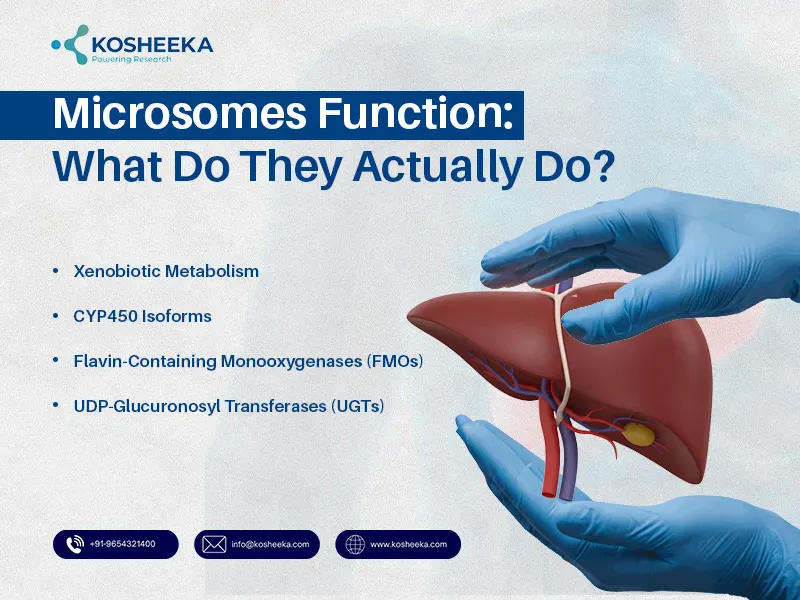
Understanding Microsomal Function is Crucial for Researchers to Use it for Research Applications. The Key Microsomal Functions Include:
- Xenobiotic Metabolism: Microsomal enzymes are the key components for drug transformation, foreign compound metabolism, processing, clearance, and toxicity
- CYP450 Isoforms: Primary microsomal enzyme involved in phase I oxidation reactions. Majorly involved in hydroxylation and dealkylation
- Flavin-Containing Monooxygenases (FMOs): Enzymes involved in the oxidation of various nitrogen- and sulfur-containing compounds, xenobiotic metabolism
- UDP-Glucuronosyl Transferases (UGTs): Phase II reaction enzymes, mainly involved in enhancing water solubility of the compounds and aiding in clearance. The enzyme generally conjugates with glucuronic acid [1]
- Other Metabolic Activities: Supports Phase I and Phase II reactions, including hydrolysis, oxidation, reduction, conjugation, etc. The activity studies depend on Human Liver Microsomes Assay design and research objective
- Research Application: Researchers use liver microsomes for assessing metabolic stability, metabolic pathways, intrinsic clearance, shelf life/half life, metabolite formation, its elimination route, ADME profiling, drug-drug interactions, etc. This serves as an exclusive in vitro model for screening drug-like candidates and developing targeted drugs.
How Are Liver Microsomes Prepared?
Human liver microsomes isolation involves a multi-step process. In in vitro research, this plays a pivotal role, as isolation quality and procedure determine their metabolic activities and reproducibility. The steps include:
- Liver Tissue Homogenization: Fresh liver tissue is minced and homogenized in a suitable buffer (chilled isotonic solution). This disrupts cellular structures while the enzymatic activities remains intact
- Centrifugation (low speed): The homogenates are centrifuged at increasing speeds for removal of nuclei, mitochondrial components, and other cellular debris. Supernatants are collected (S9 fractions)
- Ultracentrifugation: Supernatant is subjected to high-speed ultracentrifugation (100000 g; 1-1.5 h). This step pellets the crude microsomal components
- Resuspension: Discard the clear cytosolic supernatant, resuspend the microsomal pellet in potassium phosphate buffer at the desired volume
*NOTE: The quality of the final liver microsomes preparation depends on several factors. This includes donor characteristics, microsomal protein concentration, enzymatic integrity, and isolation or storage conditions. Maintaining consistency throughout preparation is key in maintaining protein content and enzymatic activities. Kosheeka, India is a leading supplier of animal cell culture components, including human liver microsomes for research purposes. The product undergoes total protein assay and subcellular marker verification to ensure its superior quality. The products come with a Certificate of Authenticity (CoA).
Microsomal Assay: How Researchers Study Drug Metabolism?
Human liver microsome assays enable researchers a controlled environment for evaluation of the human hepatic enzymatic activities on the test compounds. The key considerations include:
- Principle: Researchers measured the disappearance rate of the parent compound inside the body, or the metabolite formation rate
- Human Liver Microsomes: CYPs and UGTs provide membrane-associated drug-metabolizing enzymes
- Test Compound: Xenobiotic metabolism of any drug-like components. The test involves incubation of the drug candidate with Liver Microsomes at a desirable concentration
- NADPH-Generating System: Determining NADPH-dependent CYP-mediated metabolism
- Key Assessments: Depletion of the parent compounds, metabolite formation, CLint (intrinsic clearance rate), enzymatic metabolic stability
- Analytical Methods: LC-MS/MS reveals parent components and metabolites quantification
- Assay Validation: Testing microsomal protein components, substrate concentration, reproducibility, enzymatic activity, and linearity determination with respect to time
- IVIVE Relevance: Data are useful in in vitro in vivo extrapolation. This enables estimation of metabolic clearance and pharmacokinetic behaviour [1]
Key Differences: Liver Microsomes vs Hepatocytes vs S9 Fraction
Liver hepatocytes and their components have a pivotal role in in vitro research. Understanding the key differences enables researchers to make correct choices based on research objective and design.
| Model | Key Application | |
| Primary hepatocytes cells | Intact cells, consist of physiological hepatic activities and transportation studies | |
| Hepatocyte Microsomes | Phase I metabolism; CYP450 isoform; metabolic stability | |
| Liver S9 fraction | Broader Phase I and Phase II metabolic reaction | |
*Note: Choosing the right biological model depends on correct research questions and objectives. Researchers must not consider any model as universally superior.
What are the Key Factors Affecting Microsomal Metabolism?
- Distinct species
- Donor variability, isolation procedure
- Availability of intact enzymatic concentration and biomarkers
- Microsomal protein concentration
- Cofactor availability, solubility, nonspecific binding
- Sample handling, storage condition, cryopreservation
Conclusion
Human liver microsomes are in vitro models for drug development studies. Researchers widely use the model for large-scale drug candidate screening, ADME, and toxicology profiling. It is crucial to choose well-characterized biological models to gain reliable, authentic, and reproducible data.
References
- Gajula SN, Vora SA, Dikundwar AG, Sonti R. In vitro drug metabolism studies using human liver microsomes. InDosage Forms-Innovation and Future Perspectives 2022 Oct 20. IntechOpen.
FAQ’s
Q- What is the Use of Liver Microsomes?
Liver microsomes are subcellular fractions of smooth and rough ER isolated via differential centrifugation. They act as a reliable in vitro model for drug candidate screening, metabolism, metabolite formation, drug-drug interactions, and excretion route.
Q- What is the Function of Microsomes in Cells?
Microsomes in cells consist of intact membrane-bound enzymes. They serve as reliable tools for drug metabolism under a controlled laboratory environment.
Q- What are the use of Human Liver Microsomes?
Human liver microsomes are used in drug candidate screening, ADME profiling, toxicology, etc.
Q- What are Human Liver Microsomes Assay?
The human liver microsome assay is designed to test the metabolism of foreign or drug-like molecules. Researchers explore the rate or time involved in parent compound depletion, metabolite formation, or intrinsic clearance.