
The research involving drug metabolism studies involves the practical question: What is the fate of the drug candidate when it enters the biological system? Before any molecule is tested on the complex model, researchers develop data on a simpler efficient in vitro model.
Human liver microsomes are well-characterized in vitro models that provide insightful data. These are tiny molecules derived from liver endoplasmic reticulum in the laboratory. Human Liver Microsomes have intact enzymatic concentration including enzymes having potential role in Phase I and Phase II drug metabolism. Microsomal experiments enable researchers to investigate metabolic stability of the compound, estimate its intrinsic clearance, CYP inhibition, and understand drug-drug interactions. The current article explores the biology of human liver microsomes and discusses their role in drug metabolism research.
Why Do Human Liver Microsomes Act as an Important Research Model?
Human liver microsomes are membrane bound microsomal fractions derived from endoplasmic reticulum of human liver. These tiny molecules are biologically active. They have a rich composition of drug-metabolising enzymes involved in both Phase I and some enzymatic fractions involved in Phase II metabolic reactions. This includes:
- Phase I Drug Metabolising Enzymes: Cytochrome P450 isoforms (CYP450), esterases, amidase, flavine-containing monooxygenases (FMO), epoxide hydrolases
- Phase II Drug Metabolizing Enzymes: UDP-glucuronosyltransferases (UGTs)
*NOTE: The catalytic activities are supported by the presence of co-factors including NADPH (supports CYPs and FMOs), and UDPGA/alamethicin (supports UGTs activities)
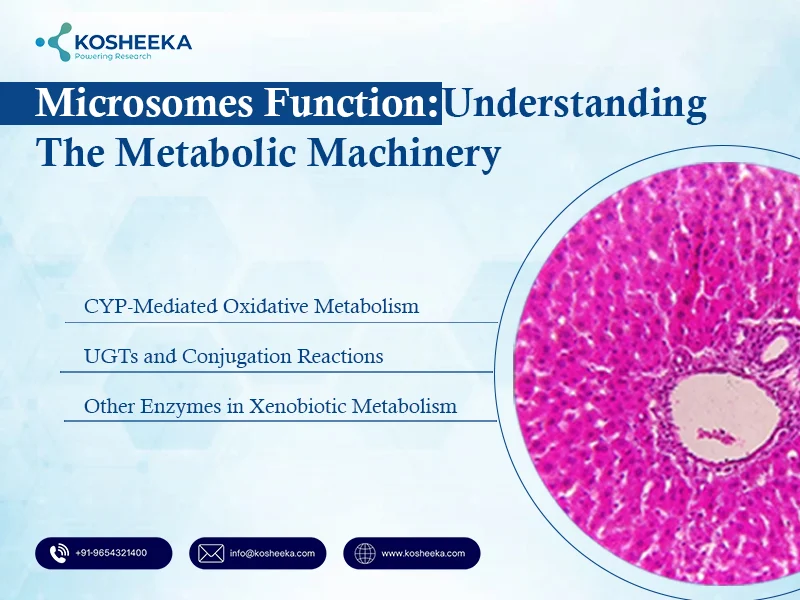
Microsomes Function: Understanding the Metabolic Machinery
Human microsomes retain the concentration of proteins present in the ER (major site for xenobiotic transformation). On preparation from the liver tissue, microsomal fraction serves as a controlled system for understanding enzyme-mediated biotransformation and eliminating complexity associated with whole cells. The key Microsomes Function includes:
CYP-Mediated Oxidative Metabolism
- CYP450 isoforms are important components of human liver microsomes
- Common isoforms involved in human drug metabolism includes CYP3A4/5, CYP2D6, CYP2C9, CYP2C19 and CYP1A2
- Catalyses Phase I metabolic reaction including oxidation, hydroxylation, dealkylation, etc.
- Transforms compounds’ chemical structures
UGTs and Conjugation Reactions
- UCTs are contributor in Phase II metabolism
- Transfers glucuronic acid to suitable substrates via glucuronidation
- Increases polarity of the drug metabolites and facilitates subsequent elimination from the body
- Provides information, including drug biotransformation
Other Enzymes in Xenobiotic Metabolism
- Based on the microsomal preparation, they can consist of other enzymatic loads, including FMOs, esterases, or epoxide hydrolases
- Enzymes involved in metabolite modification influence overall metabolic profile
- Researchers explore a broader range of enzymatic activities
From Compound to Metabolite: What Microsomes Reveal?
Liver Microsomes research enables researchers to gain insightful data related to compound metabolism, metabolite formation, and their elimination route. They provide information related to the molecule’s metabolic behaviour. This includes:
- Unveil drug candidate fate with Phase I and Phase II metabolism
- Phase I metabolic reaction (oxidation, reduction, and hydrolysis), generally adds up small polar functional groups
- Phase II reaction incorporates conjugation pathways including glucuronidation. The metabolites become more water soluble
- Understanding these pathways enables researchers to unveil the metabolic routes involved in a compound’s biotransformation
*NOTE: It is not necessary that both Phase I and Phase II reactions occur sequentially. It depends on the compound’s nature and either of the reactions can occur independently.
The Primary Experimental Studies Includes:
Metabolite Formation
- Microsomal assay enable researchers to track the disappearance rate of the parent compounds
- Analytical technique including LC-MS/MS detects the metabolite formed
- The comparison of the metabolite formation and parent compound depletion rate enable researchers to identify enzymatic transformation
- Metabolic profile enables identification of potential metabolic pathways involved in biotransformation of the drug candidates
Intrinsic Clearance
- Enables estimation of intrinsic clearance (CLint) rate. This indicates metabolic enzyme capacity to eliminate the compound
- Faster intrinsic clearance indicated faster enzymatic turnover
- Lower clearance indicated metabolic stability of the tested compound
Enzymatic-Mediated Biotransformation
- Controlled environment for investigating enzyme dependent changes in drug molecules
- Unveil specific enzymatic pathways by use of selective inhibitors, recombinant enzymes, etc.
- Understanding enzyme involvement aid in understanding variability in drug metabolism and potential interaction with other compounds
Identification of Potential Metabolic Liabilities
- Rapid metabolic turnover indicates metabolic liability
- Identification of compounds with metabolic instability
- Reveal potential metabolite formation
- ADME profiling of the compounds, toxicology reports
- Lead optimisation enables researchers to explore structural modification and improve metabolic stability
Where Liver Microsomes Fit Within the Drug Development Workflow?
Human Liver Microsomes Have a Wide Range of Applications in Drug Development, Including:
- Conduct early ADME and toxicology screening of the drug candidates
- Enable screening of huge range of potential drug candidates
- Determine metabolic stability of the compound
- Determination of drug-drug interactions
- Unveil CYP inhibition, metabolic profiling and support lead optimization [1]
*NOTE: The procured microsomal fraction are often pooled via combination of multiple subcellular fraction of the donor tissue. Various factors including age, genetic stability, health condition, gender, etc. affect the expression level of various drug-metabolizing enzymes. Pooled microsoma fraction smoothen out such differences. They rather represent the average human species. Kosheeka, India, is a leading manufacturer and supplier of human liver microsomes for research purposes. The microsomal fraction is isolated and maintained in a GMP certified laboratory. Each product lot is well-characterized and the product comes with Certificate of authentication (CoA).
What Determines the Quality of a Microsomal Experiment?
Key Factors that Determine Quality of the Microsomes Includes:
- Microsomal protein concentration
- Incubation time and substrate concentration
- Co-factor requirements
- Enzymatic activities
- Batch-to-batch variability
- Temperature, pH and experimental conditions
- Appropriate controls and analytical methods
*NOTE: Kosheeka, India carefully isolates liver microsomes. Each batch undergoes characterization
Key Takeaways
- Microsomal experimentation is a valuable in vitro model that enables researchers to understand detailed drug metabolism
- With combination of microsomal and other relevant model like primary hepatocytes, researchers can get crucial data preclinical data related to potential drug candidates
- The use of human-relevant systems strategically enables understanding human enzyme mediated metabolism
- The development of early metabolic stability data and intrinsic clearance data enable deeper ADME investigation.
References
- Gajula SN, Vora SA, Dikundwar AG, Sonti R. In vitro drug metabolism studies using human liver microsomes. InDosage Forms-Innovation and Future Perspectives 2022 Oct 20. IntechOpen.
FAQ’s
Q- What are the Uses of Human Liver Microsomes?
Human liver microsomes is an human relevant in vitro model. Researchers efficiently assess metabolic stability, enzymatic activities, intrinsic clearance rate, metabolite formation, and potential drug-drug interaction.
Q- What are the Main Functions of the Liver Microsome?
Microsomes in cells are not present naturally. It is formed by differential centrifugation of the ER in the laboratory. Liver microsomes act as controlled systems that enable enzyme-mediated drug biotransformation studies in vitro.
Q- What Enzymes are Present in Human Liver Microsomes?
Human liver microsomes consist of Phase I enzymes (CYP450 isoforms), FMO, and Phase II enzymes (UGTs, estarases, etc.).
Q- What is the Difference Between Human Liver Microsomes and Hepatocytes?
Human liver microsomes are subcellular preparations in laboratories that consist of important metabolic enzymes. In contrast, primary hepatocytes are intact liver cells. Microsomes are useful for focused enzyme-mediated metabolism studies. In contrast, hepatocytes are whole cells that reflects processes such as transport and cellular uptake.
Q- What Factors Affect Microsomal Stability Assays?
Microsomal stability are influenced by microsomal protein concentration, substrate concentration, incubation time, temperature, pH and co-factor availability. The enzyme composition and activity of the microsomal preparation can also affect the results.