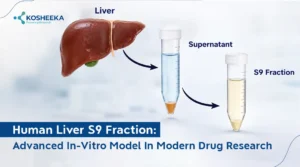

Researchers rely on the relevant in vitro drug metabolism model that potentially reproduces enzymatic reactions. Human Liver S9 fraction serves as a versatile system for understanding a broad range of metabolic reactions. One must understand that liver S9 fractions aren’t a natural part of the cell organelles. They are artificially procured via differential centrifugation. Researchers can potentially investigate a wide range of metabolic pathways of drug candidates supported by the availability of both cytosolic and microsomal components. This enables studies involving Phase I and Phase II metabolism, metabolic stability, metabolite formation, and drug candidate safety-associated investigations. Human Liver S9 Fractions are widely acceptable human-derived models to understand metabolite fate inside the body.
The efficacy of the liver S9 fraction depends on its preparation, isolation, characterization, storage, and application. Besides, tissue source, processing conditions, enzymatic activities and experimental design influence the study outcome. The current article serves as a comprehensive guide elaborating liver S9 fraction preparation and isolation, its composition, metabolic capability, and application in biomedical and regenerative research.
Why Does the Liver S9 Fraction Matter in Drug Metabolism Research?
In modern toxicology research, efficient in vitro models have become an indispensable part. The assessment of drug candidate behaviour using the S9 fraction allows efficient evaluation of xenobiotic metabolism. The liver is the primary site where any drug or foreign molecule undergoes metabolism. The metabolic enzymes allow transformation of the compounds into metabolites and take elimination routes. Understanding the metabolic pathway helps in drug development, including early drug candidate screening and ensuring safety evaluation.
Human liver S9 fractions retain both the cytosolic and microsomal enzymes of the liver cells. This provides the molecule greater leverage in comparison with microsomes that are enriched with membrane-associated microsomal enzymes. The use of human liver S9 fractions supports investigations of multiple metabolic pathways with a single in vitro system.
The Key Area of Investigations Involves:
- Determination of the metabolic stability of the drug candidate and clearance route. This enables researchers to understand the rate of metabolism of the parent compound, its shelf life, and exclusion mode.
- Identification of the metabolites and complex metabolic pathways. Researchers gain insights into what products are formed during metabolism. S9 fraction consist of phase I (CYP450) and Phase II enzymes
- Screening of the huge number of drug-like candidates and understanding their metabolic behaviour
- ADME (absorption, distribution, metabolism, excretion) and toxicology profiling of the compounds
Human Liver S9 Fraction: Why Does It Matter?
Human liver S9 fractions are popular in vitro research models that enable investigation of the metabolism of drugs or other components by human hepatic enzymes. This enables the collection of human-specific metabolic information. This is unlike the case with using animal models in research. The key features involve:
- Enable study of a broad range of hepatic metabolic activities
- Useful in translational research where understanding underlying metabolic pathways plays a vital role
- However, there can be inter-individual variation; that is, enzymatic expression or activity can differ based on the variation in donor, age, genetic features, health condition, medications, etc.
- Researchers using unveiling drug features via Liver S9 fraction metabolism must consider donor characteristics, preparation procedure, source, history, protein content, enzymatic activities and characterization data.
How Liver S9 Fraction is Isolated?
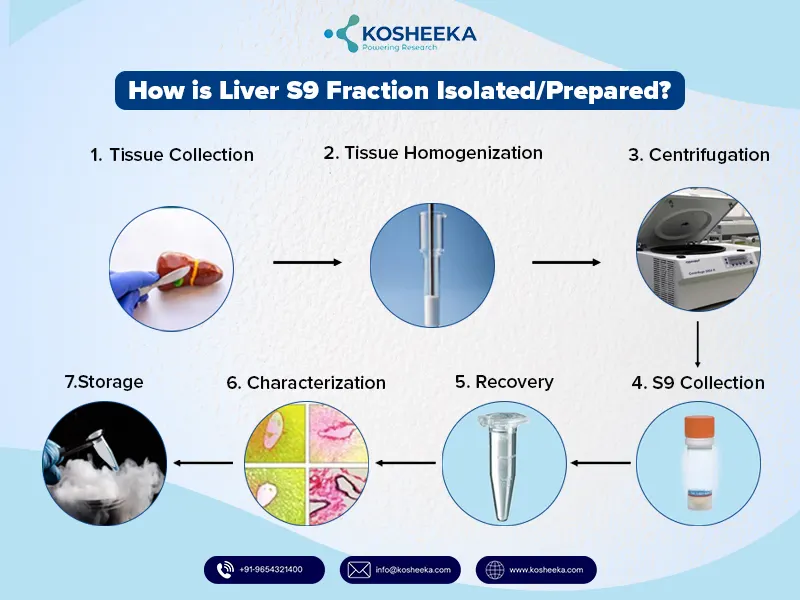
Liver S9 Fraction Preparation involves careful combination of multiple stages. This includes:
- Tissue Collection: The first step is to collect fresh or preserved human liver tissue.
- Tissue Homogenization: Human liver tissue is minced and homogenized in a cold isotonic buffer. This step enables breakdown of the cell membrane.
- Centrifugation: Tissue homogenates are centrifuged at a lower speed (600-1000 g). The unbroken cells, larger particles and cellular debris come in pellets
- S9 Collection: Supernatant spun at 9000 g (20-30 minutes)
- Recovery: The supernatant consists of the human liver S9 fraction.
- Characterization: The quality assessment of the liver S9 fraction is a crucial step. This involves enzymatic profiling, that is, availability of Phase I and Phase II enzymes. The characterization is performed using various assays such as metabolic stability assay, Ames test, metabolic profiling, etc.
- Storage: Liver S9 fractions are stored at -80°C (short-term) or liquid nitrogen (long-term)
*NOTE: Liver S9 fraction isolation requires utmost quality control measures. Kosheeka, India is a leading global supplier of cell culture components including S9 fractions for research use. Each batch undergoes strict characterization and quality check.
What Does Human Liver S9 Fraction Contain?
Human Liver S9 Fractions Consist of Various Components Including:
- Microsomal Components: Consist of membrane-associated enzymes involved in Phase I metabolic reactions. This includes CYP450 isoforms (CYP3A4, CYP2C9, CYP2E1), flavin monooxygenases (FMOs), etc.
- Cytosolic Components: Consist of Phase II reaction enzymes (Glutathione S-transferases, sulfotransferases, UDP-glucuronosyltransferases, methyltransferase) and other cytosolic components
- Cofactors: Endogenous cofactors including NADPH, GSH, acetyl-CoA, UDPGA, etc.
- Intermediate: Transporter proteins, intracellular components, small metabolic molecules, etc. [1]
Understanding Liver S9 Fraction Metabolism
Liver S9 fraction metabolism accounts for the enzymatic transformation of drug-like candidates. Liver S9 fraction and test compound together show disappearance rate (parent compounds) and metabolites. The key outcome involves:
- Phase I Reaction: Oxidation, reduction and hydrolysis (indicates modification of the chemical structure)
- Phase II Reaction: Conjugation of the endogenous compounds and the metabolites gets further modified. The compounds solubility improves [1]
Various factors regulate Liver S9 fraction metabolism such as enzymatic concentration, pH, incubation time, assay design, cofactor availability, test compound stability, and substrate concentration. It is crucial for researchers to maintain environmental conditions when comparing differences between the samples.
Applications of Liver S9 Fractions in Research
Liver S9 fraction supports various drug discovery-associated research, including ADME profiling and toxicology reports of the compound. The key applications involve:
- Metabolic Stability: assessment involve identification of compounds transformation time, shelf life estimation and metabolic susceptibility
- Metabolite Identification: investigation of the metabolites generated at the time of the in vitro research, characterization of the metabolic pathway
- Drug-drug Interaction: Identification of the compound’s capability to influence or interfere with certain metabolic pathways
- Toxicology Profiling: Determination of the metabolite’s potential toxicity inside the body. This is a crucial aspect to ensure the safety of the drug molecule.
- Compound Screening: For identification of the new group of drugs from distinct sources. For example: marine plant-derived compounds, plant-derived natural compounds, or fungi-derived natural compounds, etc. Human liver S9 fraction enables researchers to compare the metabolic behaviour before moving towards more complicated experimentation
*NOTE: Human Liver S9 Fractions have implications in broader in vitro testing strategies.
Conclusion
Liver S9 Fraction serves as a pivotal in vitro model in drug discovery research. The key considerations include careful isolation, protein or enzymatic concentration, characterization and maintenance of the storage concentration. Researchers must procure S9 fraction from renowned manufacturers to ensure experimental stability, authenticity, and reproducibility.
References
- Martin BP, Franco ME, Schirmer K. Comparative characterization of organ-specific phase I and II biotransformation enzyme kinetics in salmonid S9 sub-cellular fractions and cell lines. Cell Biology and Toxicology. 2025 Jan 28;41(1):37.
FAQ’s
Q- What is the Use of Liver S9 Fraction?
Liver S9 fractions are laboratory isolates from primary liver tissue that consist of both microsomal and cytosolic enzymes. Researchers use S9 fractions for drug metabolism, metabolic stability, ADME and toxicology profiling, metabolite identification, etc.
Q- What are the Differences Between Liver S9 Fraction and Liver Microsomes?
Liver S9 fractions consist of both microsomal and cytosolic enzymes, thus are useful in studying both Phase I and Phase II metabolic reactions. In contrast, liver microsomes consist of microsomal enzymes, including CYP450 isoforms, UGTs, etc., involved in Phase I metabolic reactions.
Q- How Liver S9 Fraction is Prepared?
Liver S9 fractions preparation includes liver tissue collection and homogenization in sterile environment. The homogenized tissue undergoes differential centrifugation to obtain a supernatant containing S9 fractions.
Q-What is a Human Liver S9 Fraction?
Human liver S9 fractions serves as an efficient in vitro model for gaining human-relevant drug metabolism and metabolic pathways information.