
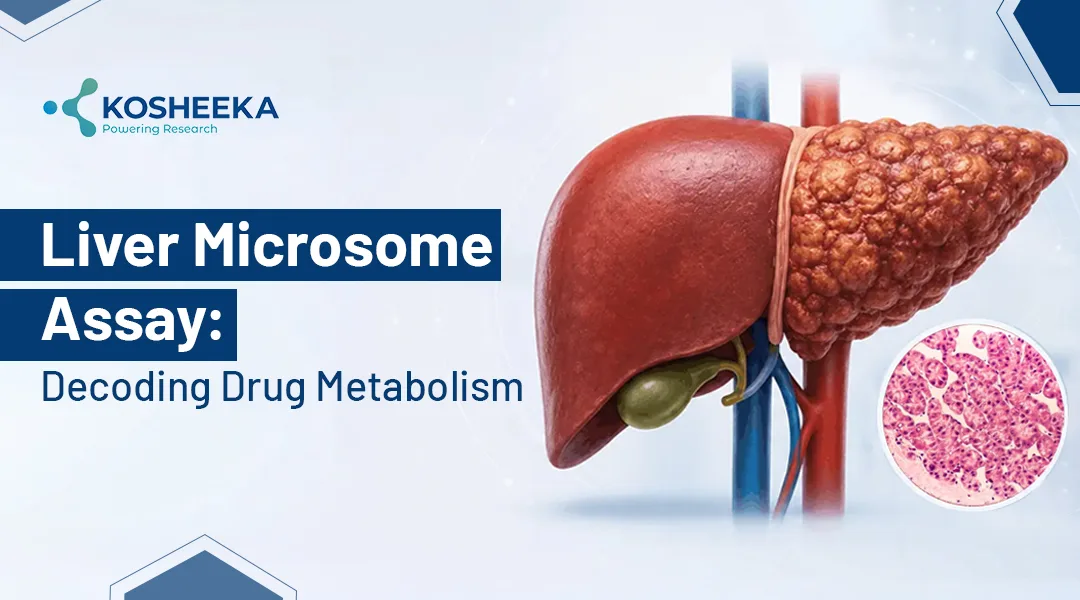
Every drug candidate has a story that begins long before it reaches a patient. One of the first questions researchers explore is how the body processes the compound. It is crucial to understand the fate of any potential drug candidate. Liver microsomes are one of the cellular components of liver cells isolated from the endoplasmic reticulum. Researchers explore potential drug compound metabolism with liver microsomes in controlled laboratory conditions.
Liver microsome assay serves as a practical approach for investigating the molecular pathway before moving to more complex systems. From understanding microsomes’ structure and function to evaluating rat liver microsomes and comparing microsomal systems with hepatocytes, these studies help researchers select appropriate models for their research questions. The current article focuses on understanding the key mechanism involved in Liver Microsome Assay, how they are developed, and how they enable the development of preclinical data.
Liver Microsomes: Structure, Composition, and Biological Function
Rat liver microsomes comprise membrane-bound fractions that are derived from the liver cells. They consist of microsomal active enzymes, including Cytochrome P450 (CYP450), which is responsible for drug candidate or xenobiotic compound metabolism. They play an important role in detoxification of waste.
Structure
- Small membrane-bound vesicles isolated from liver cells
- Originates from the endoplasmic reticulum, developed during differential centrifugation
Composition
- Microsomal fractions consist of membrane lipids and drug-metabolising enzymes
- CYP450 enzyme isomers and UDP-glucuronosyltransferases (UGTs) hold the major composition
- Other enzymes are present
Function
- Phase I metabolism catalyses oxidation reactions, transformation, and modification of the drug candidates
- Supports Phase II reactions that support conjugation reactions like glucuronidation by UGT enzymes; requires specific cofactors
- Involved in drug metabolism research, identification of enzymatic activities, metabolite formation, and metabolism rate
How Liver Microsome Assays Evolved: A Brief History
1930s–1940s | Exploring within Cells
- Before unveiling drug metabolism details, researchers explored what happened inside cells
- Advances in cell fractionation enabled separation of cellular components
- In 1943, Albert Claude introduced ‘microsomes’, establishing a foundation for later research
1950s | A Closer Look at Drug Metabolism
- Researchers explored how liver microsomes transform drugs and other foreign compounds
- Practical investigation of metabolic reactions, decreased dependency on whole-organism
1960s | Understanding Enzymatic Activities
- Cytochrome P450 enzymes research progressed, providing a clear picture of how the liver breaks down drug molecules
- Unveiled the role of specific enzymes in drug metabolism
Post-1960s-Present | Bringing Assays into Drug Development
- Improvements in biochemical methods and analytical instruments
- Investigate metabolic stability, metabolite formation, and compare the behaviour of potential drug candidates
- Estimate metabolic stability, assess intrinsic clearance, and investigate enzyme-mediated drug interactions
- The results also help identify compounds that need further investigation before progressing to more complex studies
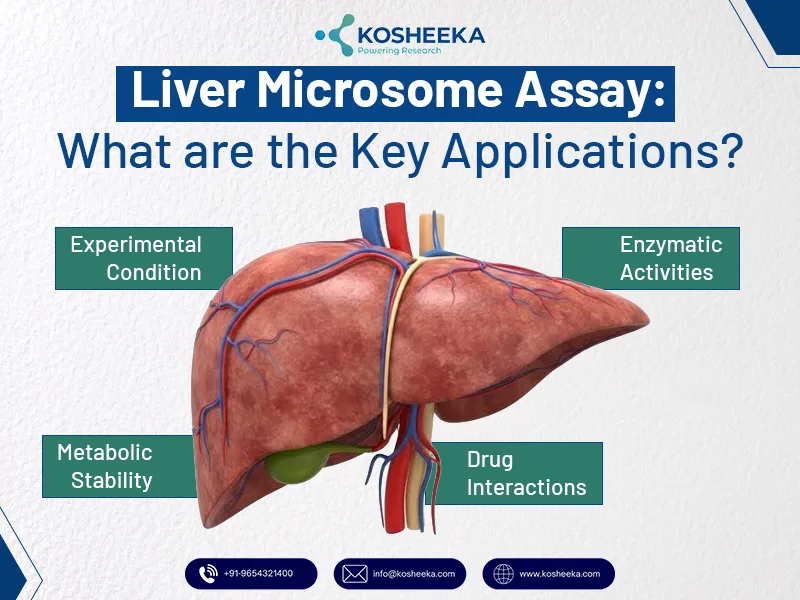
Liver Microsome Assay: What are the Key Applications?
Liver microsomal assay provides practical insights into the drug candidates break down with the action of the adequate enzyme. The reaction alters compound concentrations under controlled laboratory conditions. Besides, researchers explore metabolic stability and identify potential challenges before moving towards complex models.
The Key Steps Involve:
- Experimental Condition: Mix the test compound and microsomes and incubate at appropriate conditions. Collect samples at a distinct time point for analysis. The decline in concentration of the test compound indicates metabolism
- Metabolic Stability: The rate of the compound disappearance indicates its susceptibility to microsomal metabolism. Researchers compare drug candidates and metabolites to determine the compound’s stability. This enables compound modification for improving the metabolic profile
- Enzymatic Activities: Liver microsome assays determine enzymes (CYP450 isoforms, UGTs) that transform compounds and use suitable analytical techniques to identify the resulting metabolites.
- Drug Interactions: Microsomal studies can help determine whether a compound inhibits or undergoes metabolism in the presence of enzymes. These findings provide an early indication of possible drug–drug interactions, although further studies are needed to understand their potential significance in humans.
Performing and Interpreting a Liver Microsome Assay
To gain adequate insight from a liver microsome assay, researchers measured compound loss. Researchers establish suitable experimental conditions, including:
- Experiment Set-Up: The amount of microsomal protein, test compound concentration, incubation temperature, buffer conditions, and sampling intervals influence the experimental outcome
- Cofactors: NADPH is introduced to support cytochrome P450-mediated reactions. Other metabolic pathways are required based on the experimental findings
- Considering Appropriate Controls: Considering appropriate negative controls help reveal compound loss. These checks enable consideration of genuine metabolic activity versus experimental artefacts
- Measuring Compound Depletion: Analytical methods including LC–MS/MS enable quantification of the parent compound at distinct time points. The resulting concentration profile helps researchers understand the compound depletion rate and metabolite formation
- Estimating Half-Life & Intrinsic Clearance: The rate of compound depletion enables estimation of in vitro half-life and calculation of intrinsic clearance. These enable comparison of metabolic behaviour across compounds
- Investigating Unexpected Outcomes: At instance, compound possibly disappear due to chemical instability, poor solubility, nonspecific binding, or analytical variation
- Guide Drug Development: Researchers prioritise promising candidates, identify compounds that may benefit from structural optimisation, and decide which studies should follow
Rat Liver Microsomes: How does it contribute to Preclinical Research?
The rat is a well-characterized model used in various biomedical research. Rat Liver Microsomes offer a practical way to study the metabolism of potential drug candidates. In preclinical studies, use of rat liver microsomes enables building an early picture of compound metabolism. The key application includes:
- Drug Candidate Screening: Researchers compare how distinct drug candidates are metabolised. This enables identification of metabolic behaviour and prioritizes candidates for further testing
- Understanding Enzyme Activity: Rat liver microsomes contain drug-metabolising enzymes (CYP450). This indicates metabolism of any xenobiotic compounds. Researchers explore metabolic stability, compound’s half-life, and elimination route
- Exploring Species Differences: Enables identification of species-level differences. For instance, rat and human liver do not metabolise compounds in a similar manner. The difference in enzymatic activities, abundance, and substrate preference influences the time required for compound breakdown
- Preclinical Findings: The research outcome enables development of preclinical data. However, the interpretation requires careful attention [1]
*NOTE: To gain adequate outcomes, using superior quality rat liver microsomes is crucial. Kosheeka, India, is a leading manufacturer and supplier of animal cell culture-required products. The products come with a Certificate of Authentication (CoA)
Liver Microsomes and Hepatocytes: Choosing the Research Model
Understanding key differences between Liver Microsomes and Hepatocytes enables researchers to choose adequate research models.
Table: Comparison between Liver Microsomes vs Hepatocytes
| Features | Liver Microsomes | Hepatocytes |
| Structure | Membrane vesicles | Intact liver cells |
| Enzyme Content | CYP450 enzymes isomers, UGTs | Enzymes in Phase I and Phase II reaction |
| Metabolic Stability | Assess parent compound depletion, estimate intrinsic clearance | Assess compound depletion in complex biological experiments |
| Transporter activities | Limited cell membrane transportation system | Retain cellular transport process |
| Advantages | Controlled system, specific metabolic reaction | Broader overview of drug compound metabolism |
| Limitations | Does not capture complete cellular process | More sensitive to cell viability, donor variability and other experimental condition |
Conclusion
Liver microsome assays have a pivotal role in screening large numbers of potential drug candidates. Microsomes’ structure and function have simpler physiology that enables multiple experiments. The use of rat liver microsomes enables the development of preclinical data. Researchers must consider data interpretation based on species differences.
References
- Sun X, Ye Y, Sun J, Tang L, Yang X, Sun X. Advances in the study of liver microsomes in the in vitro metabolism and toxicity evaluation of foodborne contaminants. Critical Reviews in Food Science and Nutrition. 2024 Apr 25;64(11):3264-78.
FAQ’s
Q- What are the application of liver microsome assay?
Liver microsome assay have multiple application in drug development research. Researchers explore drug candidate metabolism, enzymatic action, metabolic stability, estimate intrinsic clearance, etc. The study unveils drug metabolites formation during early drug development.
Q- Differentiate between liver microsomes and hepatocytes?
Liver microsomes are membrane vesicles enriched in drug-metabolising enzymes. These are useful in for studying specific metabolic reactions. Hepatocytes are intact liver cells. They retain broader range of metabolic and transport functions. Researchers select the model based on the research objective.
Q- Why are the use of rat liver microsomes?
Rat liver microsomes are well-established in vitro models. They are used for understanding enzyme-mediated drug metabolism. Researchers potentially predict compound’s turnover rate, metabolic pathways, and assess metabolic stability.

Author: Dr. Siuli Shaw
PhD in Biotechnology | Scientific Writer | Advancells Group
Translating cutting-edge science into impactful scientific communication.
Research Interests: Cancer Therapeutics | Nanotechnology | Stem Cell Research | Regenerative Medicine