
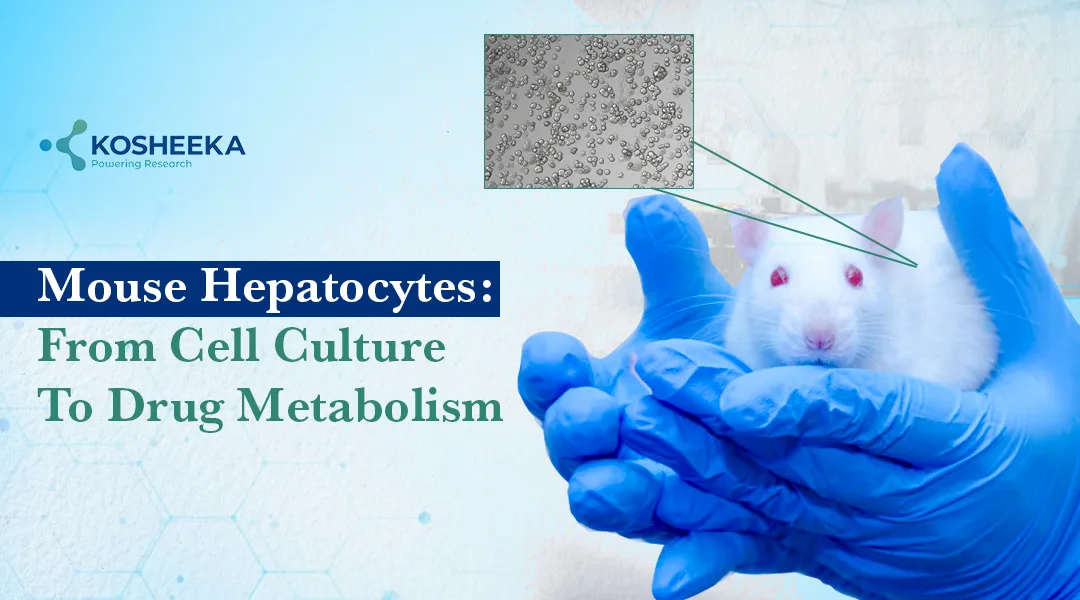
The liver is responsible for maintaining metabolic homeostasis and processing drugs or other foreign molecules in the body. Hepatocyte cells in laboratories are widely used to investigate xenobiotic transformation, drug-drug interactions, metabolite formation, ADME profiling, toxicology, and excretion routes.
CD-1 Mouse Hepatocytes are widely used animal models in preclinical research. The primary hepatocyte cells isolated from CD-1 mice under controlled laboratory conditions enable researchers to conduct drug metabolism studies. The cells retain physiological and functional aspects of liver cells. Gaining reliable research outcomes depends on the cell source, quality, experimental design, and choices of metabolic endpoints. The current article explores the use of mouse hepatocyte cells in drug metabolism, highlighting how the cells fit as reliable models in drug discovery and preclinical research.
What Makes Mouse Hepatocytes a Useful Research Model?
CD-1 Mouse Hepatocytes Serve As Crucial Models In Biomedical Research. The Key Factors Include:
- Established Preclinical Model: CD-1 mice are outbred strains used in biomedical and clinical research. In controlled laboratory conditions, the mouse hepatocyte cells serve as an efficient model to understand hepatic responses to drug-like candidates.
- Hepatic Function Retention: primary mouse hepatocytes retain maximum physiological characteristics and functions of the differentiated liver cells. They consist of metabolically active enzymes and retain enzymatic activities involved in xenobiotic processing.
- Metabolic Studies: Primary CD-1 Mouse Hepatocytes express superior quality Phase I and Phase II metabolizing enzymes. It efficiently indicates enzyme-mediated biotransformation and hepatocellular responses.
- Experimental Flexibility: Primary hepatocytes are studied in vitro under controlled laboratory environments. Researchers can efficiently avoid the complexity involved in whole animal systems.
- Core Application: Preclinical drug metabolism data, Drug-drug interaction; species-specific studies, toxicology, mechanistic studies, etc.
- Limitation: Cannot completely reproduce human hepatic metabolism. The existence of species-specific differences like enzymatic content, metabolic pathways, transportation system, etc. makes exact prediction challenging.
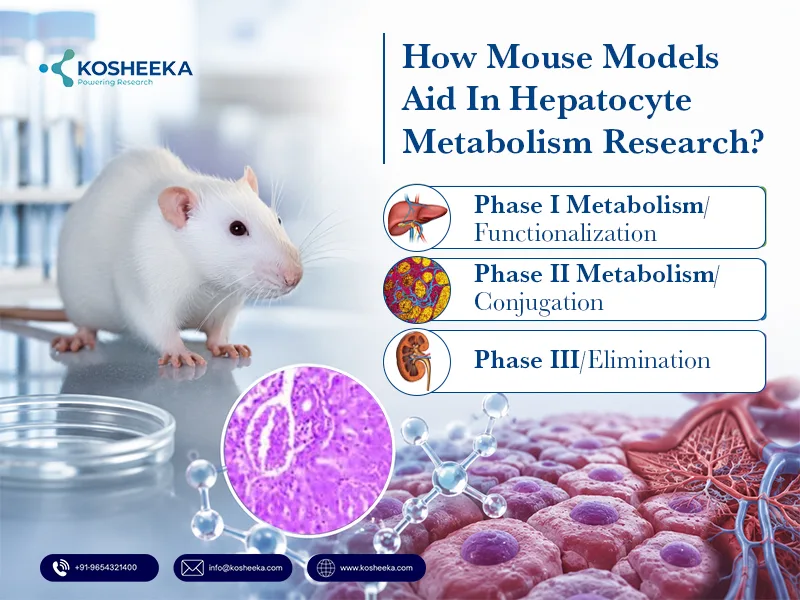
How Mouse Models AID in Hepatocyte Metabolism Research?
Hepatic drug biotransformation is the key process where liver cells transform fat-soluble molecules into water-soluble metabolites for easy excretion. Mouse hepatocyte models enable researchers to understand the key hepatocyte metabolism mechanism of any drug-like candidates. The core steps include:
Phase I Metabolism or Functionalization
Enzymes are mainly involved in the transformation of the drug molecule’s chemical structure by addition or uncovering of the polar groups. The core enzymes include Cytochrome P450 (CYP450) isoforms. During Phase I metabolism, the drug candidates are potentially subjected to chemical reactions such as oxidation, reduction, or hydrolysis.
Phase II Metabolism or Conjugation
Enzymatic reaction that incorporates large water-soluble molecules into the drug metabolite. For example, addition of a sulfate group or glucuronic acid. The metabolites become inactive and suitable for elimination.
Phase III or Elimination
Specialized transporter systems eliminates drug metabolites. Excretion occurs with urine or bile.
*NOTE: Clinically, evidence like drug molecule bioavailability, biotransformation, drug interaction, and its elimination route plays a vital role in drug discovery.
What are the Key Steps in Mouse Hepatocyte Isolation?
Mouse Hepatocyte Isolation Involves a Multistep Process. The Key Steps Include:
Cannulation
A CD-1 mouse is subjected to anesthesia and cannulated with a needle or small catheter. The liver is isolated.
Washing
Perfuse mouse liver in a warm buffer with anticoagulant. It removes blood clots and disrupts desmosome junctions.
Mechanical dissociation and Digestion
Minch liver tissues under sterile conditions. Transfer minched liver to a buffer containing collagenase enzymes for 7-10 minutes. The enzymes digest connective liver tissues.
Filter and Wash
Cell suspension passes through a 70- 100 µm nylon mesh (remove larger chunks).
Centrifugation
Centrifuge the cell suspension at low speed for 3-5 minutes to obtain a cell pellet
Seeding
Wash cells with a neutral buffer and plate in suitable coated plates. The culture vessel (plate or flask) consists of complete medium (DMEM + 10% FBS +1% antibiotic). Incubate culture plate in a CO2 incubator (37°C, 5%CO2, and relative humidity)
*NOTE: Hepatocyte isolation process efficiently bridges the gap between intact liver tissue and a high-fidelity in vitro model. It requires maintaining a highly regulated and sterile environment for gaining optimal outcomes. Kosheeka, India is a leading supplier of superior quality mouse hepatocyte cells for research use. The cells are isolated under a stringent quality-controlled protocol. The products come with a Certificate of Authenticity (CoA)
Where Are CD-1 Mouse Hepatocytes Used?
Understanding the core research application enables researchers to choose reliable models based on the research objective. Choose CD-1 mouse hepatocytes for:
- Early Stage of Drug Metabolism Screening: Mouse hepatocytes are a suitable model for assessing drug candidates (transformation, metabolite formation, metabolic pathway, elimination route)
- Metabolic Stability Assessment: Researchers can monitor persistence of the test compound in the body over time
- Metabolic Profiling: Persistence of the parent compound, its breakdown, metabolite formation, and insights into biotransformation pathways
- Preclinical Pharmacology: Extended understanding of the drug candidate, their metabolic behaviour, and drug-drug interactions. The information is important in designing human-based studies.
- Toxicology Research: Investigation of the potential toxicology profile of the compound. Researchers use primary CD-1 mouse hepatocytes for ADME profiling of the drug candidates.
- Species-Specific Investigation: Comparison of mouse hepatocyte data to reveal differences in metabolic pathways across distinct species [1]
CD-1 Mouse Hepatocytes vs. Other Hepatic Models
For metabolic profiling, various in vitro laboratory models are useful.
Table: Comparative account of Hepatocytes vs. Microsomes vs. S9 Fractions
| Parameter | Hepatocytes | Microsomes | S9 Fractions |
| Cellular function | Intact viable cells | Subcellular fractions, consist membrane bound metabolic enzymes | Subcellular fractions, consist of both cytosolic and microsomal enzyme |
| Metabolic capacity | Broad range of metabolic activities (Phase I and Phase II) | Major Phase I reaction | Microsomal and cytosolic metabolic activities, |
| Species relevance | Reflects species specific metabolic behaviour | Absence of cellular context | Evaluation of species specific metabolic activities |
| Application | Drug metabolism, metabolite formation, metabolic pathway, mechanistic cellular activities | Enzyme mediated CYP activities | Broader metabolic profiling, Phase I and Phase II reaction |
Designing Reliable Experiments with CD-1 Mouse Hepatocytes
- To ensure reliable data on hepatocyte metabolism, researchers must ensure the following:
- Viability of the mouse hepatocyte cells
- Availability of adequate controls and replicates
- Concentration of the test compound and time duration
- Adequate handling, maintaining a sterile environment, regular microscopic observation
- Utmost care to gain reproducible and authentic outcome
Conclusion
Mouse Hepatocytes are well-established research models for the development of preclinical data. Researchers correlate drug candidate metabolism with pharmacokinetics by analysis of parent compound depletion, metabolic stability, metabolite formation, and excretion route. CD-1 mouse models enable researchers to draw preliminary evidence on drug toxicity and their clinical relevance.
References
- Daripelli S, Raje AA, Kandikere V, Anand Vijaya Kumar PR. Model-based steady state pharmacokinetic predictions using high throughput cassette infusion approach in mice. Xenobiotica. 2026 Mar 16;56(3):204-13.
FAQ’s
Q- What is the Use of Mouse Hepatocytes?
Mouse hepatocytes have a wide range of research applications. This includes drug metabolism, metabolite formation, metabolic stability, understanding drug-drug interactions, toxicology, and hepatic function.
Q- Why are Primary CD-1 Mouse Hepatocytes Useful for Metabolism Studies?
Primary hepatocytes share physiological and functional relevance with liver tissues. They consist of intact enzymes involved in drug candidate metabolism.
Q- How Does Hepatocyte Cell Culture Support Drug Metabolism Research?
Hepatocyte cell culture involves a controlled laboratory environment that enables drug or foreign molecule metabolism studies, enzymatic activities, metabolite formation, or metabolite changes.
Q- How are CD-1 Mouse Hepatocytes Different from Human Hepatocytes?
CD-1 mouse hepatocytes involve murine models that enable researchers to gain preclinical data. In contrast, human hepatocyte cells are a more predictive model that shares closer relevance with human metabolic responses.