

The human liver is a metabolically active organ in the human body. Hepatocytes are the highly specialized cells that are involved in multiple cellular processes. This includes liver or cellular metabolism, protein synthesis, endogenous compound processing, and drug transformation. In research laboratories, scientists widely use human hepatocytes for multiple biomedical and regenerative research. Testing or screening of novel drug-like candidates, toxicology, reporting, discovery of novel compounds, liver disease modelling, etc. are common areas of consideration.
Hepatocyte Regeneration involves coordinated cellular proliferation, molecular signalling and cellular interactions. The cells interact with surrounding cells or tissue to restore hepatic function. Certain conditions like hepatic injury, inflammation, metabolic stress, or fibrosis alter hepatocyte function. For drug development research, the focus remains on choosing adequate in vitro research models. The current article explores key features of human hepatocytes, their function, metabolism, and regenerative capacity. Further, the study explores how these cells contribute to the generation of preclinical data.
What Are Hepatocytes? Understanding the Liver’s Key Functional Cells
Hepatocytes constitute more than 80% of the liver cell population. These cells are polygonal with approximately 25 μm in diameter. The nucleus is centrally localized at an early stage. With increasing age, the cells become binucleated and tetraploid. The cells are polarized and consist of two domains: a) basolateral domain (faces the perisinusoidal space of Disse and the lateral region between hepatocytes); b) apical region (responsible for forming the bile canaliculus). The cells are arranged in a tight junction that separates the bile canaliculus from the lateral space.
The Key Hepatocyte Functions Include: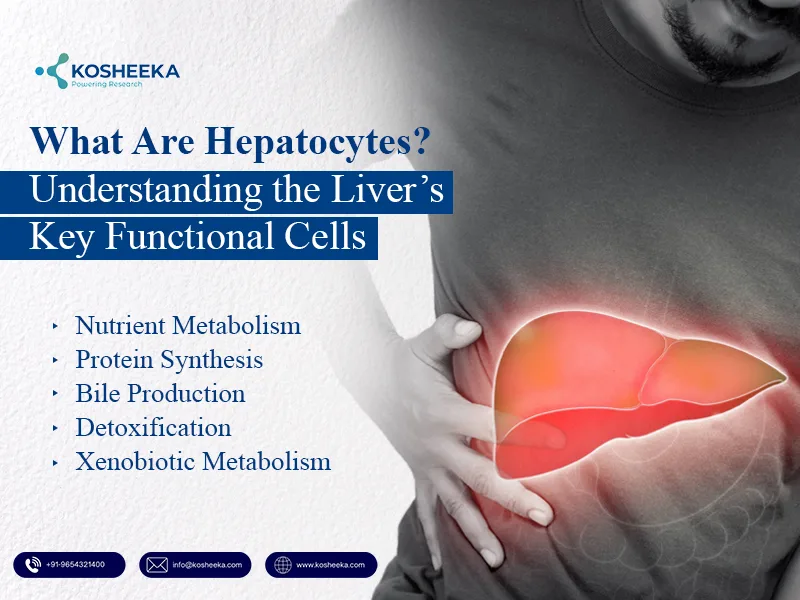
- Nutrient Metabolism: Acts as a major metabolic hub, regulating carbohydrate, lipid, fatty acid, or amino acid metabolism. The cells store glycogen and release glucose when energy is needed
- Protein Synthesis: Synthesizes proteins including albumin, fibrinogen, coagulation factors, etc.
- Bile Production: Production of bile juice, cholesterol, phospholipids, bilirubin-associated compounds. This is essential for digestion and absorption of dietary nutrients
- Detoxification: Hepatocytes convert harmful endogenous and exogenous compounds into excretory forms. This process enable maintaining biochemical homeostasis
- Xenobiotic Metabolism: Enzymes including cytochrome P45 (CYP450) isoforms transform drug components. Researchers use hepatocytes to understand drug metabolism, metabolite formation, pharmacokinetics, and hepatotoxicity.
Hepatocyte Metabolism: How Liver Cells Process Drugs and Nutrients
Hepatocyte metabolism plays a crucial role in drug discovery, pharmacology, translational research, and toxicology. Research uses human hepatocyte cells to understand the naive drug candidate’s fate. Hepatocyte cells have intact structures that consist of both Phase I and Phase II metabolic enzymes. The key functional analysis includes:
- Phase I reaction involving CYP450 isoform enzymes that metabolize various drugs such as CYP3A4 (statins, antimicrobial drugs), CYP2D6 (psychiatric, cardiovascular drug metabolism), CYP2C9 (blood thinners), CYP2E1 (ethanol, acetaminophen)
- Phase II reaction involves biological detoxification processes. This includes various process such as glucuronidation (glucuronic acid addition), sulfation (transfer of a sulfur group), acetylation (acetyl group addition), glutathione conjugation, methylation, and amino acid conjugation
- Regulation of glucose, fatty acid, amino acid, and cholesterol metabolism
- Ideal in vitro model for researchers for developing data investigating metabolic disorder, liver function, drug screening, ADME and toxicology determination, development of naive drug candidate, etc.
- Researchers investigate pharmacokinetics, intrinsic clearance, drug-drug interactions, or metabolic stability [1,2]
*NOTE: Maintaining the features of the hepatocytes cells plays key importance in gaining relevant and reproducible data. Kosheeka, India is a leading supplier of various cell culture-related products including primary hepatocyte cells for research purposes.
Why Primary Human Hepatocytes Remain a Valuable Research Model?
Primary Human Hepatocytes are widely used as an ex vivo model in hepatic biology. Unlike immortalized liver cell lines, they have a closer resemblance to human liver physiology and function. The use of human-origin liver cells improves the translational relevance of the experimental outcome. The key applications involve:
- ADMET profiling of a huge number of drug-like candidates
- Conduct hepatotoxicity assessment
- Metabolic stability and enzymatic induction
- Determine drug-drug interactions [2]
*NOTE: Certain factors like donor variability, limited lifespan of the primary cells, and changes in phenotype might impact the experimental outcome. Choose the research model based on the research design and objective
Primary Hepatocyte Culture: From Cell Isolation to Functional Research
The isolation of the Primary Hepatocyte Culture requires utmost quality control. The steps involve:
Perfusion & Digestion
- Cannulation of the fresh liver tissue and washing with calcium-free buffer
- Enzymatic digestion of the tissue (trypsine/protease/collagenase/dispase)
- Mechanical disruption in ice-cold condition
Purification
- Filtration through serial mesh (70-100 µm), low-speed centrifugation to remove cell debris
- Check cell yield for viability; cells procured with >80% viability
- Density gradient step for better purification
Culture Condition
- Isolated cells are seeded in coated plates/flask
- Supplement with complete medium (DMEM+10%FBS+1% pen-step)
- Incubation in CO2 incubator (5% CO2, 37°C, relative humidity)
- Cells observed under microscope at regular time intervals
*NOTE: Key challenges with the use of primary hepatocyte dedifferentiation include changes in morphology, metabolic strength and gene expression. The functionality of the cells declines with passages, limiting the experimental window. Currently, researchers actively work on improving media components, the development of advanced experimental platforms, co-culture approaches, 3D culture, and maintenance of hepatocyte-specific function. Kosheeka, India follows stringent quality checks while procuring the human liver tissue, isolating primary cells, and storing them before dispatch.
Human Hepatocytes vs Other Liver Models: Choosing the Right Research System
Here are the Highlights of Key Strengths of the Relative Liver Model
| Model | Key Strength | Research Use |
| Primary Human Hepatocyte | Close Resemblance to Human | Drug Metabolism, Elimination Route, ADME, Toxicology |
| Animal Hepatocyte | Species-Specific Insight Development | Comparative Research |
| Cell Lines | Accessible, Less Complex, Scalability, Reproducibility | Huge Drug Screening and Mechanistic Study |
| 3 D Liver Model | Complex Structure | Advanced Liver Research |
What’s Next for Hepatocyte Regeneration Research?
- Development of advanced 3D culture systems
- Development of organoids and liver-on-chip models
- Regenerative research including stem cell therapy, exosome-based therapy
- Combination of human hepatocytes with advanced in vitro research model
- Human-relevant and translational research
Conclusion
Hepatocyte regeneration is a key intrinsic feature of the liver that is widely exploited by researchers to gain preclinical data. The use of primary human hepatocytes enables large-scale drug-like candidate screening, determining ADME profile, toxicology, metabolism, drug shelf life, and determination of elimination route.
References
- Kaur I, Vasudevan A, Rawal P, Tripathi DM, Ramakrishna S, Kaur S, Sarin SK. Primary hepatocyte isolation and cultures: technical aspects, challenges and advancements. Bioengineering. 2023 Jan 18;10(2):131.
- Varmazyad M, Gavlock DC, Castiglione MW, DeBiasio R, LaRocca G, Reese C, Vernetti LA, Schurdak M, Stern AM, Taylor DL, Miedel MT. Road map for primary hepatocyte qualification in human liver organ models. BMC methods. 2026 Feb 9;3(1):6.
FAQ’s
Q- What is Hepatocyte Regeneration?
Hepatocyte regeneration represents the liver’s intrinsic function to proliferate healthy liver cells and replace the damaged ones.
Q- What are Primary Human Hepatocytes Used For?
Primary human hepatocytes are widely used as in vitro models by researchers to understand drug metabolism, route of elimination, drug-drug interaction, development of liver disease models, etc.
Q- Why is Primary Hepatocyte Culture Important in Research?
Primary hepatocyte culture serves as an effective in vitro model for researchers that retains the physiological and functional relevance of the liver tissue. Researchers use the cells to understand liver-specific functions, drug metabolism, toxicity and cellular response.
Q- What Role Does Hepatocyte Metabolism Play in Drug Development?
Hepatocyte metabolism enables researchers to understand how any drug candidates are processed in the liver. This includes unveiling metabolic pathways, metabolite formation, enzymatic activities, and potential toxicity.



The discussion of hepatocyte regeneration highlights how primary human cell models can help researchers better understand liver function, repair mechanisms, and disease progression. It would also be interesting to see more emphasis on how advances in cell culture techniques and tissue engineering are improving the accuracy of liver research models.