


The potential drug candidate, before moving towards clinical trials, undergoes careful evaluation to understand how they interact with the biological system. Preclinical research plays a crucial role in investigating drug response, identifying potential toxic effects, and unveiling its possible metabolic pathway. The selection of appropriate models greatly influences the quality, reliability, and interpretation of the research findings. Among various available research models, CD-1 mice have a valuable role in pharmaceutical development. These are outbred models that have genetic diversity. They enable the study of biological variability and response to different test substances. They have excellent reproductive performance, laboratory condition adaptability, and multiple experimental applications.
CD-1 Mouse in Biomedical Research enables researchers to investigate acute and dose-associated toxicity for drug safety. CD-1 mouse serves as a well-established in vitro experimental model. Understanding its detailed characteristics is important. Research applications and selection considerations enable researchers to make informed decisions and develop efficient details with preclinical studies.
Understanding the CD-1 Mouse: Characteristics and Research Significance
The CD-1 mouse in biomedical research are outbread models. They are widely used due to its genetic variability, reproductive efficiency and adaptability. Its biological characteristics make it a practical choice for several preclinical investigations. The key characteristics include:
Genetics
- CD-1 mice have a wide range of genetic variation
- Genetic diversity enables researchers to observe differences in individuals’ responses to drug candidates
- Captures the biological variability rather than responses in a genetically uniform population
Physiological and Biological Characteristics
- CD-1 mice are physically characterised by robust body development and adaptability to controlled laboratory conditions
- Physiological features enable investigation of distinct organ function, metabolic responses, metabolic pathways, and systemic effects of the test compounds
- Researchers evaluated distinct biological parameters like body weight, clinical signs, food consumption, or changes at the tissue level
Reproductive Performance and Breeding Efficiency
- CD-1 mice have efficient reproductive performance and produce larger litter sizes
- Breeding characteristics support animal availability. Researchers choose the CD-1 mouse model based on its age, and gender on basis of experimental requirement
- Consistent breeding management helps researchers maintain a suitable number of animals for the experimental group
Adaptability
- The CD-1 mouse can efficiently adapt to the unique experimental conditions
- Researchers efficiently use the model for acute and repeated-dose toxicity, pharmacological investigation and reproductive research
- Availability in distinct age groups and genders enables researchers to meet specific biological and experimental requirements
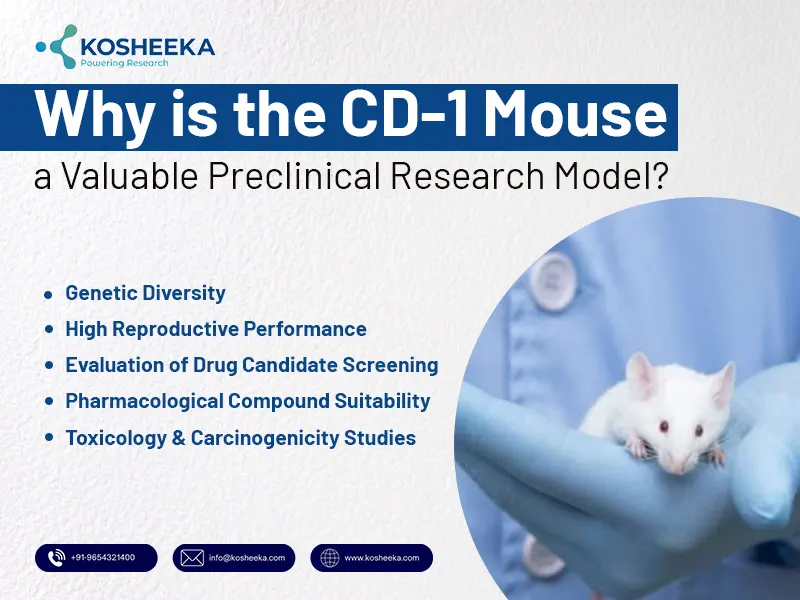
Why is the CD-1 Mouse a Valuable Preclinical Research Model?
CD-1 Mouse for Preclinical Research has a versatile role, including
Genetic Diversity
- Unlike inbred models, the CD-1 mouse has broader representation
- Enables evaluation of inter-individual response to potential drug candidates or toxins
High Reproductive Performance
- Huge litter size, strong maternal care instincts and rapid growth
- Cost-effective experimental means, efficient large-scale production, and fulfilment of experimental needs
Evaluation of Drug Candidate Screening
- Drug candidate screening, unveil ADME profile and toxicology data
- Suitability of the pharmacological compounds to induce in biological systems
Pharmacological Compound Suitability
- Assess suitability of the drug candidates, enabling experimental reproducibility
- Enable determining dose selection and preliminary drug safety evaluation
Toxicology & Carcinogenicity Studies
- Conduct carcinogenicity-associated bioassays, suitable for long-term studies
- Well-characterised and have extensive historical data
What are the Key Applications of CD-1 Mouse in Toxicity Testing?
Researchers evaluate the potential effect of drug-like compounds or drug candidates on the biological system immediately and over time. The CD-1 mouse toxicity model helps researchers evaluate a compound’s safety, uncover any unwanted biological changes, effects on vital organs, or any adverse events. The key applications include:
Acute Toxicities
- Determination of acute toxicities enables researchers to understand how the body responds to drug candidates in short-term or single exposure
- Enables researchers to evaluate immediate reactions, changes in physical activities, body weight, behaviour, etc., upon introducing a drug
- Identification of early toxicity signs; understand if the compounds have noticeable adverse events
Repeated Dose-Toxicity
- Certain compounds do not have any immediate effect, but they cause changes over a longer time period
- CD-1 mouse enables investigation of the responses and understanding the exposure effect on physiological functions
- Physiological investigation (body weight, general behaviour, food consumption, movement)
- Investigate biochemical test (blood test, biomarker evaluation)
- Identification of the effect on distinct organs (liver, kidney, blood cell parameters, etc).
Organ-Specific Toxicity
- Evaluate possible effects on the major organs (liver, kidney, lungs, heart or spleen)
- Monitor changes in body weight, biochemical markers, and changes in tissue structure
- Histopathological investigations to understand inflammation, structural damage, cellular degeneration or other abnormalities
Dose Response Evaluation
- Understand the relationship between dosage and physiological effect on CD-1 mouse
- Determination of the potential adverse effect, determine suitable drug dose, half life, metabolic activities, elimination route [1]
*NOTE: The use of CD-1 mouse as a preclinical model enables researchers to determine potential drug candidates suitability, dose determination, biological response, organ-specific effect, etc. Kosheeka, India, is a leading biomedical research laboratory that maintains and supplies various primary and secondary cells from distinct sources, including CD-1 mouse. The product comes with a Certificate of Authentication (CoA).
Role of CD-1 Mouse in Drug Safety Assessment
- Evaluation of the pharmaceutical candidate safety profile
- Monitor clinical signs, including body weight, feed consumption patterns, survival, and movement
- Investigation of haematological, biochemical and histological aspects
- Risk characterisation and make informed decisions, carry on the experimentation on a bigger model or determine suitability in human trials
What are the Key Considerations When Selecting CD-1 Mice?
- Consider age, sex, body weight and genetic variability of CD-1 mouse
- Ensure adequate animal housing, acclimatisation and environmental conditions
- Determine study design, sample size and appropriate control group availability
- Availability of ethical clearance and compliance with relevant animal research guidelines
Conclusion
CD-1 mice in biomedical research enable researchers to strengthen preclinical research data. They are suitable models for toxicity testing, suitability of pharmacological candidates, potential effects on vital organs, biomarker evaluation, etc. Appropriate model selection has a crucial role in rigorous experimental practices.
References
- Kwiatkowski CC, Akaeze H, Ndlebe I, Goodwin N, Eagle AL, Moon K, Bender AR, Golden SA, Robison AJ. Quantitative standardization of resident mouse behavior for studies of aggression and social defeat. Neuropsychopharmacology. 2021 Aug;46(9):1584-93.
FAQ’s
Q- Why is the CD-1 mouse widely used for preclinical research?
CD-1 mice are widely used in preclinical research because of their outbred genetic background, strong reproductive performance, and ease of use for a wide range of experimental studies. They help researchers investigate drug responses, evaluate test compounds, and study potential biological effects before advancing to clinical research.
Q- How is the CD-1 mouse used as a toxicity model?
CD-1 mouse as a toxicity model is a critical tool for researchers to investigate potential adverse effects of pharmaceutical compounds. Researchers use it in acute and repeated-dose toxicity studies to monitor clinical signs, body weight changes, organ function, and tissue-level responses.
Q- How does the CD-1 mouse support drug safety assessment?
CD-1 mouse safety assessment involves investigating potential drug candidates’ toxicity, and any of the compounds can affect distinct organs. In fact, observations from clinical examinations, blood tests, and histopathological evaluations contribute to a broader understanding of a compound’s preclinical safety profile.
Q- What are the major applications of CD-1 mice?
CD-1 mice in biomedical research have a wide range of applications. These involve pharmacology, reproductive research, developmental toxicity, immunology, and metabolic studies. Their versatility makes them useful for investigating biological responses, evaluating experimental compounds, and generating data that support preclinical research.

Author: Dr. Siuli Shaw
PhD in Biotechnology | Scientific Writer | Advancells Group
Translating cutting-edge science into impactful scientific communication.
Research Interests: Cancer Therapeutics | Nanotechnology | Stem Cell Research | Regenerative Medicine


