

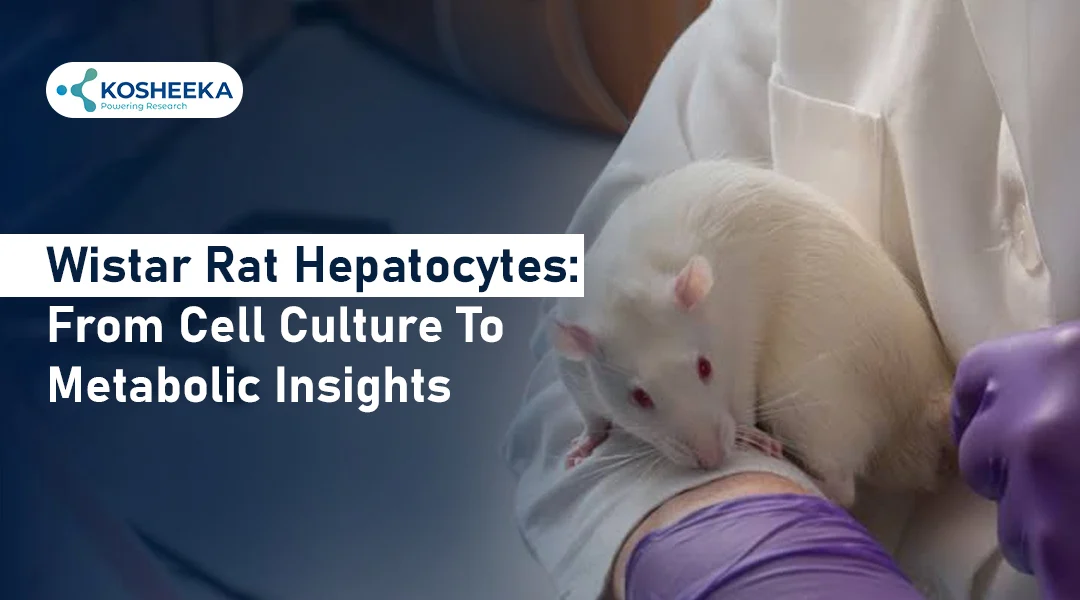
The drug metabolism research might look cool on paper, but the real story begins with layers of preclinical data based on relevant research models.
The liver is the major metabolic and detoxification organ in the body that is responsible for processing drugs and other xenobiotic candidates. Understanding the reaction cascade enables researchers to unveil the fate of the drug candidate. Among various established models, the Wistar rat has a long-standing biomedical and pharmaceutical research application. In fact, the primary hepatocytes isolated from Wistar albino rats serve as a controlled in vitro system for studying liver-specific function. These cells retain various metabolic and functional characteristics, making them useful tools for in vitro investigation.
Hepatocyte cell culture offers extensive opportunities for examining specific biological processes and determining drug candidate fate. However, species-specific differences, that is, between rat and human metabolism, must be considered when interpreting results. The current article focuses on the potential role of Wistar rat hepatocytes for biomedical experimentation and drug discovery.
From Wistar Rat Liver to Hepatocyte Cells
Wistar rat hepatocyte cells are primarily primary parenchymal cells isolated from an outbred strain. They serve as gold-standard in vitro models that are well-characterized. Researchers widely use these for various biomedical aspects, including hepatic metabolism, drug-induced toxicity and liver disease. The core biological characteristics include:
- Physical Characteristics: The cells are large (17-22 μm). They exhibit a polygonal shape with distinct intracellular boundaries. The mature cells are often binucleated.
- Yield & Viability: An adult Wistar albino rat (150-300 g) generally consists of approximately 10⁹ total liver cells (60-70% hepatocyte cells).
- Hepatocyte Cell Longevity: Unlike cell lines, primary hepatocytes do not get subcultured indefinitely. The longevity depends on the cell culture types (suspension: 4- 6 h; plate: 2- 7 days; spheroids:>42 days)
Hepatocyte Cell Culture: Maintaining Liver-Specific Function
The maintenance of superior quality Hepatocyte Cell Culture is crucial in obtaining reliable, reproducible and authentic outcomes. The quality maintenance depends on:
- Cell Quality Determination: Maintain strictly controlled conditions, including viability, purity, isolation quality and condition of the liver tissue
- Environmental Condition: Maintain culture medium (macronutrient and micronutrient content), cell density, ECM
- Monitoring: Determine cell viability, enzymatic function, metabolic activities, liver-specific markers, etc.
- Cellular Function: Primary hepatocyte culture might have distinct characteristics in prolonged culture, including changes in cellular morphology, enzymatic activities, gene expression and metabolic capacity
- Data Maintenance: Detailed donor information, viability, functional characteristics, quality-control measures or storage conditions are crucial to gain desirable experimental outcomes
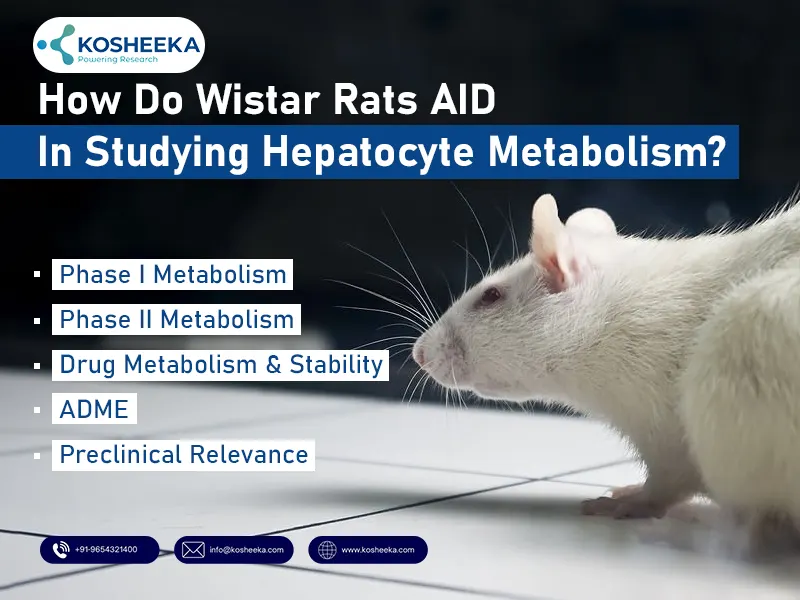
How do Wistar Rats AID in Studying Hepatocyte Metabolism?
Wistar rat hepatocytes are practical in vitro models for understanding metabolic processes. This enables generating preclinical insights. The primary area of experimentation includes:
- Phase I Metabolism: Hepatocytes contain enzymes, including Cytochrome P450 isoforms, that promote drug candidate metabolism. The compound gets chemically modified through chemical reactions such as oxidation, reduction or hydrolysis. The reaction alters the compound’s activity, stability or toxicity.
- Phase II Metabolism: The compound potentially undergoes further metabolism like glucuronidation or sulfation. This increases the polarity of the metabolites, which increases the water solubility of the compound. This prepares the compounds for the elimination route.
- Drug Metabolism and Stability: Wistar rat hepatocytes potentially enable determining the metabolic stability of the compound. It helps in the identification of major metabolites, associated metabolic pathways, its shelf life and elimination route
- ADME: Hepatocyte-based experimentation enables understanding of drug absorption, distribution, metabolism and excretion. The experiment enables determination of the potential toxicity of the compound
- Preclinical Relevance: Wistar rat hepatocytes enable researchers to develop valuable mechanistic data. However, it is crucial to interpret the findings based on species-specific differences between rat and human liver metabolism [1,2]
*NOTE: It is crucial to procure superior quality Wistar rat hepatocyte cells for experimental use. Kosheeka, India is a leading manufacturer and supplier of primary hepatocyte cells, including Wistar rat hepatocytes for research use. The products come with a Certificate of Authentication (CoA).
What are the Key Research Applications?
Wistar Albino Rat Hepatocytes have a Wide Range of Applications, Including:
- Drug discovery via screening of a huge quantity of compounds
- Determination of ADME and toxicology profiling
- Conduct metabolic profiling in relation to metabolic breakdown and biochemical studies
- Determination of enzymatic activities, unveiling metabolic pathways
- Determination of drug-drug interactions, for instance, understanding possible reactions upon administration of the two drugs at a time
What are the Advantages and Limitations?
The Wistar Rat Model Possesses Several Advantages and Limitations in Research Application. This Includes:
Advantages
- Well-established and characterized in vitro research model ideal for preclinical data generation
- Has a wide range of research applications and thus has a huge availability of standardized experimental approaches
- Well-characterized metabolic pathway, including Phase I and Phase II metabolic reactions
- Affordable screening tool and inexpensive model in comparison with human primary hepatocyte cells
Limitations
- Interspecies variability in enzymatic content and substrate specificity between rat and humans [2]
- Loses viability in a shorter time period
- Rapid dedifferentiation loses liver-specific function and CYP450 enzyme activity within 48 hours
- Variability in enzymatic content based on donor variability and isolation procedure [2]
How Superior Quality Hepatocytes are Prepared?
- Source and Strain: Confirmation of the Wistar albino rat origin
- Donor Information: Gender, age, relevant animal characteristics
- Cell Viability: Experimental cell use with >80% viability
- Purity: Intact morphology of the hepatocyte cells
- Characterization: Identification of the relevant biomarkers
How are High-Quality Wistar Rat Hepatocytes Procured?
- Choose a specialized biological research supplier
- Review strain and donor specifications
- Check isolation and processing information
- Assess viability, yield and quality-control data
- Confirm packaging, storage and transportation conditions
Conclusion
Wistar rat models continue to be useful in understanding how hepatocytes function and how the liver processes drugs and other compounds. Although quality research is based on considering multiple models for the research. The quality of the hepatocytes cells must be of superior quality. They should be maintained in a controlled laboratory environment. One must be mindful about hepatocyte cells, source, isolation procedure, storage condition, and study design. Well-characterized Wistar rat hepatocytes can therefore provide a practical and reliable foundation for metabolism, toxicology, and preclinical research.
References
- Naritomi Y, Terashita S, Kagayama A, Sugiyama Y. Utility of hepatocytes in predicting drug metabolism: comparison of hepatic intrinsic clearance in rats and humans in vivo and in vitro. Drug Metabolism and Disposition. 2003 May 1;31(5):580-8.
- Baze A, Wiss L, Horbal L, Biemel K, Asselin L, Richert L. Comparison of in vitro thyroxine (T4) metabolism between Wistar rat and human hepatocyte cultures. Toxicology in vitro. 2024 Apr 1;96:105763.
FAQ’s
Q- Why are Wistar rats hepatocytes used in research?
Wistar rat hepatocytes are well-characterized research models for studying healthy liver function, drug metabolism, enzyme activity, toxicology, liver disease modeling, etc. in controlled laboratory settings.
Q- What can Wistar rat hepatocytes help researchers study?
They help researchers examine drug metabolism, metabolic stability, CYP450 activity, hepatotoxicity, ADME processes, and other aspects of liver cell function.
Q- How to choose Wistar rat hepatocytes?
Researchers must consider key factors including cell viability, purity, donor details (health, age, gender, weight, etc.), isolation procedure, cryopreservation methods, metabolic function, storage conditions, and the specific needs of their study.
Q- Can Wistar rat hepatocyte findings be applied directly to humans?
No, Wistar rat model enables gaining preclinical data. However, there is a huge difference between rat and human metabolic enzymes and pathways. Researchers must consider these species-specific differences when interpreting results and planning further studies.

Author: Dr. Siuli Shaw
PhD in Biotechnology | Scientific Writer | Advancells Group
Translating cutting-edge science into impactful scientific communication.
Research Interests: Cancer Therapeutics | Nanotechnology | Stem Cell Research | Regenerative Medicine


