


The pancreas has a pivotal role in digestion, metabolism, and maintaining overall physiological balance. Traditionally, pancreas have gained attention as insulin-producing cells. With growing research interest, scientists have uncovered the primary pancreatic cells’ role in forming pancreatic ducts, maintaining tissue, secreting, and cellular communication. The cells serve as crucial models in investigating biological function and its dysfunction.
Recent advances in cell culture technologies in the form of organoid systems, genetic profiling and regenerative medicine have elevated the importance of human Pancreatic Epithelial Cells in biomedical research.
This article explores the biology of Pancreatic Epithelial Cells, their growing research applications, and how they are paving the way for the next generation of biomedical breakthroughs.
What Are Pancreatic Epithelial Cells?
Epithelial cells of the pancreas are a vital part of the pancreas (glandular organ) that have a critical role in the digestive system. Human pancreatic epithelial cells serve as valuable tools in biomedical research. The core use is in pancreatic development, carcinogenesis, or epithelial cell biology. Researchers widely use the cells for various pancreatic disease modeling, such as fibrosis, chronic pancreatitis, PDAC, etc. The cells are employed for various cellular and molecular functions like drug screening, toxicology, inflammation, cytokine signaling, studying EMT, and cancer therapeutics.
Human Pancreatic Epithelial Cells are Organised as Two Distinct Cell Types:
- Exocrine Tissue: Makes up the major section of the pancreas. They make up tissue consisting of acinar cells (responsible for enzyme production) and ductal cells (which direct enzymes into the duodenum). These tissues synthesize and secrete major digestive enzymes (pancreatic lipase, proteases, amylase, nucleases). While malfunction of exocrine cells leads to disease, including poor digestion, malnutrition, and pancreatitis
- Endocrine Tissue: Forms a small, structured island of Islet of Langerhans that has four cell types, including alpha, beta, delta and gamma cells. The cells are actively involved in synthesis and secretion of functional hormones. Alpha cells release glucagon, beta cells secrete insulin, delta cells produce somatostatin, and gamma cells release pancreatic polypeptide. Malfunction of the cells leads to chronic disorders like diabetes and compromised tissue homeostasis.
Understanding Pancreatic Ductal Epithelial Cells
Pancreatic ductal epithelial cells are flat or cuboidal cells that form a duct network throughout the pancreas. They form the integral gland for exocrine components and facilitate the transportation of digestive juices from the pancreas to the small intestine. The cells are primarily involved in the synthesis and release of bicarbonate ions (alkaline juice secretion). These juices majorly neutralize acidic gastric juice in the duodenum. It enables forming a conducive environment that allows breakdown of the food and maintains fluid-electrolyte balance.
Dysfunction of pancreatic ductal epithelial cells leads to pancreatic diseases, including pancreatic ductal adenocarcinoma.
Human Pancreatic Epithelial Cells: Valuable Research Models
- Closely replicates the structural, molecular and functional characteristics of the pancreas
- In comparison with the animal model, human pancreatic epithelial cells act as a better relevant research platform
- Enable researchers to understand pancreatic biology, its diseases, disease mechanisms, cellular and molecular interactions, and therapeutic responses
- In in-vitro studies, Human Pancreatic Epithelial Cells act as a valuable tool for evaluating signalling pathways, targeted therapy, and the development of precision and regenerative medicine
Scientific Value of Normal Pancreatic Epithelial Cells
- Any research value is created in the presence of a reference model that enables understanding the transition of healthy tissue to a diseased one
- Normal pancreatic epithelial cells enable comparison between healthy and diseased states
- Researchers use these cells for biomarker identification and developing baseline data against which diseased data is compared
- They enable reaching the efficacy of the experimental findings, and develop targeted diagnostic and therapeutic strategies
- Commonly used normal pancreatic epithelial cell lines include HPDE6c7, ABC-TC3744, HPanEpiC
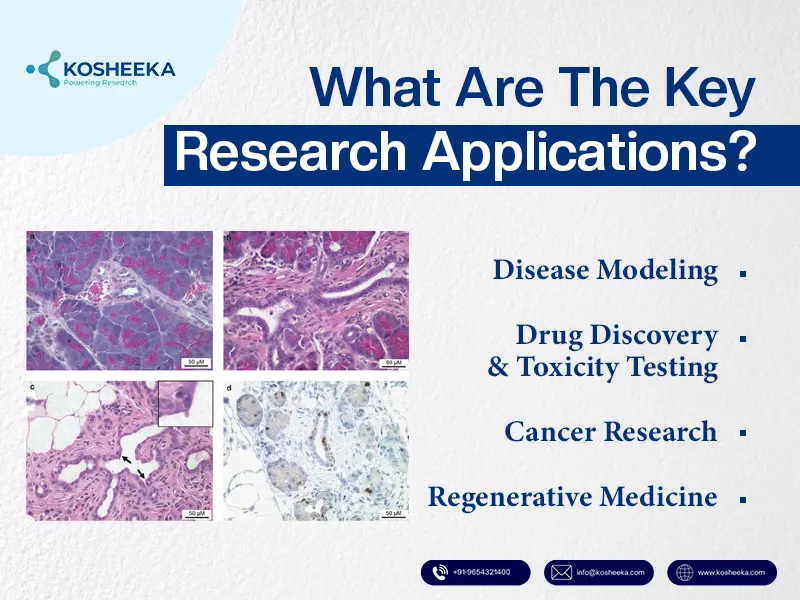
What are the Key Research Applications?
Pancreatic Epithelial Cells have a Wide Range of Research Applications, Including:
Disease Modeling
- Research related to understanding pancreatic disorders at the cellular level
- Identification of alteration in molecular pathways, identification of paracrine exocrine insufficiency
Drug Discovery and Toxicity Testing
- Drug screening, discovery of novel molecules (natural, synthetic, semi-synthetic, or derivatives) and their action against pancreatic alteration
- Evaluation of therapeutic candidates
- Assessing drug safety, efficacy, and cellular response
- Endocrine cells used in research include EndoC-βH1 [1]
Cancer Research
- Pancreatic cancer with significantly high mortality rates in comparison with other cancer types globally
- Development of novel anti-cancer molecules and targeted therapy, and their interaction with the tumour microenvironment
- Pancreatic cancer cell line includes PANC-1, MAI PaCa-2, AsPC-1, CFPAC-1, BxPC-3 [2]
Regenerative Medicine
- Explore pancreatic cell regeneration and repair mechanisms with stem cell application
- Development of cell-based therapies
- Cells widely include mesenchymal stem cells (MSCs) and induced pluripotent stem cells (iPSCs)
What are the Emerging Technologies in Pancreatic Research?
With advanced therapeutic development, pancreatic research is rapidly evolving in various fields, including:
- Development of (3D) cell culture model and organoid systems
- Developing single-cell sequencing technology
- Understanding and development of CRISPR-based gene editing
- Artificial intelligence (AI) and high-throughput screening approaches for new drug development
What are the Major Research Challenges?
- In-vitro maintenance of cellular phenotype and functional integrity is complex
- In the use of primary pancreatic cells, donor variability and reproducibility are major concerns
- Lack of diagnostic and prognostic biomarkers that generally appear at the early and end-stage of pancreatic disease
Conclusion
Pancreatic epithelial cells are an invaluable tool in pancreatic biomedical research. Researchers exploit the cells in vitro to develop critical insights into pancreatic biology, disease modeling, tissue homeostasis, diagnostic and prognostic marker development, and therapeutics. The comparison with healthy/normal cells against diseased cell lines enables understanding of cellular and molecular alterations. With the advancement of animal cell culture applications, the development of organoid culture, gene editing, high-throughput screening, and regenerative medicine is rapidly evolving. Overall, pancreatic epithelial cells bridge the gap between biological and translational research that can potentially improve future healthcare outcomes.
References
- Ahuja N, Cleaver O. The cell cortex as mediator of pancreatic epithelial development and endocrine differentiation. Current opinion in genetics & development. 2022 Feb 1;72:118-27.
- Xing L, Lv L, Ren J, Yu H, Zhao X, Kong X, Xiang H, Tao X, Dong D. Advances in targeted therapy for pancreatic cancer. Biomedicine & Pharmacotherapy. 2023 Dec 1;168:115717.
FAQ’s
Q- Why are Pancreatic Epithelial Cells Important?
Pancreatic epithelial cells form the functional tissue of the pancreas, including ductal cells and acinar cells. These cells are primarily involved in the synthesis and secretion of vital digestive enzymes, proteins and hormones.
Q- What is the Difference Between Pancreatic Epithelial Cell and Pancreatic Ductal Epithelial Cells?
Pancreatic epithelial cell are a considerable umbrella term that includes all forms of pancreatic cells and are involved in pancreatic structure formation. In comparison, pancreatic ductal epithelial cells are subtypes that are responsible for the transportation of digestive juices from the pancreas to the duodenum.
Q- What is the Significance of Human Pancreatic Epithelial Cell in Research?
Researchers use human pancreatic epithelial cell widely for various biomedical research. For example, the cells are used in primary disease models, understanding cellular and molecular dysfunction, and the development of advanced targeted therapeutics and precision medicine.
Q- How Do Normal Pancreatic Epithelial Cell Contribute to Disease Studies?
Normal pancreatic cells enable researchers to compare the diseased state with the normal/healthy functioning of the pancreas. The comparison enables understanding the difference at the translational level. It enables developing targeted therapy based on altered cellular and molecular pathways.
Q- What Emerging Technologies are Improving Pancreatic Cell Research?
Advanced technology development, including organoid culture or 3D model, CRISPR-based gene editing, high-throughput screening or development of regenerative medicine, is improving pancreatic cell research.