

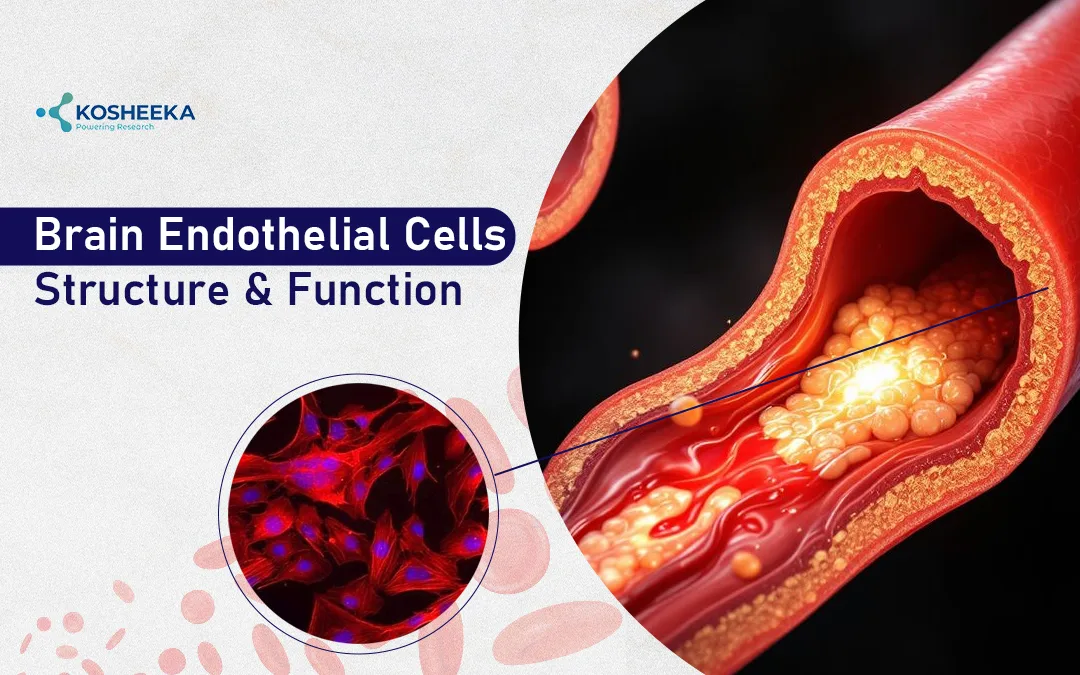
Introduction to Brain Endothelial Cells and BBB Dynamics
At the crossroad of neuroscience and vascular biology, brain endothelial cells govern the barrier function.
In neurodegenerative disease, disruption of Blood Brain Barrier (BBB) is the primary cause. For instance, diseases including Parkinson’s, Alzheimer’s, or amyotrophic lateral sclerosis (ALS) are progressive neurodegenerative diseases.
BBB is once thought to be a barrier that prevents neurotoxic substances, blood cells, or pathogens from entering the central nervous system. Brain Endothelial Cells are responsible for forming the barrier that facilitates transport mechanisms between brain tissue and cerebral capillaries.
BBB Disruption and Neurodegenerative Diseases
Brain endothelial cells form a critical structure in forming the brain vasculature. Specific vascular endothelial cells type show distinct gene expression for vascular segment. E.g. Vascular cell adhesion molecule 1 (Vcam1) are expressed in arterial and venous segments. The disruption of brain endothelial cells (BECs) function gives rise to various neurodegenerative conditions, including:
- Alzheimer’s: Characterized by the formation of β-amyloid (Aβ) extracellular plaques and the formation of tau neurofibrillary tangles. The damage to vascular endothelial cells is a key contributor to Alzheimer’s pathological conditions.
- Parkinson’s: Characterized by bradykinesia, rigidity, altered gait/posture, or rest tremors. Vascular dysfunction among Parkinson’s patients shows clustering of BECs, capillary function loss, and vessel fragmentation.
- ALS: Characterized by loss of motor neuron function in the brainstem, cortex and spinal anterior horn. The disease occurs due to BBB disruption and capillary ultrastructural impairments.
- Multiple Sclerosis (MS): Neurodegeneration due to inflammatory-mediated demyelination. Peripheral immune cells cross BBB that attack myelin membranes and neurons.
- Huntington’s Disease: Characterized via formation of CAG repeat expression in the Huntington (HTT) gene. Disruption of the BBB and increased blood vessel density appear to disrupt normal barrier function in the brain [1]
Molecular Mechanisms Governing BBB Integrity
The molecular mechanism involved in maintaining BBB integrity involves:
- Wnt/β-Catenin: Develops and stabilizes brain endothelial cells. It promotes the expression of tight junction proteins (occludin, claudins)
- Notch Signalling: Contributes to cellular communication, maintains structural organization, and functional stability
- VEGF Signalling: It promotes angiogenesis and maintains endothelial permeability via disruption of tight junctions
- Modulation of Tight Junction: BECs coordinate the selective transportation of molecules (glucose, amino acids, sodium, potassium, etc.). They majorly contribute to CNS tissue homeostasis [1, 2]
Endothelial Cell Function in Neurovascular Coupling
The function of BECs in neurovascular couplings are multifold. This includes:
- Activation of neurovascular coupling via responding to neuronal activity and modulating blood flow. Releases vasoactive factors such as prostaglandins and nitric oxide
- Facilitate crosstalk between neurons, astrocytes, and pericytes. Astrocytes regulate water and ion balance, pericytes support vessel stability and control capillary tone
- Regulates nutrient, ion and metabolic waste transportation across the BBB
- BECs integrate inflammatory signals and metabolic activities
Endothelial Cell Isolation Techniques
The steps involved in the Endothelial Cell Culture technique include:
- Tissue Harvesting and Preparation: Brain endothelial tissue isolated from an animal brain. The cells are washed with 1X PBS.
- Mechanical Dissociation: The tissues are minced with sterile scalpels (~1 mm)
- Enzymatic Dissociation: Collagenase or Trypsin is used for the enzymatic digestion of tissue. The minced tissue are placed in an enzyme for 10-60 min at 37°C (depending on tissue source)
- Filtration: Cell strainer used for passing digested cells (70-100 μm). This removes large debris.
- Centrifugation: The filtered cells are centrifuged to obtain solid cell pellets. The supernatant is discarded.
- Seeding: The cell pellet is resuspended in fresh culture medium. Cells are plated onto a coated culture plate/flask.
- Examples: Brain endothelial cell line includes hCMEC/D3 (human), HBEC-5i (human), BB19 (human), bEnd.3 (mouse)
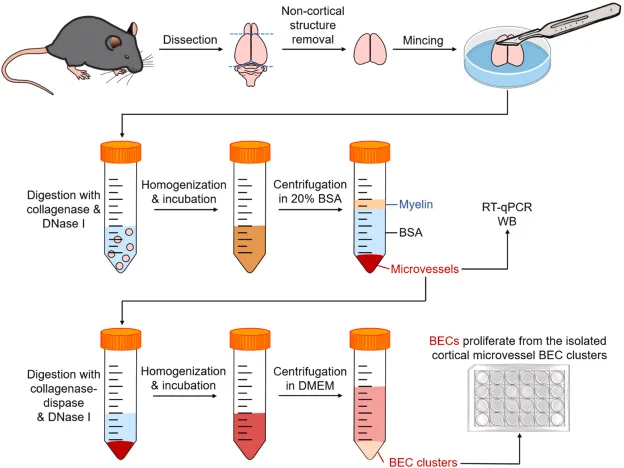
Illustration of Endothelial Cell Isolation Technique
Role of Endothelial Cell Lines in Experimental Studies
- In BBB research immortalized BECs are widely used. The cell lines in research act as a consistent and scalable platform. Understanding endothelial cell function, drug permeability or transport mechanism
- In-vitro study using cell lines enables researchers to gain high reproducibility, ease of culture, and long-term study.
- High-throughput screening, mechanistic studies, and assay standardization in BBB research
- Acts as a model for angiogenesis and vascular integrity
- Represents a disease model for various neurodegenerative diseases. Study mechanisms such as neuroinflammation, signalling, etc.
- Used for the development of co-culture systems such as astrocytes, neurons and pericytes. They represent the neurovascular unit, mimicking BBB characteristics
*The use of both BECs’ primary and secondary cultures plays a vital role in neuroscience research. Kosheeka India is a leading research laboratory that isolates and maintains various endothelial cells for research purposes
Endothelial Cell Line: Regenerative Research
- Stem cell therapy in neurodegenerative disease
- Investigation of the regenerative potential of stem cells into neural cells
- Development and understanding of the repair mechanism
- Model for paracrine signalling, studying cell-to-cell interaction
- Tissue engineering and testing of biomaterials
- Drug screening, toxicology studies, development of pro-angiogenic drugs, gene therapies, etc.
Current Challenges and Future Research Directions
Despite advanced use of BECs in various neurodegenerative diseases, there are certain underlying limitations, including:
- Translation gaps between the cell culture model and human physiology
- Lack of standardization, donor variability, and reproducibility issues
- Low survival rate of primary neurons
- Inadequate cell ratio in 3D organoid model and lack of physiological relevance (neurons, astrocytes, microglia, etc.)
Conclusion
Brain endothelial cells are a major contributor to maintaining an adequate BBB. They have a vital role in transportation mechanisms and the formation of pathological conditions. Dysregulation in BECs contributes to various neurodegenerative diseases and vascular dysfunction. The use of BECs in neurological in-vitro research enables researchers to uncover various mechanisms involved in disease progression, molecular Signalling, drug development, and regenerative medicine.
References
- Yuan Y, Sun J, Dong Q, Cui M. Blood–brain barrier endothelial cells in neurodegenerative diseases: signals from the “barrier”. Frontiers in neuroscience. 2023 Feb 24;17:1047778.
- Chen MB, Yang AC, Yousef H, Lee D, Chen W, Schaum N, Lehallier B, Quake SR, Wyss-Coray T. Brain endothelial cells are exquisite sensors of age-related circulatory cues. Cell reports. 2020 Mar 31;30(13):4418-32.
- Chen Y, Huang X, Chen H, Yi C. An easy-to-perform method for microvessel isolation and primary brain endothelial cell culture to study Alzheimer’s disease. Heliyon. 2024 Jun 30;10(12).
FAQ’s
Q- What is the Difference Between BECs and Other Endothelial Cells?
BECs specifically belong to the brain region and consist of specialized tight junctions, low transcytosis rates, and selective transport systems; they play pivotal roles in maintaining the BBB. In contrast, peripheral vascular endothelial cells have fewer tight junctions and are present in other parts.
Q- How are BECs Isolated?
BECs are isolated from specific tissue sources. Tissue are digested with enzymes, centrifuges in density gradient centrifuge and subcultured.
Q- What are the Limitations of Endothelial Cell Lines in BBB Studies?
The physiological relevance of endothelial cell lines is less. Maintaining an adequate cell ratio in the case of a 3D organoid model is a complex procedure.
Q- Why is BECs’ Function Critical in Neurological Diseases?
BEC dysregulation is associated with various neurodegenerative disease conditions such as Alzheimer’s, Parkinson’s, MS, etc. Their dysfunction compromises BBB integrity, which results in increased permeability.