
Introduction
Cell culture involves laboratory techniques where multicellular organisms (humans, animals, or insects) cells are grown in controlled artificial environments. Historically, cell lines were transformed into cell lines isolated from specific organ. At present, animal cell culture has become indispensable in the field of biomedical research.
Uncover the detailed account on Animal Cell Culture techniques, its applications, and advantages in research.
Animal Cell Culture Application
The application of animal cell culture techniques are of a wide range from vaccine development to recombinant technology. Various application involves:
- Vaccine Production: The development of viral vaccines is widely dependent on mass culturing of animal cells in laboratory environments. E.g: COVID-19 vaccine, Influenza, Flu, Chicken pox, Hepatitis, Measles, etc.
- Carbohydrate Modification: The complex modified carbohydrates are produced in animal cell culture. For instance, introducing post-translation modification for specific glycosylation (N-linked or O-linked), development of glycoproteins, glycolipids, glycosaminoglycans (GAGs), etc. E.g: antibodies
- Recombinant DNA/ Proteins: Development of rDNA/protein for development of anticancer agents, hormones, enzymes, immunobiologicals (interleukins, lymphokines, etc.)
- Unveiling Cellular and Molecular Mechanisms: Animal cell culture study enable researcher to unveil underlying cell-to-cell communication, cellular function and cell-matrix mechanisms
- Drug Toxicology: Determining new drug development, drug toxicity, shelf life, safety, tolerance, excretion route, etc.
- Gene Therapy: Replacement of non-functional genes and reintroducing functional gene-carrying cells
How is Animal Cell Culture Obtained?
Animal cell culture techniques are mainly sub-categorized into three types, including:
Organ Culture
- Whole organs are used for the development of culture in vitro
- Maintain distinct differentiating characteristics, functional activities, cellular mechanisms, and in vivo architecture
- Grows at a slow pace and have limited periphery of explant
- Culture does not propagate for a long time
- Multiple experiment requires establishing a new organ culture, reproducibility, and homogeneity vary due to the distinct sources
- Crucial in studying cellular properties (hormone production, examining the effect of drugs, etc.)
Primary Explant Culture
- Culture developed from specific animal tissue
- Tissue adheres to surfaces coated with extracellular matrix (ECM) constituents (collagen, plasma clots, etc.)
- With time, cells migrate out of the tissue piece and grow on the surface
- Studies enable the determination of differentiating and migratory properties of cells
- For example, cancer cell tissue explants show uncontrolled proliferation, while in normal tissue, proliferation occurs at a subtle pace
Cell Culture
- The most common and widely used method in animal cell culture
- It is of 3 subtypes: precursor cells (undifferentiated cells), differentiated culture (differentiated cells), and stem cell culture (undifferentiated cells that can grow into distinct cell types)
- For cell line development, cells are initially isolated from a specific tissue type and transformed through immortalization
- Cell grown in an in-vitro setup and grow in different forms- adherent/monolayer culture (cell attaches to the culture flask surface) or suspension culture (cells are nonadhesive, they grow in suspension)
Types of Animal Cell Lines in Research
Animal cell cultures are divided into distinct types based on their source, such as:
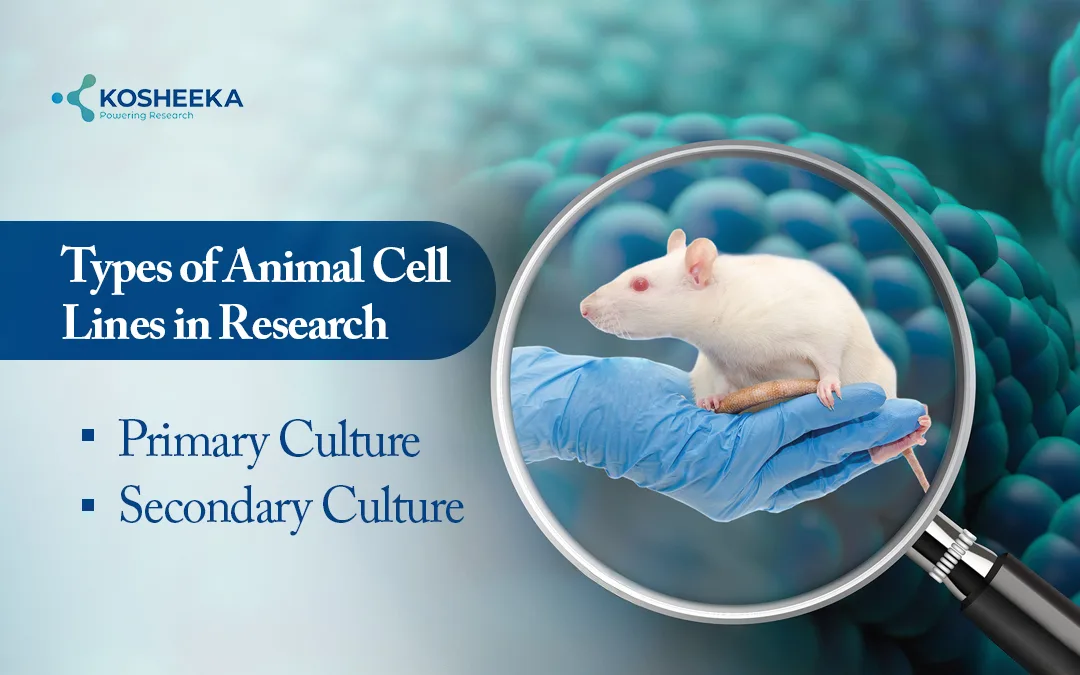
Primary Culture
- Cell isolated directly from the source (in vivo mechanism)
- Cells are slow-growing and have a definite shelf life.
- They have similar genetic makeup and chromosome number from the origin.
- The morphological shape and size might vary in epithelial, epithelioid, fibroblast, or connective tissue/cells.
- Difficult to maintain in culture and more prone to contamination (bacterial, mycoplasma, virus)
- The cells can be adherent, where cells attach to the substrate, or non-adherent, where cells float in the medium.
Secondary Culture
- Primary Cell Cultures are transformed to develop into a distinct cell line.
- Long-lasting lifespan, grow upto 50 passages (for experimentation, early passage cell use is recommended)
- The cells are well-maintained in optimal density.
- The transformation compromises cells’ ability to resemble the parental tissue.
- Multiple passages can potentially induce mutation or genetic alteration in the cells.
- The contamination risk is lower in cell lines in comparison with secondary culture.
- Cell lines can be finite or continuous.
- Finite cell lines can be passaged between 20 and 100 times, while continuous cell lines have infinite life; the cells can group on top of each other.
- Examples: HeLa, HL 60, MCF-7, MDA-MB231, HEK-293, etc.
Animal Cell Culture Techniques: Procedure
Culture Media
- Animal cell culture media consist of all essential macronutrients and micronutrients. This includes inorganic salts, vitamins, growth factors, nitrogen source, fats, hormones, pH buffer, and antibiotics.
Culture Condition
- Animal cell culture needs a controlled environment, a temperature of 37°C, appropriate humidification and a 5% CO2 incubator.
Cell Culture Procedure:
- Cell isolation: Isolated from the source (primary cells). Cell lines are sub-cultured
- Cell confluency: Cells seeded in appropriate culture condition.
- Enzymatic dissociation: Cell trypsinized (adherent culture)
- Cell Collection and Centrifugation: Cells are collected and centrifuged
- Washing: Cells washed (1X PBS) and centrifuged (1000-3000 rpm)
- Cell resuspension: Cell palettes resuspended in fresh culture medium
- Seeding: Cell suspension poured into fresh culture vessel
Cryopreservation
- Cells harvested at log phase (high viability) are centrifuged (1000-1500 rpm for 3-5 min)
- Cells palette resuspended in cryopreservation medium (Complete medium + 10% DMSO + 20% FBS)
- The cells adjusted in each cryo vial are approx. 1* 10⁶ cells/mL
- Cryo vials subjected to a gradual temperature decrease (4 °C to -20 °C to -80 °C to liquid nitrogen). The temperature drop is like −1 °C per minute.
Advantages of Animal Cell Culture
The following are the Advantages of animal cell culture:
- Animal cell culture studies enable the accumulation of preclinical data.
- Crucial elements in cancer research, regenerative medicine, etc.
- Understanding cell biology, metabolism, cellular pathways, etc.
- Effect of any drug on a certain cell type, identification of biomarkers, or karyotyping
- Useful in the production of large-scale proteins, antibiotics, vaccines, etc.
- Development of precision medicine and cellular studies
Limitations and Challenges in Animal Cell Culture
- The procedure requires experienced personnel and maintenance of a sterile environment.
- The procedure is expensive.
- Risk of contamination is high (Bacterial, Fungal, Mycoplasma)
- Genetic Instability over an increased number of Passages
- Cells procured from a commercial organisation must maintain high viability and minimal genetic alteration/mutation.
*Kosheeka, India, is an indigenous laboratory that isolates and maintains high-quality cells (primary cells and cell lines). The laboratory supplies superior-quality cells for research purposes.
Role of Animal Cell Culture in Preclinical Research
- Drug Screening and Toxicology Studies
- Cancer Research and Target Discovery
- Personalized Medicine and Regenerative Medicine
- Biopharmaceutical Production
Emerging Trends and Innovations
- 3D Cell Culture and Organoids
- Stem Cell and Regenerative Applications
- CRISPR-Cas9 and Gene Editing
- Developing automation and AI
Conclusion
The animal cell culture technique plays a crucial role in understanding cell biology, molecular biology, cell cycle mechanisms, cell-matrix interactions, cancer research, and biomolecule production. Mammalian cell culture technique is a prerequisite for the development of biological therapeutics, including recombinant proteins, carbohydrates, hormones, clotting factors, vaccines, etc.
References
- Verma A, Verma M, Singh A. Animal tissue culture principles and applications. In Animal biotechnology 2020 Jan 1 (pp. 269-293). Academic Press.
FAQ’s
Q- What is ACC, and why is it important?
Animal cell culture involves growing eukaryotic cells in controlled laboratory conditions. This enables researchers to study cellular behaviour, disease mechanisms, diagnostic markers, drug response, etc.
Q- What are the main applications of animal cell culture(ACC)?
The main application includes the production of vaccines, recombinant proteins, carbohydrates, hormones, toxicology testing, etc. It helps in drug development, gene therapy, cancer research, regenerative medicine, etc.
Q- How are animal cell lines different from primary cells?
Primary cell culture are isolated from the animal tissue or organ. Cell lines are transformed cells from primary cells. They have longer lifespan. It is suitable for developing long-term experiments and enabling reproducible studies.
Q- What are the advantages of ACC over in-vivo studies?
Normal cell culture technique enables a controlled environment that reduces ethical concerns associated with animal sacrifice. The technique enables easier manipulation, provides faster results, and is cost-effective.