
Introduction
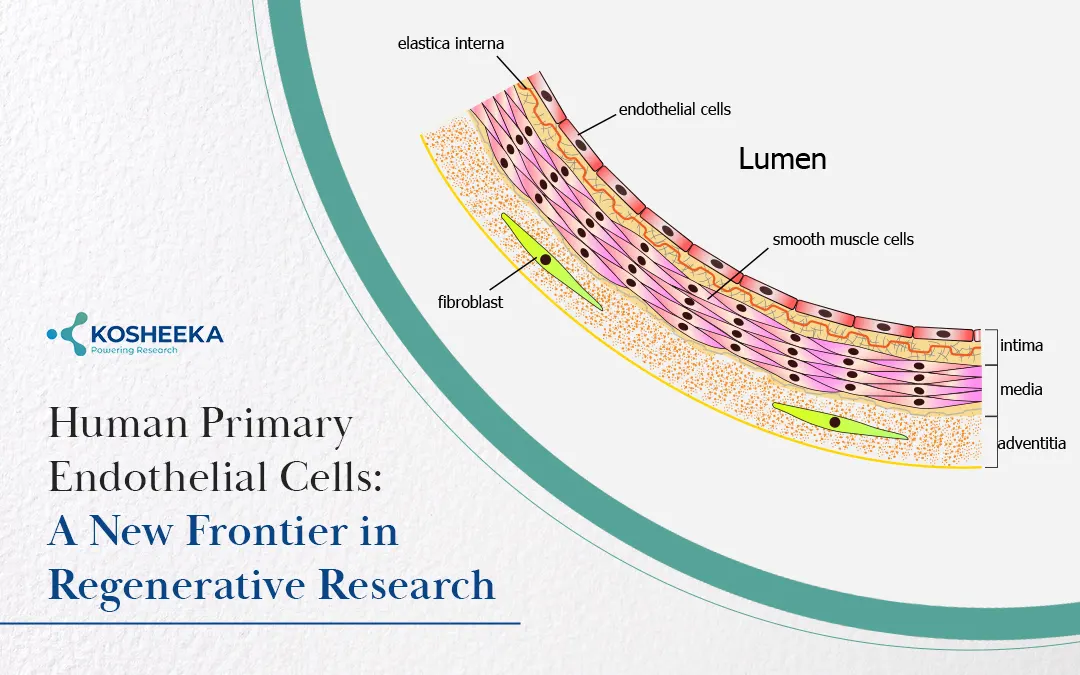
Human primary endothelial cells are isolated from various human cells or tissues. This includes the umbilical vein, pulmonary and coronary arteries, aorta, and dermal vascular tissues. Researchers use endothelial cells as research models for cancer therapy, angiogenesis, wound healing, burn, cell signalling, toxicology screening, high-throughput screening, tissue engineering and tissue regeneration. Infact, Human Primary Endothelial Cells incubated with fibroblast cells or mesenchymal stem cells (MSCs) establish a complex endothelial-smooth muscle cell culture. This is an artificial representation of the architecture of arterioles.
Understanding Human Primary Endothelial Cells
Origin of Cells
The cells originated from mesoderm during embryonic development, which aided in the formation of blood vessel linings. In adults, the cells are present in resident vascular cells and bone-marrow-derived progenitor cells. The most common source includes umbilical vein, microvasculatures, and arteries.
Key Difference Between Primary Endothelial Cells and Immortalized Cell Lines
Human Umbilical Vein Endothelial Cells (HUVECs) are primary cells that have been immortalized to overcome senescence, unlike other primary endothelial cells, which have a finite lifespan.
| Primary Endothelial Cells | Human Umbilical Vein Endothelial Cells (HUVECs) primary cells |
| Isolated from living tissue | Derived from primary cells, the cells have overcome senescence |
| Finite lifespan | Can be passaged indefinitely |
| Closely mimics the function of actual tissue, retains specific traits | Might loose specific functions due to genetic drift |
| Growth condition requires complex environment (specific growth factors and cytokines) | Relatively lesser complex medium, more consistent and abundant growth |
| High physiological relevance, limited availability and finite supply | Limited biological relevance, yet useful in setting up primary base for research |
Type of Endothelial Cells
There are two major subtypes of human endothelial cells. This includes:
Vascular Endothelial Cells (VECs)
- VECs covers inside of blood vessels (capillaries, veins, arteries)
- Protective barriers
- Regulates blood flow, facilitates the transfer of nutrients, gases, and waste products
- Involved in inflammation, immune responses, and clotting
Lymphatic Endothelial Cells (LECs)
- Involved in lymph (fluid rich in WBC) transportation
- Immune surveillance, maintain fluid balance, and adsorb dietary fats
- Forms the inner lining of lymphatic vessels
Endothelial Cell Function in Vascular Biology
The endothelial cells are actively responsible for controlling the degree of vascular constriction or relaxation. Endothelial cell functions include: 
- Angiogenesis: Plays a crucial role in the formation of new blood vessels. The cells release growth factors, including vascular endothelial growth factors (VEGF), fibroblast growth factors (FGFs), TGF-β, and PDGF, that help in forming new or new blood vessels.
- Vasculogenesis: Regulates vascular permeability, mediated by the presence of endothelial progenitor cells
- Stabilization: Endothelial cells interact with pericytes, helping in the stabilization of new vessels and homeostasis, facilitates cellular communication [1]
Molecular and Cellular Function of Endothelial Cells
Haemostasis
- Initiates haemostasis, constricts blood vessels
- Releases von Willebrand factor (vWF) and tissue factors, restricting blood flow at the injury site
- Promotes platelet adhesion and binding
Prevents Thrombosis
- Release factors like antiplatelet or anticoagulant
- Inhibits blood clot by the release of nitric oxide and prostacyclin
- Promotes blood fluidity
Facilitates leukocyte interaction
- Regulates the movement of leukocyte cells
- Involves immune responses and inflammation
- Involved in leukocyte capture, migration, and adhesion
- Regulates adhesion molecules like integrins and selectins
Regulation of Vascular Tone
- Maintains blood vessel diameters
- Control blood flow, maintain blood pressure
- Involved in vasoconstriction and vasodilation
Inflammation and Immune Regulation
- Endothelial cells in inflammation get activated
- Activates inflammatory markers (TNF-α, IL-1β)
- Contribution to chronic inflammatory diseases
Disorders of Endothelial Cells
The dysfunction of endothelial cells is associated with various adverse events. The dysfunction leads to a reduction in vasodilation, increased risk of thrombosis and inflammation. The disease involved includes:
- Atherosclerosis: Plaque formation at artery walls. Plaques are built up of fatty acids, cellular wastes, etc. Overtime, plaque formation results in thinning of the arteries, reduces blood flow and increases the risk of blood clots.
- Coronary Artery Disease (CAD): Characterized by the narrowing or blockage of coronary arteries. Restricted supply of blood and oxygen in the heart tissue
- Peripheral Vascular Disease (PVD): blood vessels in the limbs narrow. Symptoms appear like leg pain, also called rest pain.
- Stroke: Ischemic stroke due to the development of atherosclerosis
- Chronic Kidney Disease (CKD): Compromised ability of the kidney to filter waste materials. Leads to the buildup of toxins and waste products in the body
Human Umbilical Vein Endothelial Cells (HUVECs) Primary Cells
Human Umbilical Vein Endothelial Cells (HUVECs) Primary Cells, primarily isolated from umbilical cords, play a vital role in cardiovascular disease research. The cells gave the following features, making them ideal candidates for scientific research:
- Grown in Vascular Cell Basal Media (VCBM), supplemented with components of the endothelial cell growth kit
- Adherent cell type
- Enable researchers to conduct detailed studies on various cellular model systems, e.g., membrane structures, subcellular organelles, and cytoskeletal elements
- Secretory organelles present, like Weibel-Palade bodies (small storage granules)
- Helpful in reading various factors like exocytosis, complete or partial release of contents
- Overall, helpful in studying diverse research frameworks, enables developing valuable insights, and enriches knowledge in vascular biology [2]
What are the Research Applications?
In research, human primary endothelial cells have multifold functions. They are considered a vital disease model. This includes:
- Cardiovascular Disease Modeling: Cardiovascular or vascular research involving gene, cellular signalling, molecular mechanism and pathways involved in disease progression alteration
- Cancer Research: Cancer therapeutics, angiogenesis and metastasis, growth and progression of tumour
- Drug Screening: Toxicity testing, development of personalized medicines, nanoparticle research
- Regenerative Medicine and Tissue Engineering: Endothelial cell-based cellular regeneration for wound healing, developing engineered blood vessels, and regeneration of blood vasculature
- Development of Experimental Models: establishing in-vitro models, development of 2D vs 3D culture systems, co-culture models and establishing organ-on-chip platforms.
*NOTE: Researchers must use superior quality cells for obtaining optimal research. Kosheeka, Noida, India, is among the leading research laboratories that supply endothelial cells and other cell types for research purposes. The organisation aims to maintain infection free superior quality cells that can meet high research standards.
Limitations & Challenges in Endothelial Cell Research
In in-vitro research use of human primary endothelial cells poses specific challenges, including:
- Variability in the donor in each batch
- High heterogeneity, as the cells are specialized depending on organ type
- Phenotypic instability due to the rapid loss of in-vivo phenotype when converted to in-vitro culture. This includes loss of shear stress, challenge with maintenance of a specialized environment, and cells reaching senescence
- Functional complexity: In the niche environment, endothelial cells act as a collective swarm. This means cells communicate and respond together to environmental changes. However, in-vitro transformation, the collective behaviour is lost.
Conclusion & Future Directions
Human primary endothelial cells are valuable tools in conducting various research. The cells are crucial in conducting various cancer studies, wound healing, cardiovascular studies, and high-throughput research. In modern biomedical science, these cells serve as the primary medium that enables research. This enables advancement in endothelial cell engineering. The integration of these cells in stem cell and exosome-based research makes them the primary mode for clinical and translational research applications.
References
- Trimm E, Red-Horse K. Vascular endothelial cell development and diversity. Nature Reviews Cardiology. 2023 Mar;20(3):197-210.
- Duranova H, Kuzelova L, Borotova P, Simora V, Fialkova V. Human umbilical vein endothelial cells as a versatile cellular model system in diverse experimental paradigms: an ultrastructural perspective. Microscopy and Microanalysis. 2024 Jun;30(3):419-39.
FAQ’s
Q- What are Endothelial Cells?
Endothelial cells are highly metabolic cells that are responsible for forming a one-layer barrier between the vascular lumen layer and the vascular walls. These cells serve as the tunica intima and play a crucial role in maintaining vascular homeostasis.
Q- What are Human Primary Endothelial Cells?
Human primary endothelial cells are isolated from various human cell types, such as umbilical veins, capillaries, arteries, etc. These cells are essential disease models that help in cellular and molecular studies like cancer research, angiogenesis, wound healing, etc.
Q- What are HUVEC Cells?
HUVEC are endothelial cells that are isolated from human umbilical veins. These cells are important in-vitro models that are widely used for cardiovascular disease, cancer therapeutics, and regenerative medicines.