

The selection of the right animal is the first vital step in biomedical, pharmacological, and regenerative research. The research model selection influences the research outcome, including the effect of the potential drug candidate, its fate, toxicology, and the interpretation of preclinical findings. Sprague Dawley rats have become a preferred choice for researchers across several scientific fields. Their manageable size, adaptable nature, and well-documented physiological characteristics make them suitable for a variety of experimental studies.
The model has profound research applications, beginning with drug development and toxicity testing to metabolic disorders and neurological research. Researchers efficiently unveil biological responses under controlled laboratory conditions. The Sprague Dawley rat model also provides a useful platform for studying disease progression, assessing experimental interventions, and generating data to support further research. The current article focuses on unveiling the application of Sprague Dawley rats across chronic conditions, pharmacology, and regenerative research. Understanding these applications helps researchers identify the suitable model based on their experimental objectives and develop adequate preclinical research data.
Understanding the Sprague Dawley Rat Model: Key Characteristics
Sprague-Dawley rats, or SD rat models, are outbred albino rat models. These are heterogeneous models with genetic variability. The key characteristics of the SD rat include:
Origin and General Characteristics
- Bred by Robert W. Dawley in 1925 by crossing an albino Wistar female and a hybrid hooded male
- Possesses genetic variability and mirrors the broader population
- Availability of breeding history, research documentation, and well-characterized
Physical, Behavioral & Physiological Features
- Have white coats, pink eyes, long tails, and large body size
- Docile, easy to handle, and readily adapt to laboratory housing conditions
- Well-documented information, including metabolic, cardiovascular, reproductive, and toxicology research
Why SD rat model is suitable for Experimental Studies
- SD rat model is widely used in preclinical drug development and safety evaluation
- Investigation of multiple disease conditions and underlying biological mechanisms
- Enables understanding biological variability that is suitable for the research objectives
- Establishes research protocols and development of comparative data
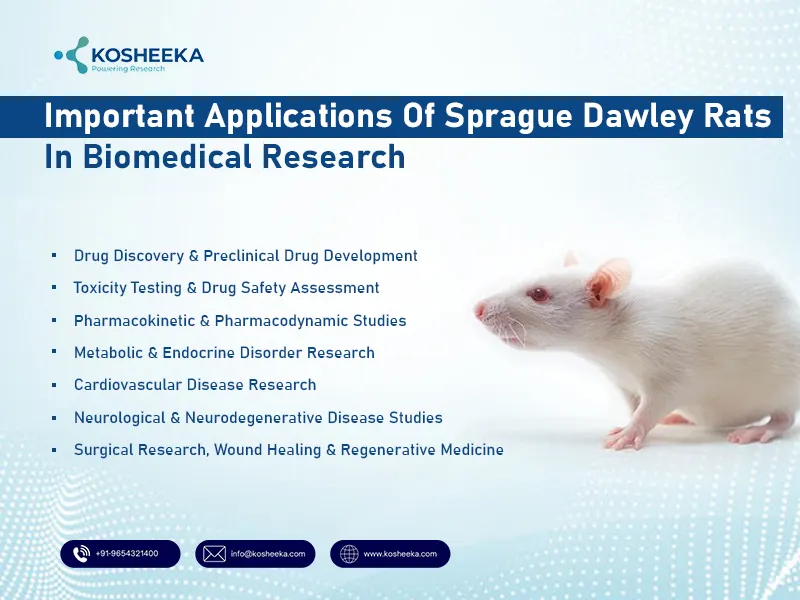
Important Applications of Sprague Dawley Rats in Biomedical Research
Sprague Dawley rat model key applications include:
Drug Discovery and Preclinical Drug Development
- Evaluation of ADME (Absorption, Distribution, Metabolism, & Elimination) of potential drug-like candidates
- Determination of potential toxicology studies and safety profiling
- Development of specialized models (for example: for diabetes streptozotoch-induced/ high fat diet model) is developed
Toxicity Testing and Drug Safety Assessment
- Determination of acute toxicity and LD₅₀ by introduction of the short-term lethal dosage. Researchers explore the effect of a single dose via oral, intravenous, or percutaneous route introduction
- Subacute or subchronic dosage effect of the drug introduction (28- 90 days or 180 days for chronic condition)
- Carcinogenicity and safety profiling to determine long-term safety, systemic tolerance tracking, or effect on tumorigenicity
Pharmacokinetic and Pharmacodynamic Studies
- Drug candidate screening for a large number of potential drug candidates
- Determining ADME and toxicology profiling
- Metabolic profiling of the drug candidate, its undertaken metabolic pathway, shelf life
- Determination of the drug clearance pathway
Metabolic and Endocrine Disorder Research
- Investigation of Type 2 diabetes by introducing a high-fat/high-sucrose (HFHS) diet and a low-to-moderate dose of streptozotocin
- Track hyperglycemia, systemic metabolic profiling, or hypertriglyceridemia
- Determination of the metabolic syndrome (high blood pressure, dyslipidemia, central adiposity, alteration of adiponectin level)
Cardiovascular Disease Research
- Explore various cardiovascular research, including hypertension modeling, myocardial infarction, diabetic cardiomyopathy, diet-induced obesity, etc.
- Determination of drug dosing, targeted approach, cardiac aging, mitochondrial dynamics, etc.
Neurological and Neurodegenerative Disease Studies
- Determination of the amyloid precursor protein (APP) or presenilin mutation by replicating extracellular β-amyloid pathology
- Development of an induced model with help of aluminum chloride for understanding hippocampal synaptic plasticity, BDNF/AKT signaling, or neuroinflammation
- Evaluation of traumatic brain injury, spinal cord injury and Huntington disease
- Development of regenerative medicine for neurodegeneration and neuroprotection [1]
Surgical Research, Wound Healing and Regenerative Medicine
- Exploration of the tissue repair potential, wound healing ability, and post-surgical recovery
- Development of biomaterials, bioscaffolds, tissue engineering, and potential regenerative approaches [1]
Why SD Rats Are Preferred for Biomedical/ Pharmacological Research?
The key advantages of using SD rats for research include:
- Well-characterized physiological conditions and biological features of the rat
- Adaptable to various experimental conditions and research environments
- Body size is manageable, suitable for experimental procedures, and easy to handle for various procedures like surgical procedures
- Large-scale data availability to support experimental planning and result interpretation
- Suitable for longitudinal studies and possibility of repeated sample collection
What are the important considerations for selecting SD Rats for Research?
It is crucial to consider key factors while selecting a research model. This includes:
- Age, gender, body weight, and SD rat strain characteristics
- Consider animal health, survival conditions, source, and genetic background
- Details of housing, dietary habits, adequate handling, and environmental conditions
- Ensure availability of the ethical clearance, and consider experimental reproducibility
- Superior quality primary cell isolates from SD rat for experimental purposes
*NOTE: Isolation of tissue-specific primary cells from the specific animal model can be hectic. Kosheeka, India, is a leading manufacturer and supplier of superior quality animal cell culture products, including SD rat primary cells for research purposes. The products come with a Certificate of Authentication (CoA). The products can be customized based on specific experimental demands and needs.
What are the key limitations of using the SD rat research model?
- Existence of a human translational gap; for instance, rodents have specific metabolic and lipoprotein processing pathways, and they are a poor predictive model for atherosclerosis or other hyperlipidemia-associated problems
- Female SD rat model has frequent episodes of endocrine aging shifts; they show prolonged estrous cycles between 9-12 years
- Higher experimental variance (behavioral and physiological) condition
Conclusion
Sprague-Dawley rat models are well-characterized experimental models used for various biomedical and pharmacological research. The key applications involve drug candidate screening, toxicology profiling, metabolism studies, determination of the experimental route, disease condition, and behavioral assay. Researchers must make careful choices of the appropriate research model based on their specific research questions and objectives.
References
- Wang BB, Chao GU, Sun SQ, Zhang XN, Zhen LI, Li WJ, de Li Z, Schumacher M, Song LI. Comparison of the nerve regeneration capacity and characteristics between sciatic nerve crush and transection injury models in rats. Biomedical and Environmental Sciences. 2023 Feb 1;36(2):160-73.
FAQs
Q- Why are Sprague Dawley rats commonly used in biomedical research?
Sprague-Dawley rats are an efficient outbred albino model that possess well-documented biological characteristics, manageable size, and adaptability to different experimental settings. They are well established and characterized and are suitable for laboratory studies. Researchers investigate diseases, drug responses, and conduct preclinical safety assessments.
Q- What makes the SD rat model suitable for preclinical studies?
SD rat model is an efficient laboratory model that enables researchers to use a well-characterized system for studying physiological changes, disease progression, and responses to experimental treatments. Its extensive use in previous research also provides valuable reference data for designing and interpreting new studies.
Q- Which diseases are studied using SD rats?
SD rats have a wide range of applications in biomedical, pharmacological, and regenerative research. Researchers investigate several chronic diseases, including diabetes, obesity, hypertension, CAD, neurological disease, and kidney or liver disorders. SD rat models enable understanding of disease mechanisms, potential interventions, targeted therapeutics, and evaluation of treatment responses.
Q- How do researchers select the right Sprague Dawley rats for research?
The selection of adequate Sprague Dawley rats depends on various factors. Researchers closely consider research objectives, experimental design, and specific research requirements. Factors including age, sex, body weight, health status, and genetic background are important considerations. Other factors like the animal’s source, quality documentation, and suitability for the intended experimental procedures are considered.

Author: Dr. Siuli Shaw
PhD in Biotechnology | Scientific Writer | Advancells Group
Translating cutting-edge science into impactful scientific communication.
Research Interests: Cancer Therapeutics | Nanotechnology | Stem Cell Research | Regenerative Medicine